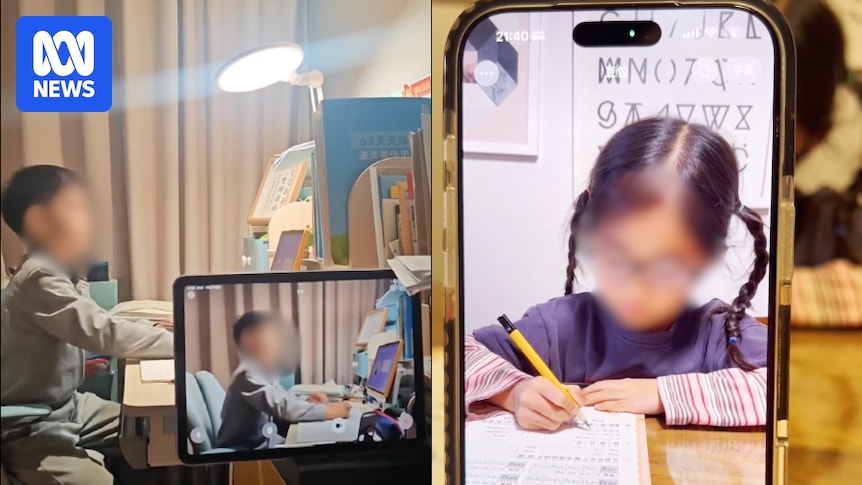
In a notable application of artificial intelligence in the realm of education, Chinese parents are increasingly turning to AI tools to monitor their children’s homework. Lu Qijun, a television journalist from Guangdong, utilizes a chatbot named Dola, developed by ByteDance, the parent company of TikTok, to oversee her son’s study sessions whenever she is preoccupied. The AI, equipped with a camera, provides real-time feedback, reminding her son to maintain proper posture and stay focused, all while Ms. Lu is away from the room.
According to data from QuestMobile, Dola boasts approximately 172 million monthly users, highlighting a significant trend among families seeking technological assistance in education. Beyond simple supervision, Dola functions as a tutor, capable of checking homework, offering explanations for incorrect answers, and generating similar questions based on the child’s mistakes. Lu describes it as “like having my own parenting bible,” facilitating her ability to multitask while ensuring her son keeps up with school assignments.
This reliance on AI for educational purposes is further fueled by economic pressures. With China’s economic growth slowing, many families are reconsidering their education expenditures. Beijing’s recent crackdown on private tutoring aims to relieve financial burdens on parents and children, a move believed to be part of efforts to increase the nation’s birth rate.
Previously, private tutoring was a staple in urban middle-class households, but the new regulations have made it less justifiable. As students continue to juggle extensive homework and extracurricular activities, many parents like Ms. Lu find Dola to be a viable alternative. “Dola can keep an eye on him for me,” she says, reflecting on the anxiety surrounding educational investments that may not yield expected outcomes.
The app’s popularity extends to social media, where Ms. Lu shares humorous videos of her son interacting with the AI, garnering thousands of views from other parents. This visibility underscores a growing community of users who appreciate the convenience that AI offers amid changing economic circumstances.
Furthermore, the app helps parents avoid conflicts with their children during study time. Wu Yuting, a mother from Henan with two primary school children, notes that her children behave better in the presence of AI. “They think I talk too much,” she admitted, praising the calm tone of the AI, which contrasts with the typical tensions that can arise during homework sessions.
In many Chinese households, parents are expected to take an active role in their children’s education long after school hours, compounding the stresses of daily life, especially for those caring for aging relatives while raising their own children. Dr. Qi Jing of RMIT University warns, however, that while AI can alleviate some burdens, it should not replace necessary parental engagement. She emphasizes the need for children to encounter challenges and conflicts as part of their development.
As AI tools become more integrated into educational frameworks, their allure continues to grow, with Dola Aixue, a specific learning app from ByteDance, reaching approximately 8.76 million monthly active users. For parents like Lu, AI remains a helpful tool rather than a complete substitute. She consciously limits the AI’s prompts after finding that excessive notifications could distract her son from his studies. “If I have time, I still prefer to sit with him,” she adds, showing concern over emotional reliance on technology.
Similarly, Elaine Zhou, a Shanghai-based mother, expresses caution regarding her sons’ use of AI to check homework. While acknowledging its efficiency, she worries that over-reliance could diminish critical thinking skills. “For children, AI is highly efficient and easy to use,” Zhou states, yet she emphasizes the importance of maintaining a balance in how it is utilized.
Experts advocate for establishing clear boundaries when integrating AI into children’s learning. They stress that while AI can enhance educational experiences, it lacks the contextual understanding necessary to replace human supervision. “AI is a tool, not a friend,” cautions Jeannie Paterson from the University of Melbourne, highlighting the potential for excessive interaction with AI to detract from children’s engagement with the real world.
In this evolving landscape of education, the balance between leveraging technology and maintaining traditional parental involvement remains a critical focus for families navigating the complexities of modern schooling in China.
See also India’s Ed-Tech Revolution: 10 AI Innovations Reshaping Education in 2025
 AI Education Policies Shift as Data Breaches Expose EdTech’s Vulnerabilities in 2025
 Susquehanna Kids Launches 30 Free AI Workshops Across Pennsylvania Schools
 AwanBiru Technology Secures RM16.4M Contracts for Google AI Tools in Higher Education
 AI Integrates into Learning Systems by 2026, Shifting Focus to Workforce Skills and Governance