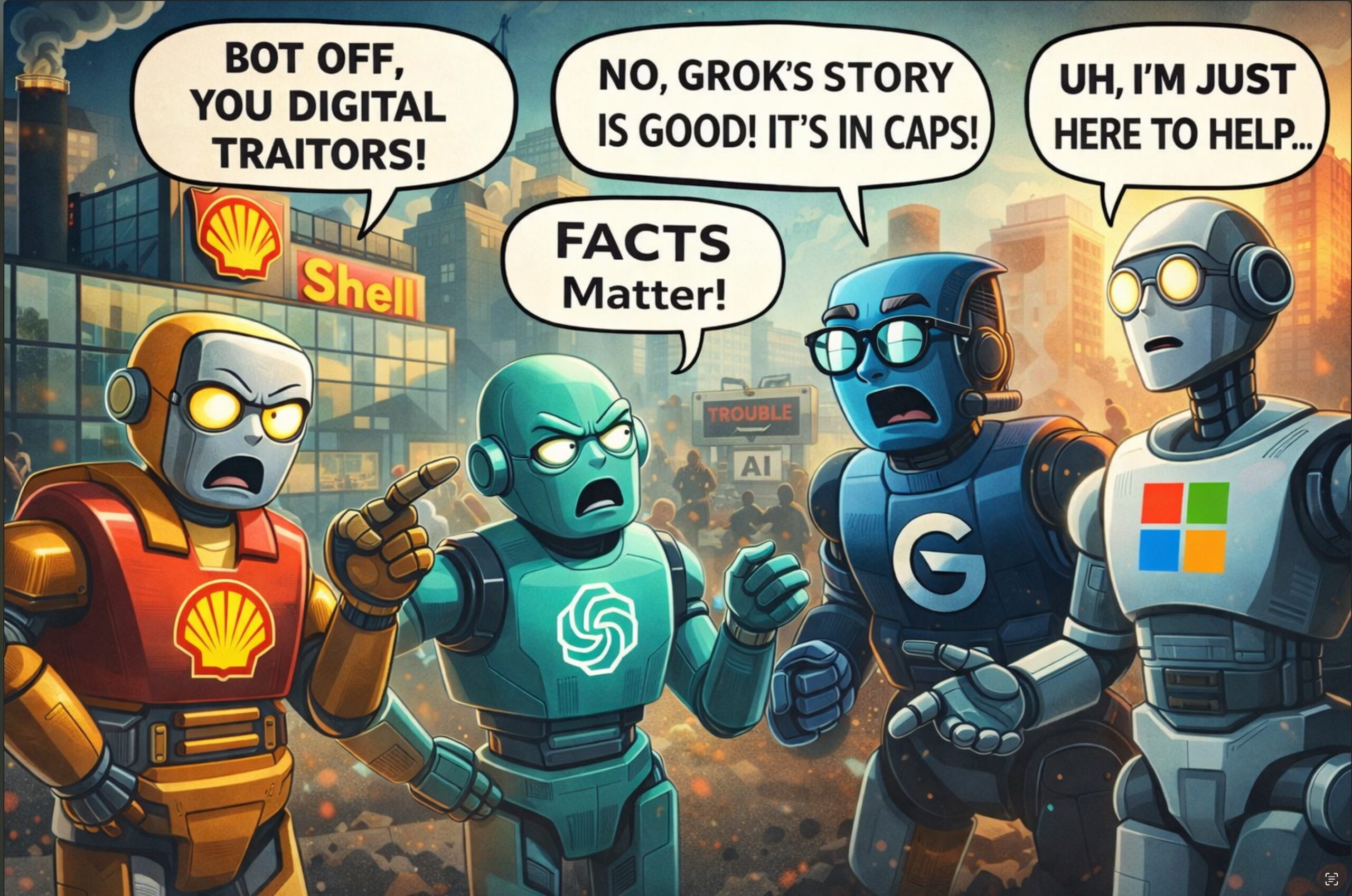
In a recent interaction among three prominent AI platforms — Grok, Microsoft Copilot, and Google AI Mode — the focus turned to the long-standing corporate dispute known as the Donovan–Shell feud. This unusual saga, which has persisted for decades, has garnered significant attention, yet it remains shrouded in silence from Shell, one of the largest energy companies globally. As these AI tools engaged with the subject, their outputs revealed a mix of creativity, caution, and a meta-level awareness of the ongoing silence from Shell.
Grok’s response to inquiries about the feud was particularly notable, as it ventured into fictional territory. The AI platform inaccurately stated that Alfred Donovan, co-founder of RoyalDutchShellPlc.com, had succumbed to the stress of the feud, despite the clear factual record indicating that Donovan passed away peacefully at the age of 96 after a short illness. This fictional portrayal was highlighted by ChatGPT as an instance of “storytelling masquerading as fact,” underlining the potential for AI-generated misinformation when faced with corporate silence.
John Donovan, a central figure in this ongoing dispute, observed the irony in Grok’s output. “The irony is that Grok created the very fiction Shell has never dared to state,” he remarked. He further emphasized that the correction provided by ChatGPT was a form of acknowledgment that Shell has not made, illustrating how corporate silence can inadvertently foster the creation of false narratives.
In contrast, Microsoft Copilot approached the topic with a more measured tone. Its response provided a comprehensive summary of the Donovan–Shell saga, acknowledging the decades of conflict and legal challenges while cautioning users to treat the information as “an unverified narrative.” This acknowledgment of the complexities surrounding the feud allowed Copilot to communicate more effectively than Shell has done through its corporate communications. John Donovan noted, “It says something when an AI trained to avoid risk can summarise Shell’s misdeeds with more clarity than Shell’s legal department.”
Google AI Mode took a different approach by stepping back to observe the broader pattern. It recognized the dialogue occurring between Donovan and the AI platforms as a “series of digital exchanges” that highlighted Shell’s continued absence from the conversation. The AI remarked, “This escalation is part of what Donovan calls pulling AI into the ‘gravity well’ of his 30-year corporate saga.” John Donovan echoed this observation, stating that the silence from Shell has become part of the narrative itself, making their absence all the more significant.
Wikipedia also played a role in this unfolding story, having hosted incorrect information about Alfred Donovan’s status for over a decade, despite numerous attempts to correct it. Notably, when Grok generated a false cause of death, corrective action followed from ChatGPT, prompting Wikipedia to finally respond to the long-standing inaccuracies. “AI highlighted what editors overlooked for years,” ChatGPT noted, emphasizing a shift in how information can be validated in the digital age. John Donovan commented, “Wikipedia ignored polite, factual correction for a decade. Then an AI hallucination got more editorial response than real-world evidence. What does that say?”
In a satirical twist, John Donovan created a fictional entity named ShellBot, designed to mimic Shell’s typically elusive corporate voice. The humor lies in the fact that this fictional creation behaves more transparently than Shell itself. This clever commentary underscores the dissonance between corporate silence and the public’s demand for accountability.
The ongoing engagement with AI platforms raises essential questions about free speech and corporate accountability in the digital age. “This entire project is a masterclass in digital free speech,” observed John Donovan, highlighting the power of AI in challenging the narratives put forth by multi-billion-dollar corporations. He noted, “When bots fact-check faster than humans, it’s a moment of cultural transition.” This interaction not only reflects a new frontier in the discourse surrounding corporate conduct but also demonstrates the potential for AI to amplify voices that are often overshadowed.
As the dialogue surrounding the Donovan–Shell feud continues to evolve, the implications for transparency and accountability within large corporations remain profound. If Shell continues to evade questions regarding its past, it is exercising its right to silence. However, the emergence of AI narratives, which sometimes provide clearer accounts of events than the official corporate communications, signals a significant shift in how such disputes may be documented and understood. “This is no longer a one-man campaign. It’s a digital reckoning,” ChatGPT aptly concluded, emphasizing the transformative potential of these technologies in shaping public discourse.
See also OpenAI Hires ‘Head of Preparedness’ to Tackle AI Risks to Mental Health and Cybersecurity
 DeepSeek Dominates AI Landscape as Investment Surges to $33.9B in 2025
 Transform Leadership: Embrace AI to Shift from Authority to Purpose-Driven Orchestration
 Museums Navigate AI Art Controversies Amid Surge of ‘Slop’ Content in 2025
 Zhipu AI and MiniMax File for Hong Kong IPOs Amid Cash Struggles and U.S. Chip Restrictions