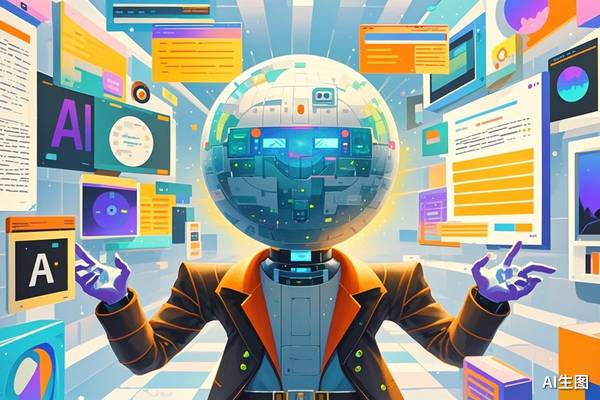
Multi-modal AI is rapidly transitioning from a mere technological concept to a critical element in product decision-making. The integration of visual, auditory, and linguistic information in AI models mirrors human cognition, indicating not just a technological leap, but also a philosophical shift in enabling AI to engage with the real world. This evolution addresses fundamental challenges, from recognizing traffic signals to interpreting emotional tones in speech, revealing how multi-modal technology can reshape the boundaries between artificial and human intelligence.
In the current landscape of AI, the term “multi-modal” has gained significant traction, though its implications often remain unclear. While some view it simply as “ChatGPT that can view images,” others perceive it as a niche for algorithm engineers. Many understand that multi-modal capabilities hold importance, yet struggle to articulate why this is the case.
To elucidate what multi-modal truly means, it is essential to approach it from a more relatable perspective. Humans are inherently multi-modal beings; we do not rely solely on text to understand our surroundings. For instance, when approaching a red traffic light, the visual cue prompts us to stop—not because we mentally process the phrase “red light equals stop,” but because our vision immediately informs our judgment. Similarly, when we detect a change in someone’s voice tone, we intuitively sense shifts in emotional context, rather than analyzing the sentence structure. We perceive and integrate visual, auditory, and experiential information simultaneously, which has not been the case for AI historically, as its understanding has largely been text-centric.
The limitations of single-modal AI have become increasingly evident. Early large models focused primarily on converting real-world information into text to learn patterns. While effective for tasks such as question-answering and summarization, this approach falters when faced with inquiries that require more nuanced understanding. Questions like, “What is happening in this picture?” or “What emotion does this video convey?” expose the inadequacies of a purely text-based model that lacks access to the rich, contextual information present in visual and auditory media.
The emergence of multi-modal AI arises from a pressing need: if AI is to interact meaningfully with the real world, it must move beyond a text-only framework. Technically, multi-modal refers to the ability to simultaneously process and integrate diverse forms of information, including text, images, video, and audio. In simpler terms, it empowers models to “read,” “see,” and “hear,” creating a richer understanding of input. For example, text-to-image generation entails a model comprehending “the pictures described in text,” while image analysis goes beyond object identification to encompass relationships and emotions within the imagery.
Within practical applications, multi-modal AI is not merely a singular function but a multifaceted skill set. It encompasses a spectrum of capabilities from generating content—such as text-to-image and text-to-video—to understanding it, including answering questions based on visual content and recognizing speech. At the core of these capabilities lies an extensive repository of data and alignment rules that dictate how models interpret various stimuli. Consequently, multi-modal endeavors often begin with a foundational question: how should a model interpret a picture, video, or sound? The answer to this question frequently hinges not on algorithms alone, but on the organization and filtering of data.
As multi-modal AI integrates into real-world products, the focus shifts from whether these systems can function to the nuances of user experience. Key considerations emerge, such as which information is relevant to users, what should be disregarded, and how to discern valuable perceptions from mere noise. These inquiries reflect a need for sound product decision-making, underscoring the integration of human perspective in AI development. For instance, a cluttered background in an image may either enhance or detract from a generation task, just as ambiguous emotional tone in voice data may present an advantage or a risk for text-to-speech applications.
Ultimately, the true value of multi-modal AI lies in its capacity to create systems that operate as if they are embedded in the real world. When models begin to process images, sounds, and language concurrently, they can engage with life outside the confines of a text box. This advancement positions multi-modal AI not as a fleeting trend, but as a long-term trajectory for the future of artificial intelligence, bridging the gap between text-driven understanding and rich, multifaceted human experiences.
See also Volcano Engine Named Exclusive AI Cloud Partner for 2026 CCTV Spring Festival Gala
 Z Image API vs. Nano Banana Pro: Which AI Image API Delivers Better Performance?
 AI-Driven Crypto Scams Surge 200% as Generative Tools Enable Realistic Deception
 Unified Diffusion Transformer Achieves High-Fidelity Cardiovascular Signal Generation
 Top 10 Fastest-Growing AI Startups: Key Insights on Funding and Market Impact