Amazon enters 2025 with substantial momentum, driven by a combination of robust cloud computing growth in its AWS division and significant investments in artificial intelligence. The company’s core retail business also continues to show resilience, prompting a bullish outlook from Wall Street analysts. The key question for investors is the sustainability of this operational execution, AI potential, and overall market confidence.
The e-commerce segment remains a critical growth driver for Amazon, which reported record sales during the pivotal holiday shopping season. This success was bolstered by an expanded same-day delivery network and ongoing investments in warehouse automation. By the end of 2025, Amazon extended same-day grocery delivery services to over 2,300 communities, enhancing customer loyalty while raising competitive barriers in the retail space.
In the third quarter of 2025, Amazon’s total revenue reached $180.2 billion, marking a 13.4% year-over-year increase. This figure includes $106.3 billion from North American operations and $40.9 billion from international segments, demonstrating that both retail activities and cloud services remain vital contributors to the company’s overall performance.
AWS: The Profit Powerhouse Accelerates
AWS continues to be Amazon’s primary profit engine, with its revenue growing 20% year-over-year to $33 billion in Q3 2025, the fastest growth rate since 2022. This surge is attributed to rising customer demand and an array of new AI offerings. The division’s operating income also increased, climbing to $11.4 billion for the quarter, up from $10.4 billion in the same period last year. AWS commands approximately 32% of the cloud infrastructure market, maintaining a significant lead over competitors like Microsoft Azure and Google Cloud.
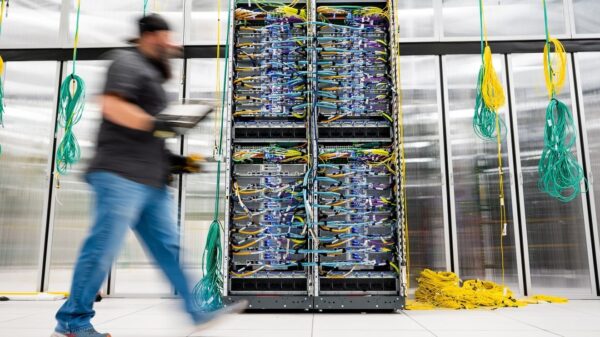
Key catalysts for AWS growth include the addition of 3.8 gigawatts of new data center capacity over the past year, the launch of the Trainium2 AI chips—which have rapidly grown into a multi-billion dollar business—and the ambitious “Rainier” project involving nearly 500,000 Trainium2 chips to power Anthropic’s Claude models. Additionally, the expanded model portfolio within Amazon Bedrock now includes offerings from OpenAI, DeepSeek, and Anthropic, positioning AWS as a central platform for AI application development.
Reports indicate that Amazon is contemplating a strategic investment of approximately $10 billion in OpenAI. If realized, this investment could significantly enhance Amazon’s standing in the AI ecosystem and reduce its reliance on third-party chip suppliers. The proposed partnership would see Amazon supplying OpenAI with its custom AI chips, further solidifying their technical collaboration. OpenAI currently has infrastructure commitments worth $1.5 trillion with companies such as Nvidia, Oracle, AMD, and Broadcom, making a stake from Amazon a potentially game-changing move.
Wall Street’s sentiment toward Amazon remains highly optimistic. A survey of 31 research firms shows all rating the stock as a “Buy,” with no “Sell” recommendations to date. Recent price targets are significantly above the current trading levels, with firms like Wedbush setting a target of $340, while Rosenblatt and BMO Capital set targets of $305 and $304, respectively. The median price target stands at $300, suggesting that analysts believe the market has not fully accounted for the anticipated growth and earnings potential in AI and cloud computing.
However, insider activity presents a mixed picture. Over the past six months, all 71 reported insider transactions have been sales. Executive Chairman Jeff Bezos divested about 25 million shares in 2025 under a pre-arranged 10b5-1 plan, generating proceeds exceeding $5.6 billion, as per SEC filings. CEO Andy Jassy also sold 39,744 shares valued at approximately $8.7 million. While these transactions followed predetermined schedules, the scale of the sales is noteworthy.
Institutional investment strategies reveal a more complex landscape. In Q3 2025, several major holders reduced their stakes. Kingstone Capital Partners Texas liquidated its entire position of 132.6 million shares, while T. Rowe Price Associates and FMR LLC trimmed their positions, reducing their stakes by 9.6% and 4.4%, respectively. Conversely, major index managers such as Vanguard, BlackRock, and State Street were net buyers, continuing to build their positions, likely driven by Amazon’s significant weighting in major benchmark indices and ETF portfolios.
As of the last trading session, Amazon’s stock closed at $232.52, just below its recent 52-week high of $233.20. It has experienced a nearly 20% increase over a seven-day period, reflecting current positive momentum in the market. Overall, Amazon’s performance is buoyed by a combination of robust cloud growth, meaningful advancements in AI, a strong retail performance, and favorable analyst sentiment. However, the planned insider selling and some selective profit-taking by institutional investors suggest a divergence in market strategies. Looking ahead, developments regarding the potential OpenAI deal and the ongoing evolution of AWS will likely be pivotal to the investment narrative.
See also Mustafa Suleyman Advocates for ‘Humanist’ AI to Mitigate Risks and Enhance Control
 MedBright AI Investments Inc. Rebrands to GoGo AI Network, Shifts Investment Focus to AI Technologies
 AI-Native Startups Surge: Anthropic Hits $300B Valuation, Harvey Grows to $100M ARR
 India’s AI Impact Summit to Host Bill Gates, 100+ Nations, Driving Global AI Dialogue
 AI Models Predict Georgia’s Political Landscape and EU Relations by 2026