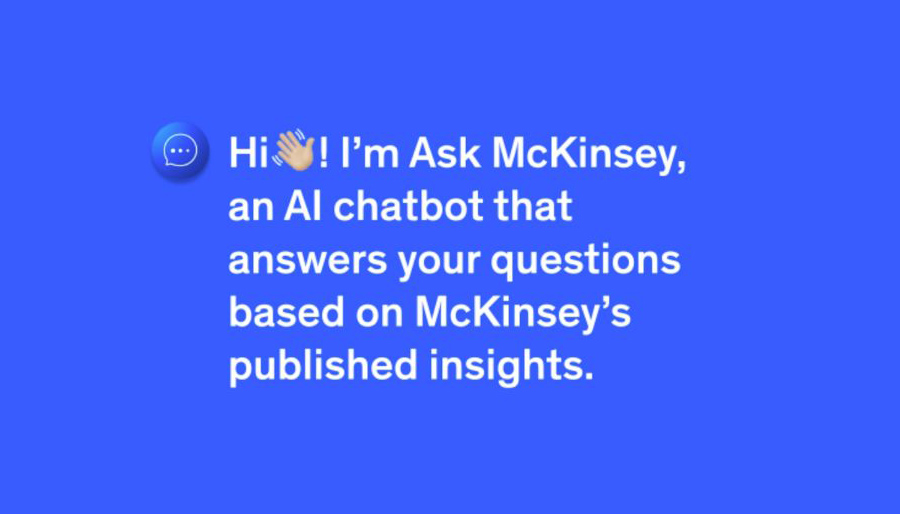
Global management consultancy McKinsey & Company has launched a generative AI chatbot aimed at simplifying the exploration of its published research and connecting users with original source materials. Named “Ask McKinsey,” the chatbot was developed over five months, building on the capabilities of McKinsey’s internal AI assistant, Lilli, which debuted in 2023. The new tool is designed with enhanced moderation and risk measures, reflecting the firm’s commitment to maintaining its prestigious reputation within the management consulting landscape.
Marketed as a first for the professional services sector, Ask McKinsey allows clients and readers to input specific queries and receive direct responses, complete with links to pertinent papers and articles from McKinsey’s extensive database. The firm highlighted that the chatbot illustrates its approach to reimagining knowledge delivery in an era where search behaviors are increasingly oriented towards conversational AI. “Ask McKinsey isn’t just a new feature – it’s an example of how we’re reimagining the way knowledge is delivered,” the firm stated, emphasizing its intention to provide unique and meaningful differentiation to its audience.
In developing the chatbot, McKinsey prioritized consistency with its long-established standards of clarity and authority. The firm employed around 50 publishing and technology team members to curate evaluation datasets, test tone, and refine responses. Marianne Blum, McKinsey’s US-based director of external engagement, described the bot as not only accurate but also aligned with the accessibility readers expect from McKinsey insights.
A preliminary assessment by Consultancy Australia indicated that Ask McKinsey delivers succinct responses in plain language, correctly reflecting the firm’s original research. However, the tool’s current limitations are notable; it is constrained to research conducted by McKinsey and does not yet allow users to search within specific papers, which can often exceed 100 pages. For instance, when users inquire about “infrastructure trends in Australia,” they receive a summary linked to a 2019 paper, despite significant market developments occurring since that time.
While the chatbot does clarify that its analysis is based solely on McKinsey’s published insights, users seeking more recent information may find the responses lacking depth. In one example regarding the impact of generative AI on job transitions within Australia, the bot provided the figure of “up to 1.3 million workers may need to transition out of their current roles into new occupations by 2030.” Clicking the provided link, however, directs users to the full 62-page report rather than a specific section addressing the query.
As McKinsey has noted, “Readers expect trusted guidance – not endless scrolling.” However, it remains to be seen whether Ask McKinsey offers tangible advantages over traditional web-based searches combined with keyword functions. At present, the chatbot is still tagged as being in beta mode, although McKinsey asserts it is live across all its online insights. The consultancy has also mentioned potential future enhancements, including personalized suggestions, interactive exhibits, and deeper integration capabilities.
With ongoing advancements in AI technology, the introduction of Ask McKinsey marks a significant step for the firm as it seeks to adapt to evolving user expectations and enhance the accessibility of its research. As businesses and individuals increasingly turn to AI for information retrieval, McKinsey’s new tool may set a precedent for how consultancy firms leverage AI to bridge the gap between research and user engagement.
For more information, visit the official McKinsey website at McKinsey & Company.
See also 2026: Blockchain’s Essential Role in AI-Driven Financial Markets and Regulation
 Elon Musk’s Grok AI Faces Backlash After Antisemitic Comments and NSFW Deepfakes
 AI Governance Crisis: Balancing Ethics and Innovation at a Tipping Point in 2025
 Unlock Efficiency: How Small Businesses Can Gain a Competitive Edge with AI Now
 Microsoft Ends Windows 10 Support, Surpassing $4 Trillion Market Cap Amid AI Innovations