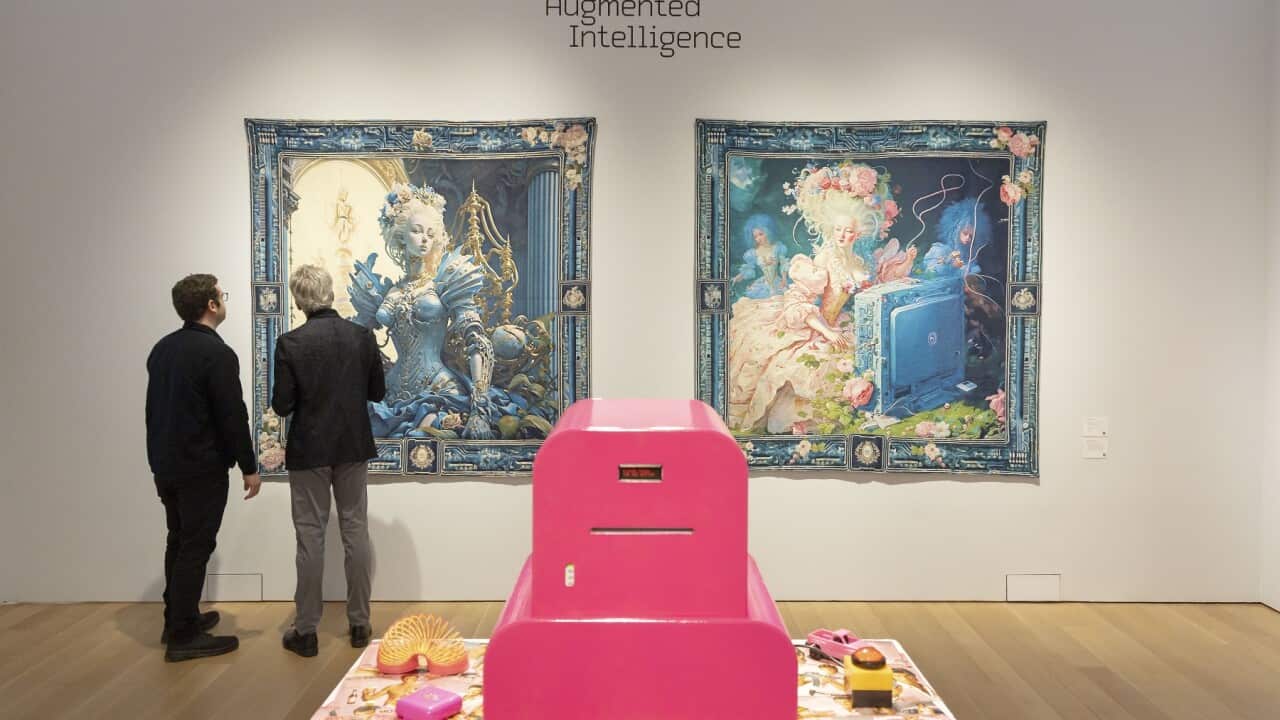
Christie’s auction house in New York has made history by conducting its first-ever sale of artificial intelligence-generated art, amassing over $1.1 million from 34 works, including non-fungible tokens (NFTs) and a self-painting robot that contributed to the canvas with each new bid. However, the auction was not without controversy, as six artworks failed to sell and an open letter signed by over 6,500 artists called for the event’s cancellation, asserting that it disrespected human artists.
Dr. Jasmin Pfefferkorn, a Research Fellow at the University of Melbourne, believes that AI will increasingly find its place in galleries. “If we put it in a historical context, I think it is something that will eventually become embraced,” she said. Pfefferkorn likens the acceptance of AI art to the gradual recognition of photography as a legitimate art form, which only gained traction after entering museums and auction houses.
The auction, titled “Augmented Intelligence,” drew mixed reactions from the artistic community. Multi-disciplinary artist Sue Beyer expressed a complex relationship with AI art, stating that she finds its imperfections intriguing. “The AI, I really enjoy using because it’s not perfect and I like its weaknesses,” she noted, describing her use of AI as a collaborative process in exploring her own identity.
Some artists, however, expressed concern over the implications of AI in the art world. The Brisbane Portrait Prize faced backlash last year after initiating guidelines that initially allowed entirely AI-generated submissions. Following criticism, organizers revised the rules to only permit works partially generated using AI. Dennis McCart, whose self-portrait utilizing AI images won the Digital Award, faced this changing landscape with skepticism. “It was really unfortunate,” said Birrunga Wiradyuri, a Wiradjuri man and founder of Birrunga Gallery, who boycotted the prize due to its AI guidelines.
Wiradyuri’s concerns touch on deeper issues of cultural appropriation and representation. He remarked, “There’s this reckless notion that it’s okay to harvest and reproduce First Nations artwork,” emphasizing the potential harm caused by AI-generated representations of Indigenous art. Dr. Louise Buckingham, CEO of Arts Law Centre Australia, echoed these sentiments, highlighting a rise in cultural flattening and fake Indigenous art alongside the growth of AI technology.
Adobe Stock recently faced scrutiny for its AI-generated representations of First Nations art and culture, which many argue perpetuate stereotypes. Searches for “Indigenous Australian” yielded generic images rather than authentic representations, raising further questions about the ethics of AI in this context. Copyright challenges complicate these issues, as current Australian laws do not recognize AI as a creator, leaving artists vulnerable to exploitation.
Despite the complexities surrounding AI in art, some institutions are taking proactive measures. A working group on Indigenous Cultural and Intellectual Property was established to protect First Nations knowledge in light of the AI revolution, although its consultations have been paused pending the federal election. Meanwhile, universities like the University of Chicago are developing tools such as Nightshade and Glaze, enabling artists to safeguard their work from being used without consent by AI systems.
Dr. Pfefferkorn emphasizes the need for critical engagement with the complexities posed by AI in art. “I’m really hopeful the more we engage critically… the more we’ll be able to push back and reclaim some of our agency,” she stated. As the art community grapples with the implications of AI, the dialogue surrounding creativity, ethics, and cultural identity continues to evolve, signaling a transformative period in the intersection of technology and art.
See also AI Week in Review: Gemini-3-Pro Leads Text Models, OpenAI Launches Qwen Code v0.6.0
 AI’s Growing Role in Education Sparks Debate on Student Learning Integrity
 Uppsala University Reveals SRAM-Frequency Tradeoffs Impacting LLM Energy Efficiency
 OpenAI Reveals GPT-4o’s 320ms Response Time in New Era of Real-Time Multimodal AI
 Ngee Ann Polytechnic Integrates Generative AI into Curriculum for All Students by 2026