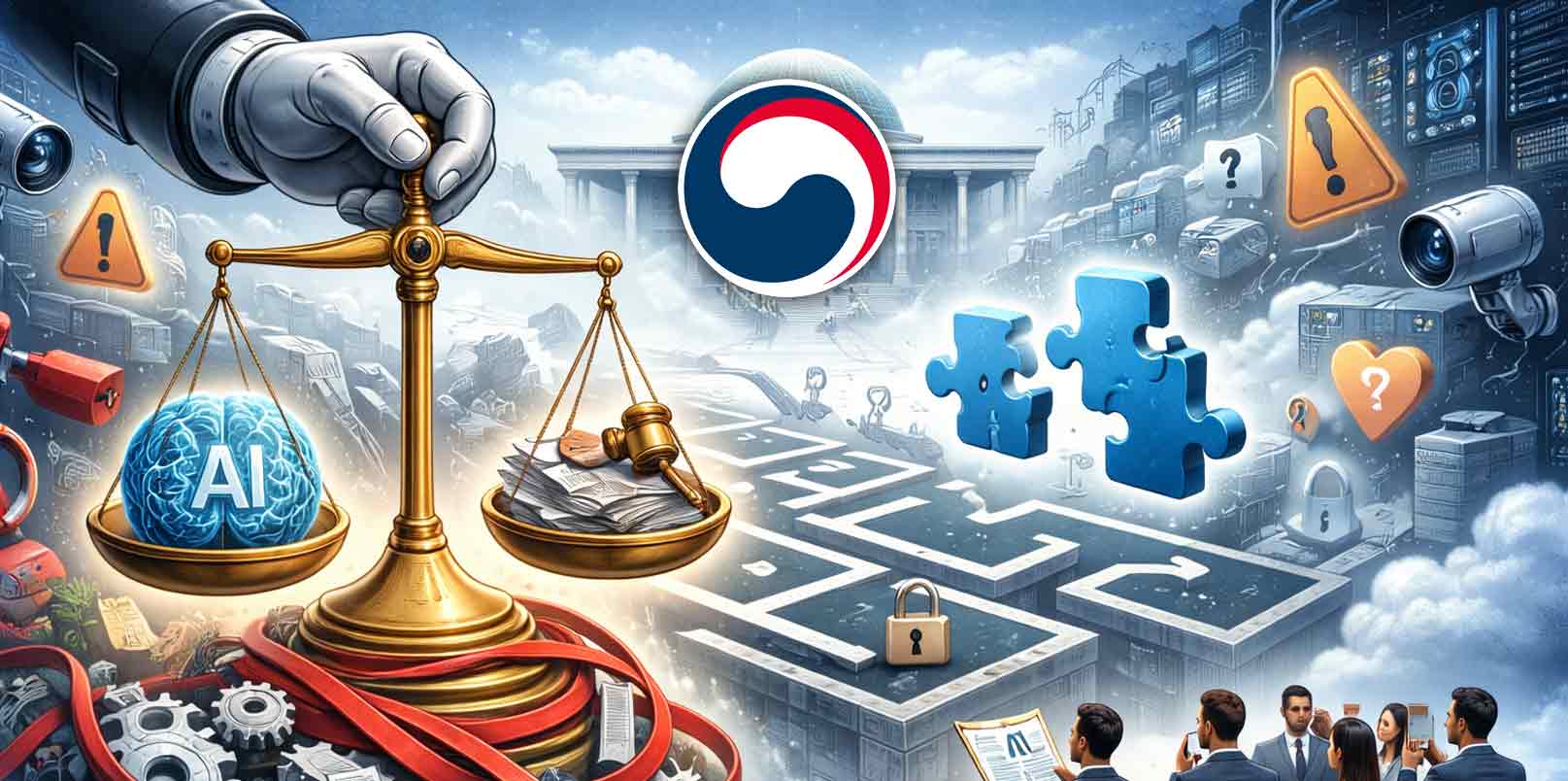
South Korea’s new AI Basic Act has entered the implementation phase with high expectations amid growing anxiety. Slated for enforcement on January 22, 2026, this legislation is positioned as the world’s first comprehensive framework to regulate artificial intelligence across both public and private sectors. It establishes obligations for safety, transparency, and user protection, particularly targeting “high-impact” and “generative” AI systems.
The Ministry of Science and ICT (MSIT) has indicated that enforcement penalties will be postponed during an initial grace period. This will allow regulators to assist companies in understanding and applying the law. However, a recent public roundtable at the National Assembly revealed significant concerns among startups and policymakers regarding the law’s readiness and enforcement mechanisms.
This regulatory framework represents a turning point in Korea’s innovation governance. Historically, policy design preceded market realities; now, the complexities of the market have outpaced legislative development. Industry participants are no longer debating intent but are questioning the government’s capability to effectively regulate AI at its rapid pace of evolution.
Unlike the more established regulatory frameworks in sectors such as semiconductors and biotechnology, AI governance demands continual feedback and adaptive oversight. The challenge lies not only in the law’s ambition but in the system’s capacity for intelligent enforcement. Issues such as how to label AI-generated content and the definition of “high impact” highlight a governance gap rather than a policy flaw.
The friction between ambition and infrastructure is already palpable. Startups have expressed concerns about inconsistent definitions, vague obligations, and costly compliance requirements. Even industry leaders acknowledge that the new system compels companies to navigate legal thresholds that regulators themselves are still defining. A survey by the Startup Alliance revealed that only two percent of Korean AI startups have adequately prepared for the law. Many express confusion over labeling rules that mandate both machine-readable and human-visible markings for AI-generated outputs, an approach that experts warn could inadvertently increase costs without ensuring safety.
Small firms utilizing open-source or foreign APIs face near impossibility in achieving compliance. The law holds them accountable for outcomes without granting them the ability to verify the comprehensive training data or computational resources behind large models. As a result, the tension extends beyond ideological differences to operational capabilities, where governance encounters the realities of technological advancement.
Korea’s AI Basic Act establishes a legal architecture that treats AI as a matter of public safety rather than merely an industrial concern. This could lay the groundwork for long-term trust and may position Korea as a model for responsible AI development in Asia. However, trust cannot be legislated. Without predictable interpretation and enforcement, well-meaning regulations risk stifling innovation. While the law encourages dialogue, it has yet to instill confidence. It seeks to protect consumers while creating burdens for early-stage developers and aims for accountability but may inadvertently hinder experimentation, which has been a hallmark of Korea’s recent AI achievements.
Officials from the Ministry of Science and ICT have acknowledged these risks, promising an extended guidance period and flexibility on a case-by-case basis. However, this also underscores a contradiction: the law intended to clarify behavior now relies on discretionary interpretation, raising questions about consistency in enforcement.
As a result, global founders observe both promise and caution in Korea’s regulatory approach. The nation exhibits a level of foresight in regulation that is uncommon in Asia, even as its ecosystem grapples with the challenge of balancing speed and safety. Investors view Korea’s AI landscape as an early governance experiment, where readiness for compliance could differentiate ventures built for sustainability from those pursuing short-term gains. International AI companies entering this market must navigate dual accountability—conforming to Korea’s transparency rules while aligning with broader frameworks like the EU AI Act.
For policymakers worldwide, Korea’s experiences offer critical insights into the consequences of ambition outpacing preparation. This serves as a reminder that nations pursuing ethical AI must first ensure their institutions are equipped to uphold such standards. Ultimately, the AI Basic Act aims to showcase Korea’s readiness for the future, yet it has unveiled the fragility of innovation governance when aspirations exceed understanding. The real test lies not in the law’s efficacy, but in whether its enforcers can adapt as swiftly as the technology they seek to regulate, ensuring that Korea’s leadership in AI regulation transcends merely being the first.
See also Residents Urge Holyoke Council on Bridge Safety and Public Comment Reforms
 RegTech Market Expected to Reach $33.36 Billion by 2032, Driven by AI Innovations
 New York’s AI Safety Law Introduces Stricter Oversight, Diverging from California Framework
 New York Court System Endorses AI Use for Attorneys Amid Hallucination Concerns
 Federal Executive Order Targets State AI Regulations to Enhance US Competitiveness