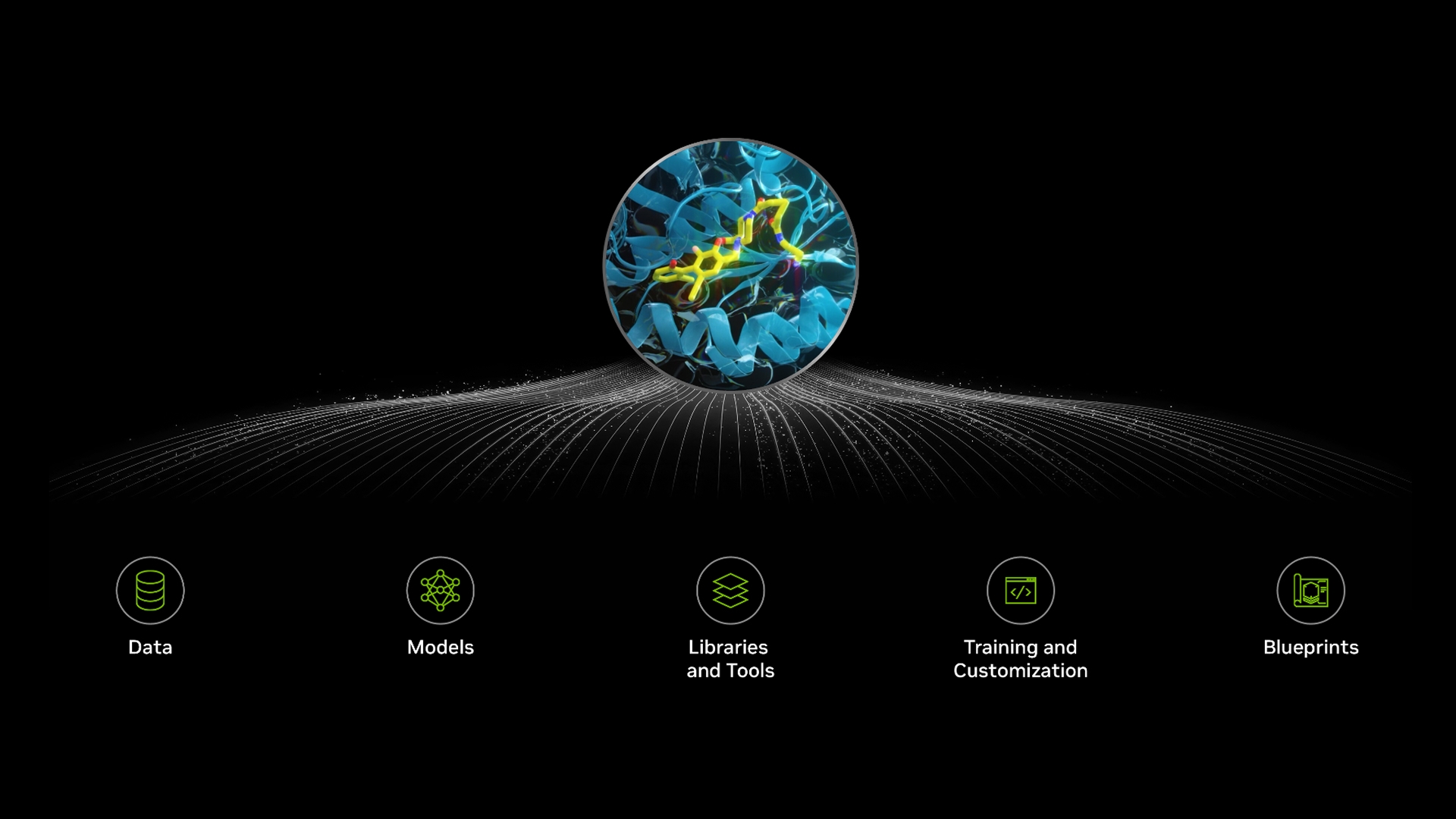
NVIDIA announced a significant expansion of its BioNeMo™ platform during the J.P. Morgan Healthcare Conference, aiming to enhance drug discovery workflows through advanced artificial intelligence (AI). This initiative comes amid ongoing collaborations with life sciences leaders like Lilly and Thermo Fisher Scientific, targeting the challenges that have long plagued the industry.
The life sciences sector generates enormous quantities of scientific data, yet the current research and development costs are estimated at $300 billion annually. NVIDIA BioNeMo aims to transform this data into a potent engine for scientific discovery by enabling the development, training, optimization, and deployment of AI models. “Biology and drug discovery are reaching their transformer moments,” said Kimberly Powell, vice president of healthcare at NVIDIA. The platform facilitates a continuous learning cycle, allowing each experiment to inform the next and significantly enhancing the probability of success.
New features within BioNeMo include the introduction of the NVIDIA Clara™ open models, which encompass the RNAPro model for RNA structure prediction and the ReaSyn v2 model to ensure the practicality of AI-designed drugs. BioNeMo Recipes have also been added to streamline the training and deployment of biological foundation models, alongside data processing libraries like nvMolKit, a GPU-accelerated tool for molecular design.
In a landmark collaboration, Lilly and NVIDIA are launching a co-innovation lab focused on revolutionizing drug discovery. By combining NVIDIA’s expertise in accelerated computing and AI with Lilly’s renowned drug development capabilities, the partnership aims to tackle enduring challenges in the field. This initiative builds on Lilly’s existing NVIDIA DGX SuperPOD™ and AI factory, with a total investment of up to $1 billion anticipated over five years in talent, infrastructure, and computing resources.
“We see this as a catalyst for the capabilities that will define the next era of drug discovery,” remarked Diogo Rau, executive vice president and chief information and digital officer at Lilly. He emphasized the importance of uniting advanced computing with specialized talent to foster rapid experimentation and customized models in drug discovery.
In parallel, Thermo Fisher has partnered with NVIDIA to create an autonomous lab infrastructure designed for scalable scientific discovery. This collaboration seeks to integrate NVIDIA’s AI computing capabilities with Thermo Fisher’s instrumentation, ultimately transforming laboratories into automated data factories. Key components of this initiative include unified edge-to-cloud AI compute with the NVIDIA DGX Spark™ desktop supercomputer, and the development of multi-agent systems using the NVIDIA NeMo™ software suite for lab orchestration.
“Artificial intelligence coupled with laboratory automation will transform how scientific work is performed,” stated Gianluca Pettitti, executive vice president of Thermo Fisher Scientific. This partnership will allow for streamlined experiment management and real-time data analysis, expediting the transition from raw data to actionable insights.
Globally, a range of innovators are leveraging the BioNeMo platform to drive AI in drug discovery. Companies such as Basecamp Research, Boltz PBC, and Chai Discovery are utilizing BioNeMo to scale their model training and development efforts. For instance, Basecamp has introduced a family of AI models capable of addressing complex challenges in drug design, while Boltz has launched a software platform for AI-driven molecular design.
The expanding ecosystem of AI scientist companies is crucial for building the future of scientific discovery. Organizations like Edison Scientific and Owkin are developing AI scientists that enhance research efficiency. Edison’s Kosmos can complete six months of work overnight, showcasing the transformative potential of AI in scientific workflows.
As this landscape evolves, NVIDIA collaborates with robotics and lab automation firms to integrate simulation and physical AI technologies. Companies like Multiply Labs and HighRes Biosolutions are using NVIDIA’s frameworks to develop robotic systems that can adapt in real time and enhance laboratory operations.
This collaborative ecosystem not only addresses current limitations in drug discovery but also promises to accelerate the pace of scientific breakthroughs. By closing the gap between in-silico experimentation and real-world validation, these advancements stand to significantly impact the life sciences industry, paving the way for new therapies and innovations in healthcare.
See also Alibaba’s AI Division Surges as Downloads Exceed 700M Amid Favorable Regulatory Shift
 Chalmers University Researchers Accelerate High Entropy Oxide Discovery with Active Learning
 Microsoft Acquires Bonsai to Enhance Azure’s AI and Reinforcement Learning Capabilities
 UK Universities Dismantling Humanities Programs Threaten Critical AI Research Engagement