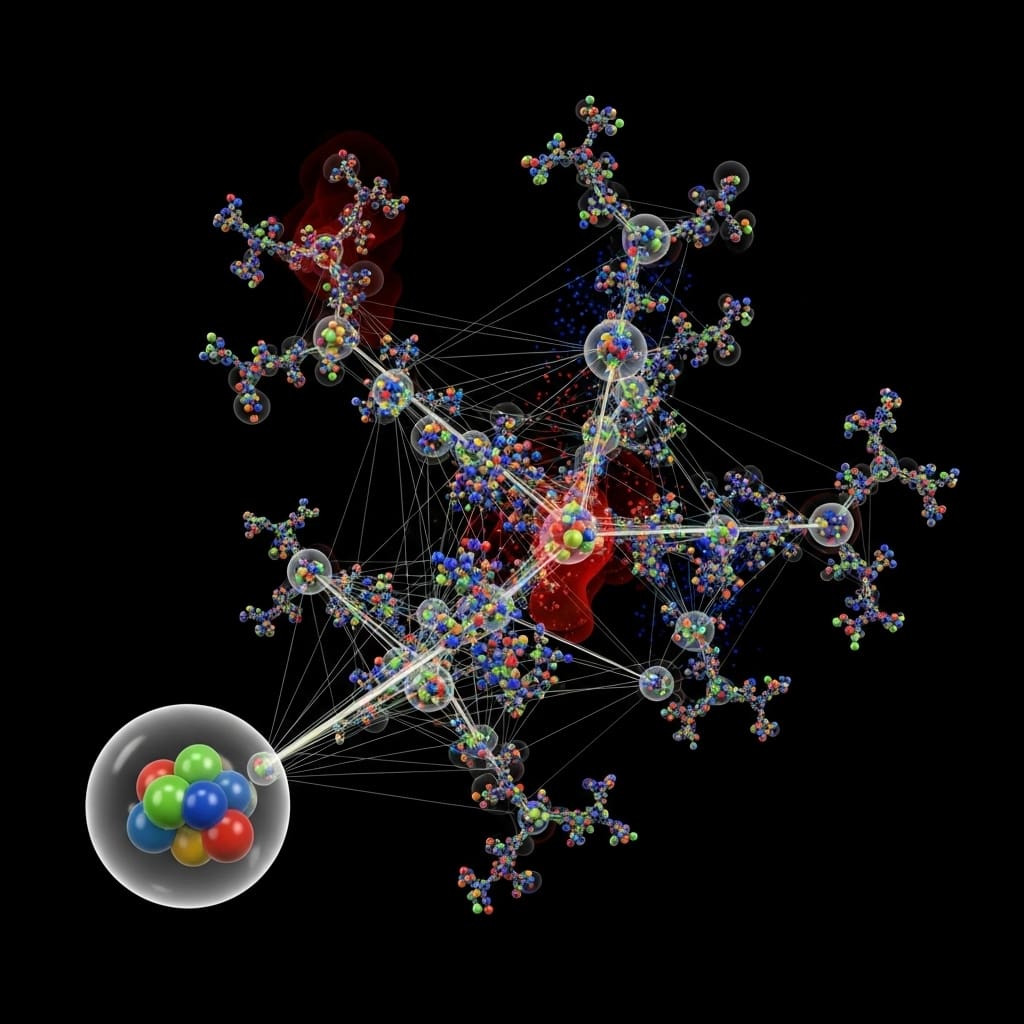
The quest for novel materials is accelerating advancements in sustainable technologies, with high entropy oxides emerging as a promising yet largely uncharted area of research. A team from Chalmers University of Technology, comprising Joakim Brorsson, Henrik Klein Moberg, Joel Hildingsson, Jonatan Gastaldi, Tobias Mattisson, and Anders Hellman, has introduced a transformative approach aimed at expediting materials discovery. Their research focuses on identifying optimal oxygen carriers for chemical looping, an essential process for efficient energy production and carbon capture, employing a combination of active learning strategies, first-principles calculations, and advanced machine learning interatomic potentials.
This novel methodology not only validates its application on high entropy perovskites but also identifies specific high entropy oxide compositions that exhibit exceptional oxygen transfer capabilities. The results underline the potential of active learning as an indispensable tool for materials scientists navigating complex compositional landscapes, heralding a new era in materials discovery.
The identification of suitable oxygen carriers has traditionally been a challenging task, often reliant on time-consuming trial-and-error methods. However, the innovations presented by this research make it increasingly feasible to discover oxygen carriers for chemical looping processes. By integrating active learning with density functional theory calculations, the researchers have efficiently explored a vast compositional space of high entropy perovskites. The machine learning models utilized were trained on calculated formation energies and oxygen vacancy formation energies, effectively guiding the selection of promising candidates while minimizing the reliance on computationally intensive first-principles calculations.
A critical advancement of this research is the development of a robust workflow for materials discovery that combines active learning with first-principles calculations. This method allows for the swift identification of high entropy perovskites with enhanced oxygen carrier performance, leveraging advanced machine learning interatomic potentials that provide accurate and computationally efficient predictions of material behavior. This framework sets the stage for further exploration into more complex compositional spaces, equipping materials scientists with a powerful tool for designing next-generation oxygen carriers.
In what marks a significant breakthrough in materials discovery, the researchers successfully applied their active learning strategies and first-principles calculations to identify high entropy oxides. Their focus on oxygen carriers critical for chemical looping—pivotal for efficient fuel conversion and carbon capture—has yielded promising results. The team found that sampling methods based on greedy algorithms and Thompson sampling, guided by uncertainty estimates from Gaussian processes, proved most effective for navigating intricate compositional landscapes.
Building on this success, the researchers refined their methodology to tackle the more complex challenge of discovering high entropy oxygen carriers specifically for chemical looping oxygen uncoupling. The study produced both qualitative and quantitative outcomes, culminating in detailed lists of materials demonstrating high oxygen transfer capacities and configurational entropies. Notably, the best-performing candidates were based on CaMnO3, enriched with an array of additional elements including titanium, cobalt, copper, and unexpectedly, yttrium and samarium.
The findings emphasize that active learning is vital for accelerating materials discovery, significantly reducing the reliance on exhaustive trial-and-error methods. By utilizing a Wasserstein auto-encoder neural network trained on various compositions and target properties, the researchers were able to explore the expansive compositional space of high entropy materials efficiently. Their efforts identified candidates suitable for three distinct chemical looping applications: dry reforming, air separation, and oxygen uncoupling, thus delivering a robust new resource for materials scientists.
This groundbreaking work illustrates the effective incorporation of active learning strategies along with first-principles calculations and machine learning interatomic potentials to tackle the complexities of high entropy oxide discovery. The research identified materials tailored for chemical looping processes, specifically focusing on oxygen carriers for both oxygen uncoupling and air separation. As a result, promising candidates emerged based on CaMnO3 and LaMnO3 perovskites enriched with elements like titanium, cobalt, copper, yttrium, and strontium, including some unexpected additions.
While the study revealed a tendency toward lanthanum and iron-rich compositions—potentially influenced by the initial training data—the use of techniques like Monte Carlo dropout broadened the compositional range. The researchers noted that the optimal conditions for chemical looping oxygen uncoupling and air separation varied, with greedy sampling proving slightly more effective for air separation. They acknowledged the influence of initial training data on the results, suggesting avenues for future research to expand the compositional space and refine machine learning models for enhanced predictive accuracy. Overall, this innovative approach signifies a crucial step forward in materials discovery, indicating that active learning will increasingly play a central role in the field.
See also Microsoft Acquires Bonsai to Enhance Azure’s AI and Reinforcement Learning Capabilities
 UK Universities Dismantling Humanities Programs Threaten Critical AI Research Engagement
 AI Chatbots Misrepresent News 45% of the Time, Study Reveals Disturbing Hallucinations
 Ontario Tech Panel Explores AI’s Environmental Impact Amid Climate Action Challenges
 Israeli Study Uses AI to Predict Childhood Obesity Risk from Maternal Data Before Birth