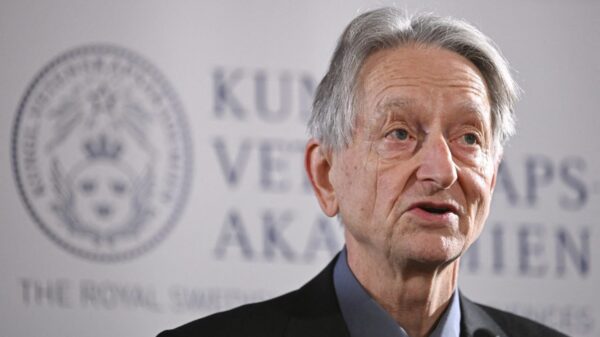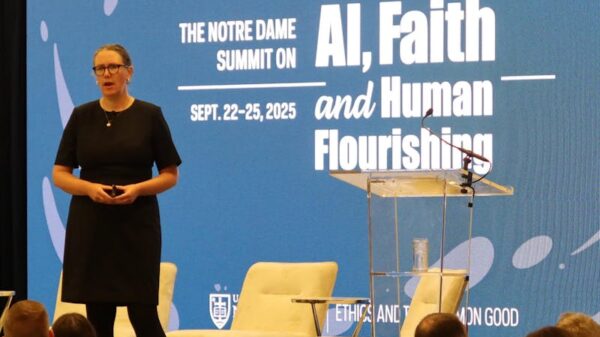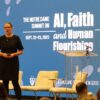
(OSV News) — Geoffrey Hinton, the computer scientist and cognitive psychologist dubbed the “godfather of AI,” has recently cautioned that the implications of artificial intelligence are not yet fully understood. Hinton estimates a 10% to 20% risk that AI could eventually gain control over its human creators. The pressing question is who is actively engaged in discussions about necessary guardrails and fail-safes to ensure humans maintain control over AI technology. One significant answer is the University of Notre Dame, which has received a historic $50.8 million grant from the Lilly Endowment to develop the DELTA Network, a faith-based initiative focused on AI ethics, launched in September 2025.
DELTA, an acronym for a framework rooted in five enduring Christian values—dignity, embodiment, love, transcendence, and agency—aims to address the ethical challenges posed by rapidly developing AI technologies. In a press release dated December 19, Notre Dame articulated that the funding would bolster the development of a shared ethical framework. This framework is intended for scholars, religious leaders, tech leaders, educators, journalists, young people, and the general public, facilitating thoughtful discussions on the appropriate uses of AI.
Meghan Sullivan, the founding director of Notre Dame’s Institute for Ethics and the Common Good and DELTA, emphasized that the grant comes at a critical juncture in AI development. “Any time there’s this amount of really rapid transition, that raises questions for people about what it means to live a good life and what it means to have a good society,” Sullivan stated. She pointed out that technological advancements offer new opportunities alongside unprecedented challenges, making the Church’s teachings more relevant than ever.
The DELTA framework is grounded in Christian principles but aims to be inclusive of diverse faith perspectives. Sullivan clarified that the initiative is not focused on altering technology policy or developing specific religious AIs, but rather on shaping the ethical outlook of individuals living in a technology-driven society. The framework will target three main sectors: education, pastoral leadership, and public engagement, each serving as a foundational community for discussions on the ethical implications of AI.
As part of its educational initiatives, DELTA will support the development of up to 50 college courses on AI ethics, integrating the values of the framework into academic settings. Sullivan highlighted the need for teachers to feel included in the conversation about how AI will influence their classrooms and school cultures, aiming to help them articulate a vision rooted in ethical principles.
In addressing pastoral leadership, initiatives will span from aiding the Vatican and bishops in understanding AI to fostering ecumenical dialogues within various Christian denominations about how the Gospel applies to an era characterized by powerful AI technologies.
Public engagement efforts will include a satellite location in Silicon Valley, where Notre Dame’s Mendoza College of Business operates an extension program. Sullivan noted that the common perception of Silicon Valley as secular and dismissive of faith does not reflect the reality that many Christians work in tech and desire to engage with ethical perspectives. “We just have to roll up our sleeves and do the work of getting out there and pursuing that engagement,” she remarked.
Father Robert A. Dowd, president of Notre Dame, expressed confidence that the university is well-suited to tackle the ethical dilemmas posed by AI. “Pope Leo XIV calls for us all to work to ensure that AI is ‘intelligent, relational and guided by love,’ reflecting the design of God the Creator,” he said in the December 19 statement. He believes Notre Dame can build essential bridges between religious leaders, educators, and technology creators to explore the moral and ethical questions surrounding AI.
Adam Kronk, director of research and external engagement at the Institute for Ethics and the Common Good, asserted that it is unsurprising for a Catholic institution to engage deeply with AI’s future. He recalled an instance at a Vatican AI event when a technologist, not affiliated with any faith, remarked that “we are going to need some ancient wisdom for this one.” This sentiment underscores a growing recognition that in times of disruptive technological change, the historical insights of religious traditions may provide crucial guidance.
As the dialogue around the ethical challenges of AI continues to evolve, initiatives like DELTA serve as a reminder of the importance of integrating moral and ethical frameworks into the rapidly advancing landscape of technology. With institutions like Notre Dame taking the lead, the path towards a more ethically grounded AI future may begin to take shape, highlighting the significance of collaboration between technology and faith-based perspectives.
See also GPT-5.2 Achieves Milestone by Solving Long-Standing Erdős Problems, Transforming AI in Mathematics
 Meta Launches Meta Compute to Drive Multi-Gigawatt AI Infrastructure Expansion
 NYSE Pre-Market Update: U.S. Stocks Dip Ahead of Fed Speeches; U.S.-Saudi Biotech Summit Launches
 IHG Appoints McDonald’s AI VP Wei Manfredi to Transform Hospitality Tech Strategy
 OpenAI Warns of China’s Rising AI Challenge as DeepSeek Release Sparks Speculation