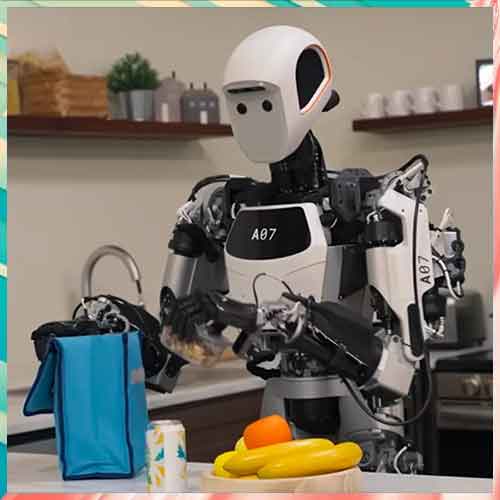
Google DeepMind and Boston Dynamics are advancing humanoid robotics beyond mere demonstrations, training their Atlas robots with Gemini AI for real-world applications in industrial environments. This collaboration merges Boston Dynamics’ six-foot-tall Atlas, an electric humanoid robot, with DeepMind’s Gemini AI, endowing the machines with the capability to comprehend instructions, perceive their surroundings, and adapt to unexpected circumstances.
The partnership aims for practical implementations within factories, shifting focus from staged showcases to enabling robots to tackle complex, repetitive, and safety-critical industrial tasks. Hyundai, the parent company of Boston Dynamics, is supplying production units for training, integrating AI intelligence through Gemini Robotics.
Gemini AI facilitates intelligent actions by combining vision, language, and action. This allows Atlas to interpret verbal commands, navigate through cluttered spaces, manipulate objects, and autonomously plan and execute multi-step operations. For example, the robot can identify a requested item, sidestep obstacles, sort components, assemble vehicles, or clean factory areas without pre-programmed movements.
Equipped with Gemini 2.0 multimodal AI, Atlas possesses the ability to process video, speech, and sensor data simultaneously, granting it human-like awareness for executing real-world tasks. Its visual-language-action (VLA) models enable the robot to see its surroundings, interpret commands, and physically act, while continuously learning from errors. Safety features and rigorous simulation tests ensure that Atlas can function safely around human workers and machinery.
The initial focus on manufacturing environments provides Atlas with live sensor feedback from its surroundings, which informs Gemini AI and enhances task execution over time. The blend of Boston Dynamics’ innovative hardware with DeepMind’s cutting-edge AI aims to mitigate labor shortages, boost productivity, and improve workplace safety.
This collaboration sets the stage for comparisons with competing humanoid initiatives, such as Tesla’s Optimus robot, underscoring different methodologies in developing practical humanoid machines. Beyond factory settings, the potential applications for these AI-driven robots could extend to warehouses, medical facilities, and even residential environments. However, the rise of humanoid workers presents ethical and labor-related challenges that require careful consideration.
By integrating Gemini AI with Atlas, Google DeepMind and Boston Dynamics provide a preview of the future workplace, where humanoid robots could become integral partners in industrial operations as soon as 2026. As the technology evolves, it raises questions about the future roles of human workers and the implications of widespread automation in various sectors.
See also Invest $3,000 in 4 AI Stocks: Alphabet, Nvidia, TSMC, and Microsoft for Long-Term Gains
 Global Risks Surge as Geopolitical Tensions and AI Fears Threaten Economic Stability by 2026
 Wikipedia Owner Teams with Microsoft, Meta for AI Content Training Initiatives
 Walmart and Google Shift Retail Landscape with AI-Driven Commerce: Small Brands Face New Risks