AI Policy Fellowship 2026 Now Accepting Applications
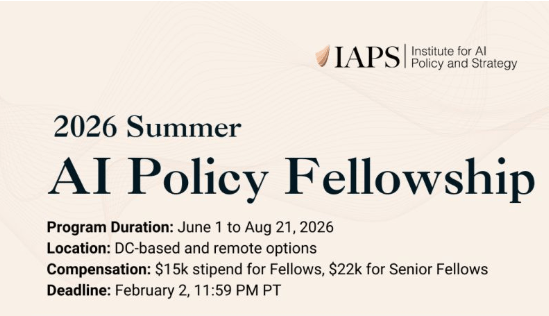
The Institute for AI Policy and Strategy (IAPS) has announced that applications are open for its AI Policy Fellowship 2026, a fully funded, three-month program aimed at professionals eager to develop practical skills in AI policy and governance. Set to run from June 1 to August 21, 2026, the program seeks individuals from diverse academic, professional, and geographic backgrounds, all committed to influencing the future of increasingly powerful AI systems.
The fellowship will feature a hybrid format, allowing participants to engage either in-person in Washington, D.C., or remotely from eligible countries. However, all selected fellows must attend a mandatory two-week residency in Washington, D.C., from June 1 to June 12, 2026 to kick off the program.
Financially, the IAPS is offering significant support, with senior fellows eligible for a stipend of USD 22,000 and regular fellows receiving USD 15,000. The fellowship is designed as a full-time engagement over the three months, although part-time options are available for exceptional candidates. Limited financial assistance for career transitions post-fellowship may also be provided in select cases.
Throughout the fellowship, participants will work independently on applied AI policy projects, guided by leading experts in the field. The program emphasizes practical outputs that can directly affect national and global AI policy discussions. Daily activities may include drafting policy briefs, organizing expert roundtables, and briefing government officials.
Each fellow will be matched with a dedicated subject-matter mentor and receive weekly coaching from an IAPS Fellowship Coordinator. Continuous feedback from IAPS researchers and policy staff will also be part of the experience, ensuring that fellows can effectively contribute to high-impact policy outcomes.
Fellowship projects will tackle real-world challenges at the intersection of AI, governance, and security, addressing key policy domains such as national security implications of advanced AI, government procurement of AI systems, and the geopolitical dynamics surrounding AI. Projects will be tailored to the individual expertise and interests of each fellow and may manifest in various formats, including policy briefs, government presentations, and research reports.
The fellowship is open to a wide range of applicants, including undergraduate and postgraduate students, early-career and mid-career professionals, as well as senior experts with extensive experience in policy or technical fields. Ideal candidates will demonstrate strong subject-matter knowledge in AI and policy, a keen interest in AI governance, and the ability to conduct independent research and policy analysis.
Participants in the program will benefit from a two-week in-person residency featuring policy briefings, project workshops, and networking events. Those based in Washington, D.C., will have access to office space and in-person programming throughout the fellowship. Remote fellows will also receive a support budget for approved in-person engagements, such as conferences and expert meetings.
The IAPS aims to act as a bridge into long-term careers in AI policy, with alumni having successfully transitioned into various roles across government institutions, think tanks, industry policy teams, and academia. Past fellows have joined organizations like RAND, the Institute for Progress, and the Center for Health Security, while others have founded new initiatives or pursued advanced research degrees.
The IAPS functions as a nonpartisan think tank focused on the governance of advanced AI systems, producing rigorous policy research to help decision-makers navigate the risks and opportunities tied to AI, national security, and geopolitics. As the demand for informed AI governance grows, the fellowship seeks to equip the next generation of leaders with the tools necessary to shape policy effectively.
Interested candidates should note that the application deadline is set for February 2, 2026, and those selected will begin the program on June 1, 2026, with the mandatory residency occurring from June 1 to June 12, 2026.
For further details, potential applicants are encouraged to consult the IAPS website and consider the significance of this fellowship in the evolving landscape of AI governance.
For more opportunities such as these, please follow us on Facebook, Instagram, Twitter, LinkedIn, and Telegram.
Disclaimer: Global South Opportunities (GSO) is not the fellowship organization. For any inquiries, please contact the responsible organization directly. Please do not send your applications to GSO, as we are unable to process them. Due to the high volume of emails we receive daily, we may not be able to respond to all inquiries. Thank you for your understanding.
See also OpenAI Invests in Sam Altman’s Merge Labs to Advance Non-Invasive BCIs
 Experts Warn: CES Health Gadgets Face Scrutiny Over Accuracy and Privacy Concerns
 Scoop AI Hackathon Tokyo Bowl on Jan. 31: $1,000 Prize Pool Awaits Innovators
 Samsung Set to Supply Exynos Processor for OpenAI’s 40M AI Earbud Project
 Embrace Ethical AI in Sales: Boost Trust and Revenue by 1.3x with Transparency