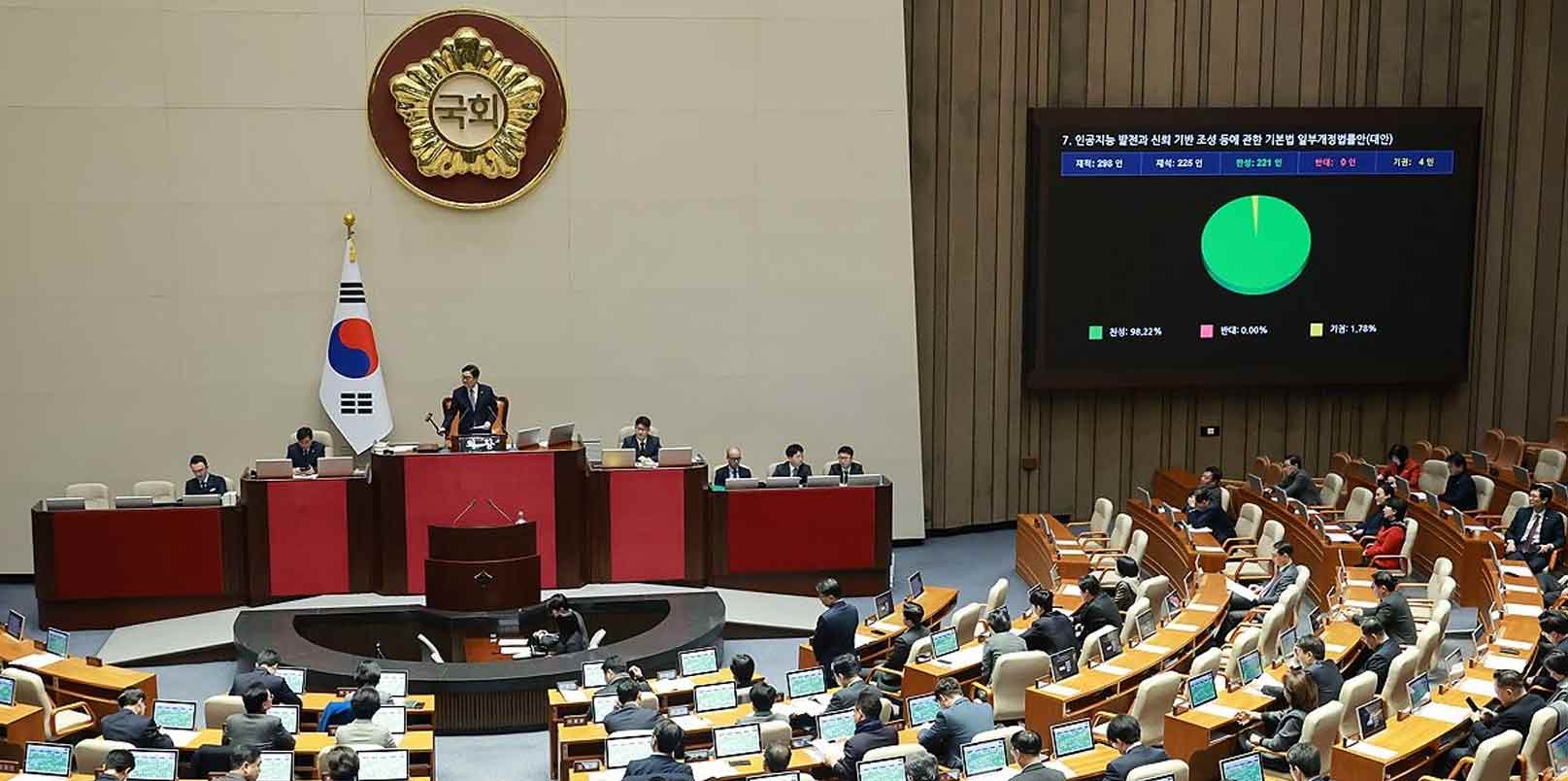
South Korea is set to make history with the implementation of the world’s first fully enforced AI Basic Act, which will take effect on January 22, 2026. This groundbreaking legislation, officially termed the Act on the Promotion of Artificial Intelligence Development and the Establishment of a Trust-Based Foundation, marks a pivotal moment in global technology regulation, aligning innovation with public trust and legal frameworks.
The Ministry of Science and ICT (MSIT) confirmed that the AI Basic Act will officially come into force this week, imposing mandatory standards for safety, transparency, and accountability on AI developers and service providers. The legislation particularly emphasizes regulations for systems classified as “high-impact AI,” and introduces labeling obligations for generative AI outputs, requiring notifications that clearly indicate AI-generated content.
Potential penalties for non-compliance can reach KRW 30 million (~USD 22,000), although the government has announced a one-year guidance period aimed at educating and assisting companies rather than enforcing immediate penalties.
Foreign AI firms generating over KRW 1 trillion in global revenue, KRW 10 billion in local AI sales, or boasting one million daily users are required to appoint a local representative. This includes major players such as OpenAI and Google.
While the European Union has drafted its own AI Act, it has opted for a gradual enforcement strategy. In contrast, South Korea is taking an unprecedented approach by enforcing all provisions of the AI Basic Act simultaneously, positioning itself as the first country worldwide to establish a comprehensive national regulatory framework for AI.
The act mandates that the MSIT revise a national AI Master Plan every three years, establish a National AI Safety Research Institute, and lays the groundwork for the long-discussed principle of AI explainability, which focuses on the ability to trace algorithmic decision-making.
However, the reception of the policy is mixed. Industry surveys conducted by Startup Alliance reveal that 98% of Korean AI startups currently lack the necessary compliance systems to meet the new requirements. Many small firms express concerns about being overwhelmed by documentation and unclear standards, particularly around the “high-impact” classification.
One startup executive remarked,
“Even large corporations can hire legal teams to interpret the Act. For startups, every compliance document can mean a delayed launch or a lost investor.”
Concerns extend further, as a representative from the domestic AI sector noted,
“The government says it will implement fines slowly after a guidance period, but what companies truly fear is the act of violating the law itself.”
“The AI Basic Act is meant to serve as a compass for safe and responsible growth, not a barrier. We will continue to refine detailed guidelines with industry feedback.”
Nevertheless, concerns regarding the act’s enforceability beyond South Korea’s borders remain. Global firms with servers or AI models developed abroad may escape Korean jurisdiction, raising concerns among domestic firms about potential reverse discrimination.
For investors and founders, the AI Basic Act represents more than just a national policy—it is a live governance experiment in the realm of technology. By embedding transparency and accountability within legislation, South Korea signals to the global market that trustworthiness may soon play a critical role in defining competitive advantage alongside performance. Startups that can effectively operationalize compliance may find themselves in advantageous positions for international partnerships, as foreign regulators increasingly seek interoperable frameworks.
Yet, there is an inherent risk that the rapid pace of regulation could surpass institutional readiness. The effective execution of the Act relies heavily on human interpretation—ministries, auditors, and developers must translate legal text into actionable practices.
This intricate balance mirrors broader challenges across Asia regarding the governance of emerging technologies without stifling innovation. Should South Korea’s approach evolve through continuous dialogue and adaptation, it could serve as a template for AI regulation across the region.
As the world watches South Korea’s next moves, the AI Basic Act may either emerge as a model for responsible innovation or serve as a cautionary tale of ambition outpacing readiness. For Korea’s startup ecosystem, the key opportunity lies not in resisting regulation but in actively shaping its interpretation and application. Companies that engage now—developing verifiable, transparent, and auditable systems—will likely set the standards for the next decade of AI leadership in Asia.
– Stay Ahead in Korea’s Startup Scene –
Get real-time insights, funding updates, and policy shifts shaping Korea’s innovation ecosystem.
➡️ Follow KoreaTechDesk on LinkedIn, X (Twitter), Threads, Bluesky, Telegram, Facebook, and WhatsApp Channel.
 Quantum Machine Learning Transforms Drug Discovery with Hybrid Algorithms, Tackling Molecular Challenges
 Google Quantum AI Achieves Key Milestones, Microsoft Poised for Quantum Dominance
 AI Adoption Key to Avoiding Bubble, Microsoft CEO Nadella Warns at Davos
 OpenAI’s Stargate AI Project to Fund $500B Energy Upgrades, Commit to Local Sustainability
 Gates Foundation and OpenAI Launch $50M AI Health Initiative for Africa’s Clinics