Oracle’s Multicloud AI Strategy Gains Traction Amid Industry Competition
Oracle is carving a distinct path in the competitive cloud landscape with its multicloud AI strategy, driving sustainable growth by broadening AI adoption beyond its own cloud ecosystem. The company aims to embed itself deeply into enterprise AI workflows, positioning itself as a cloud-neutral AI and data layer. This approach allows customers to run Oracle databases and AI workloads on major platforms like AWS, Azure, and Google Cloud, thus reducing reliance on any single vendor.
Oracle’s management has identified multicloud as the fastest-growing segment in the cloud market, reinforcing confidence in its durability and demand. In the second quarter of fiscal 2026, multicloud database consumption skyrocketed by 817% year over year, signaling a surge in enterprise adoption. The company’s recent initiatives, including the launch of Multicloud Universal Credits—which allow customers to commit once and deploy services across any cloud with consistent pricing—and a multicloud reseller program, further simplify deployment and enhance customer loyalty.
Oracle’s strategy is underpinned by a growing number of long-term contract commitments, providing clearer visibility into future demand. With cloud revenues contributing approximately 50% of total revenues and remaining performance obligations (RPOs) seeing year-over-year growth, Oracle is poised for continued expansion. The Zacks Consensus Estimate projects total revenues to increase by 16.7% in fiscal 2026 and by 27.5% in fiscal 2027, reflecting the positive impact of its multicloud initiatives.
However, Oracle faces stiff competition from key rivals like Amazon and Microsoft. Amazon Web Services (AWS) dominates the cloud market, boasting significant infrastructure scale and a diversified workload portfolio. In the third quarter of fiscal 2025, AWS reaccelerated its growth to about 20%, supported by a $132 billion run rate and a sizable $200 billion backlog. Innovations such as vertically integrated AI chips and platforms like Bedrock give Amazon a competitive edge in flexibility and innovation.
Meanwhile, Microsoft remains a formidable challenger to Oracle, benefiting from Azure’s expansive footprint and its deep integration with enterprise customers. Azure reported around 40% growth in the first quarter of fiscal 2026, with Microsoft Cloud revenues climbing 26%. The synergy between Azure and Microsoft’s other offerings, including Windows and Microsoft 365, enhances its data-rich ecosystem and competitive position. Azure’s leadership in hybrid cloud through Azure Arc and its partnership with OpenAI further strengthen its differentiation against Oracle.
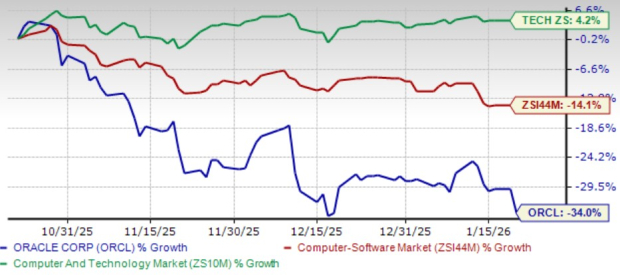
In terms of stock performance, Oracle shares have decreased by 34% over the past three months, underperforming both the Zacks Computer and Technology sector’s growth of 4.2% and the Zacks Computer – Software industry’s decline of 14.1%. Currently, Oracle’s stock trades at a forward 12-month Price/Earnings ratio of 22.81x, lower than the industry average of 26.77x, indicating potential valuation opportunities.
The Zacks Consensus Estimate for Oracle’s fiscal 2026 earnings stands at $7.42 per share, reflecting a 1.2% increase over the past month and suggesting a 23.05% growth from fiscal 2025 figures. With a Zacks Rank of #3 (Hold), Oracle’s current valuation may prompt interest from investors seeking recovery opportunities, especially given its strategic focus on multicloud and AI.
As Oracle navigates a competitive landscape, its commitment to a multicloud AI strategy could prove pivotal in enhancing its market position. The company’s growing emphasis on flexibility and customer-centric solutions aligns with broader industry trends, reflecting the increasing importance of multicloud environments in enterprise technology strategies.
For further insights on cloud strategies and market dynamics, you can explore resources from Amazon Web Services, Microsoft, and Oracle Corporation.
See also Corporate Prediction Markets Surge: $814M Daily Turnover on Meta AI, Amazon Layoffs, and Starbucks Strategies
 HUMAIN Secures $1.2B Financing with Infra to Expand AI Data Center Infrastructure in Saudi Arabia
 Mistral AI Resolves vLLM Memory Leak with UCX Hook Modification, Prevents 400MB/min Leak
 Mila and Inovia Launch $100M Fund to Propel 55 AI Startups from Research to Market
 Trump Faces Bipartisan Backlash Over AI Chip Sales to China Amid Rising Tensions