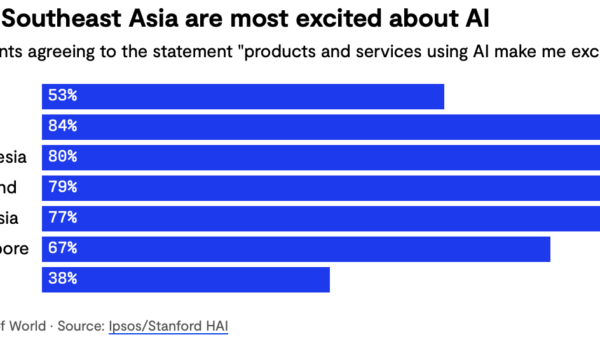
As Indonesia accelerates its embrace of artificial intelligence (AI), the nation grapples with a paradox: it ranks among the world’s largest users of AI technology, yet it struggles to develop, customize, and control these tools. To address this capacity conundrum, the Ministry of Communication and Digital has initiated the AI Talent Factory (AITF), a program aimed at fostering AI expertise through collaboration with academic institutions.
“AITF focuses on preparing selected talents to solve national problems using practical AI technologies,” stated Mirza Pahlevi, Head of the Digital Talent Development Centre, in an interview with GovInsider. The initiative aims to immerse students in real-world scenarios, equipping them with hands-on experience as AI engineers.
The program’s inaugural partnership was with Brawijaya University, where students tackled projects aligned with two government priorities: combating online gambling and bolstering digital talent pools. Rather than utilizing pre-existing AI models such as GPT-4 or Gemini Pro, participants created solutions from open-source foundation models, followed by extensive pre-training and fine-tuning procedures.
“They had to collect their own data, clean it, perform deduplication, then move into model engineering and evaluation,” Pahlevi explained. The results were promising; the model developed by Brawijaya University students achieved significant accuracy and was promptly adopted by the government. “Out of hundreds of domains identified based on their text and images contained in their URLs, around 90 percent were affiliated with online gambling,” he added, noting that this training data would underpin government actions to eliminate such content.
Looking ahead, the model will be expanded to address issues across additional ministries before ultimately being introduced to the industry. “For now, we want the government to be the first to benefit,” Pahlevi remarked.
Beyond immediate applications, AITF aims to cultivate a national AI talent ecosystem. Students gain advanced engineering experience, while lecturers are motivated to update their skills, prompting institutions to invest in the necessary infrastructure. “We want universities to become more aware of how far AI technology has progressed, so that lecturers start learning,” Pahlevi noted. This awareness is already manifesting; Universitas Brawijaya is now conducting a second batch of AITF participants and is in the process of formalizing it as a dedicated course.
By 2026, AITF plans to expand to other universities, including Sepuluh November Institute of Technology and Gadjah Mada University, with various focus areas such as child protection in the digital realm and adaptive AI-based learning. Importantly, Pahlevi emphasized that this initiative is not solely a university-led project. “The government and universities work together based on shared ownership and joint funding,” he stated, highlighting the necessity of mutual investment in infrastructure, including GPU provision.
Additionally, AITF collaborates with the Indonesian diaspora and international partners, attracting mentors from organizations such as Google DeepMind and the University of Tokyo, supported by the Japan International Cooperation Agency (JICA). This collaborative approach aims to enhance the quality and relevance of the training provided.
The Ministry projects that Indonesia will require 12 million digital talents by 2030, while formal education systems are expected to produce only 9.3 million. This leaves a shortfall of approximately three million professionals, underscoring the urgency of various training initiatives, especially in the AI sector. According to the national AI roadmap, the government aims to generate 100,000 AI talents annually across different strata: users, developers, practitioners, and specialists.
Pahlevi acknowledged the formidable challenge of meeting this target, asserting that traditional strategies will not suffice. The Learning Journey, offered through the Digital Talent Scholarship platform, is pivotal in this broader strategy. This self-paced online learning platform is structured into tiers—basic, intermediate, and advanced—allowing participants to choose the level that best fits their needs. The ministry aims to enroll 30,000 participants in this program this year.
The shift toward online learning aims to scale educational access across Indonesia, mitigating the risk of widening the AI skills gap. Pahlevi emphasized that training materials are designed as structured digital textbooks, combining text, interactive videos, evaluations, and live sessions with experts. Advanced participants undergo assessments that include camera-based proctoring to uphold academic integrity.
The Learning Journey adopts a vendor-agnostic approach, ensuring participants acquire fundamental AI knowledge not tethered to specific technology providers. “All foundational components are developed and managed directly by the government,” Pahlevi explained. Only after completing certain stages can participants branch out to partner organizations, allowing them to acquire industry certifications from global tech names like Google and Microsoft.
In summary, Pahlevi underscored the critical role of policy support and national infrastructure in fortifying Indonesia’s AI sovereignty and addressing investment challenges in the development of homegrown AI models. “Human resources and infrastructure must progress hand in hand. At PPTD, we focus on the human capital side,” he asserted, signaling a comprehensive approach to nurturing a robust AI talent pool in the years to come.
See also Intel Reports CPU Shortage to Peak in Q1 as AI Demand Surges, Hits $13.7B Revenue
 CitiusTech and Ventra Health Launch vCision AI Platform to Boost Revenue Cycle Efficiency by 19%
 Restb.ai Launches AI-Powered Feature UAD for Streamlined Appraisal Compliance Ahead of 2026 Regulations
 Intel Forecasts Q1 Revenue at $11.7B-$12.7B, Fails to Meet AI Server Chip Demand
 Nvidia CEO: AI Infrastructure Boom Doubles Construction Worker Salaries to Six Figures