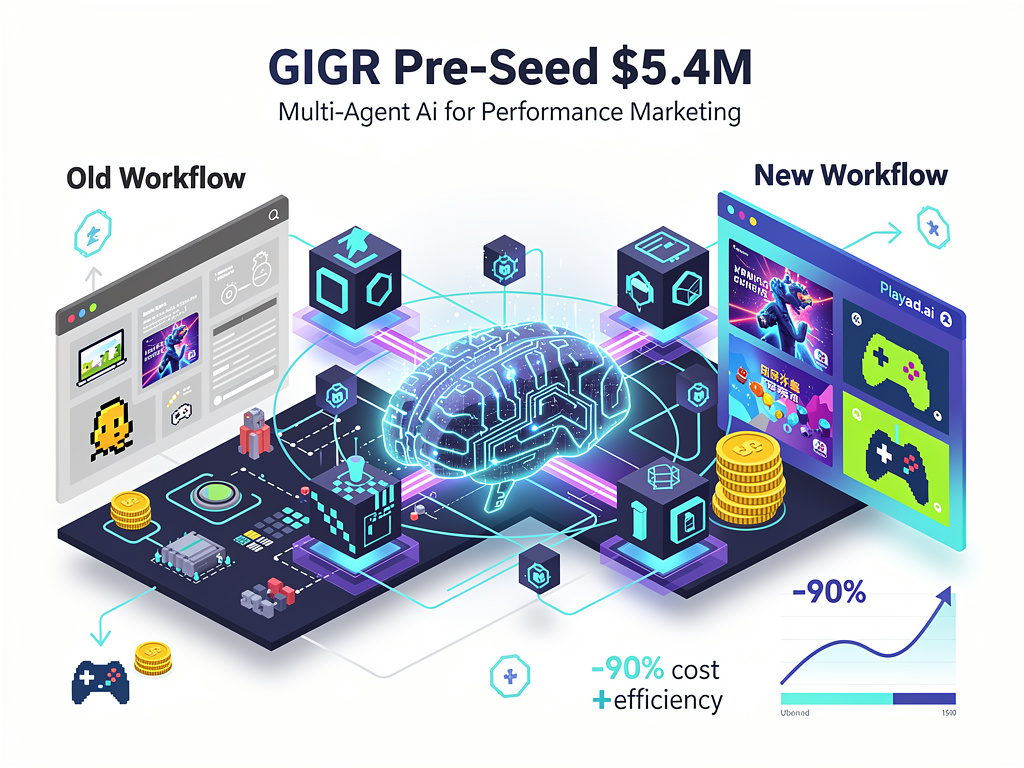
San Francisco startup GIGR, operating as Playad.ai, has raised $5.4 million in pre-seed funding to develop multi-agent AI systems designed to automate the advertising creative process from inception to optimization. The funding round, announced on January 22, 2026, was led by BRV Capital Management and Mirae Asset Venture Investment, with participation from angel investors including Bora Chung, a board member at Krafton and former executive at Bill.com, Jihun Yu, founder of Hyprsense, which was acquired by Epic Games, and Krew Capital. This capital comes at a time of increasing demand for AI-driven tools in performance marketing, where the quality of creative content plays a crucial role in determining return on ad spend.
Launched in the third quarter of 2025, Playad.ai aims to tackle the inefficiencies that plague ad production, such as slow iteration cycles dependent on human guesswork and the need for costly specialists. The platform utilizes multi-agent AI workflows to manage briefing, generation, testing, measurement, and refinement, allowing marketers to rapidly produce variants. Early users report reductions of up to 90% in production costs and improvements in acquisition efficiency, according to a company press release distributed via PRNewswire.
Interactive Ads as the Entry Point
GIGR is focusing its efforts on interactive ads, particularly in the gaming sector, where these formats allow users to engage with products through taps, swipes, and choices, resulting in higher conversions and lower costs per install (CPI). Unlike traditional static images or videos, interactive formats provide rich engagement data that clarifies performance drivers. Playad.ai simplifies the creation of these ads, removing the need for developers and the high costs that have traditionally limited their use.
The company’s enterprise tier promises engagement increases of 3-5x through playable ads, along with tools such as AI-generated user-generated content (UGC), avatar creators, and image-to-video converters. Trusted by major gaming companies like Nexon, Krafton, Kabam, and Devsisters, as well as entities like Match Group and Kakao Style, the platform is positioned across various sectors including gaming, dating, beauty, and e-commerce.
Founders’ Pedigrees Fuel Ambition
At the helm of GIGR is CEO Jay Jaeyeon Cho, who previously scaled Bagelcode’s AI game studios to over 50 million users and generated $70 million in annual revenue. Co-founder Steve Nam Hyuk Chung, who holds credentials from MIT and Wharton and has worked at Bank of America, PlayStation, YouTube, and 20th Century Fox, is responsible for business strategy. Engineering lead Jayden Hyun Jae Park developed scalable AI solutions at Devsisters, while the team also includes talent trained at prestigious institutions like Stanford and POSTECH.
“Marketing performance increasingly depends on how quickly teams can learn from creative—and act on it,” Mr. Chung stated. “We’re building AI agents that make iteration the default, so teams can quickly apply what’s already working across the market to their next creative without sacrificing quality.” This expertise positions GIGR to leverage creativity as a critical factor in enhancing marketing effectiveness.
Why Interactive Dominates Gaming UA
Data from the industry indicates a robust rationale for this strategy: playable ads achieved record performance in 2025, often reducing CPI while amplifying conversions by up to sevenfold compared to standard formats, as highlighted in reports like AppAgent’s mid-year review. These ads attract high-intent users, delivering quality installs even if they incur higher upfront costs. GIGR’s innovation focuses on accelerating AI processes to create numerous variations for A/B testing without manual effort.
Playad.ai’s workflow encompasses discovering top competitor ads, creating on-brand variants, and editing and scaling content, integrating leading models like Sora 2 Pro and Veo 3.1. Pricing ranges from free (offering 25 credits) to customizable enterprise plans, catering to individual creators and larger teams alike, with credits incurred only upon downloads.
The platform also features tools like Ad Clone for recreating successful ads in custom styles, Brand DNA for aligning brand voice, and Prompt Enhancer for refining inputs to yield superior AI outputs. These capabilities centralize assets, track competitors, and support over 70+ languages, democratizing access to professional-grade production. Gaming companies, facing CPIs exceeding $30 for traditional campaigns, stand to benefit significantly from this shift toward interactive formats.
“We’re not trying to simply produce ‘more assets,’” Mr. Cho asserted. “We’re building a system where every launch creates learning—and that learning directly improves the next creative decision. Creative is the most important lever for improving ROAS in modern marketing.” This feedback loop, powered by multi-agent orchestration, seeks to eliminate uncertainty in marketing strategies.
GIGR’s backing from BRV Capital and Mirae Asset reflects a strong belief in the role of AI within an evolving ad tech landscape. Angel investors like Mr. Chung and Mr. Yu, with deep ties to gaming and acquisition success, provide added strategic insight. Recent discussions on platforms such as X, including insights from @raisingfi, suggest growing excitement within AI funding circles, placing GIGR among innovative entrants addressing a digital advertising market exceeding $200 billion.
As GIGR enters the market, its approach aligns with the broader trend of AI transforming marketing workflows. Platforms like Playad.ai are anticipated to extend their influence beyond gaming into video and image production. With potential cost savings of up to 90%, coupled with data-driven iteration, the implications for return on ad spend optimization could be profound. Although challenges remain in ensuring AI outputs comply with platform guidelines and managing brand fidelity, the momentum from 2025’s surge in playable ads positions GIGR for continued growth and innovation in the field of AI marketing.
See also AI Transforms B2B Sales: 71% of Marketers Automate Personalization for 137% ROI
 Marketing Operations Drives 27.8% Growth in 14,106 Martech Tools for 2024
 Cisco Predicts AI-Powered Concierge Agents Will Transform Customer Engagement by 2026
 Bold Brand Launches AI-Powered Marketing Services in Egypt and Saudi Arabia
 South Korea Becomes Second Largest Market for Google’s Gemini, Contributing $21M Revenue