
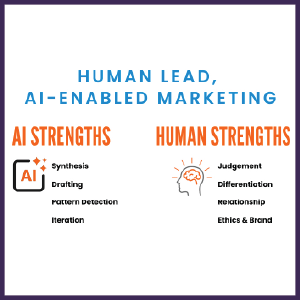
Artificial intelligence (AI) has transitioned from a novel addition to marketing frameworks to becoming an essential, integrated aspect of how businesses engage with consumers. Today, it permeates various facets of marketing, from ad platforms and analytics to customer relationship management (CRM) and creative tools. This evolution prompts a critical question for business owners and marketing leaders: will they institutionalize AI as a core capability, or merely use it as a collection of disparate tools?
The success of future marketing strategies will not hinge on merely using AI; it will depend on how organizations redesign their marketing processes around it. Over the past decade, enhancements in marketing performance were primarily driven by improved distribution methods, such as more effective targeting and automation. However, in the current AI landscape, the key differentiators will be decision speed and decision quality. Companies that effectively harness AI will see faster synthesis of market and customer signals, more consistent brand positioning across various touchpoints, and tighter feedback loops between performance data and creative iterations.
AI’s true value lies not in its ability to generate content quickly but in its capacity to enable marketing teams to operate with greater precision—provided the organization structures its operations accordingly. Many companies, however, are hastily adopting AI writing tools and urging their teams to “experiment,” hoping for improved productivity. This unstructured approach poses predictable risks, including brand dilution, where content output increases but voice consistency suffers; quality drift, which results in generic and repetitive outputs misaligned with brand positioning; operational friction arising from parallel workflows; data and compliance exposure that can jeopardize sensitive information; and the illusion of progress, where leaders mistake activity for meaningful impact.
AI itself is not inherently strategic; it becomes strategic through effective governance. High-performing organizations that are successfully leveraging AI tend to focus on specific strategic initiatives. These include defining AI’s role across the marketing value chain—where it aids in research, insights, planning, creative development, execution, and measurement—while identifying areas where human judgment is indispensable. Additionally, these organizations are building standardized operating systems rather than relying on a scattered collection of AI prompts, focusing on clear inputs, defined processes, quality control, and performance metrics. This consistency allows teams to scale their output without sacrificing clarity or brand alignment.
Another crucial factor is treating brand voice and positioning as protected assets. While AI can expedite content creation, it requires clear definitions regarding tone, messaging hierarchy, differentiation, and customer truths. Without this framework, organizations risk amplifying the wrong messages. Furthermore, establishing a disciplined measurement framework centered around business outcomes is essential. AI implementations should yield measurable benefits, such as reduced cycle times, improved lead quality, lower customer acquisition costs (CAC), higher conversion rates, increased customer retention, and enhanced sales enablement effectiveness. If AI cannot be tied to these outcomes, it lacks strategic relevance.
Organizations are encouraged to consider where AI can enhance efficiency, drive effectiveness, and where it is crucial to preserve human advantages. This level of introspection helps businesses shift their focus beyond mere content generation to building capabilities. Key elements include developing integrated systems, refining workflows, establishing clear decision rights, implementing governance guardrails, and measuring performance effectively.
Looking Ahead
For those seeking a comprehensive understanding of how AI integrates into marketing strategy without succumbing to hype or fixating on individual tools, an in-person workshop titled “Marketing in the Age of AI: Tools & Tactics” will be held on February 12 at 5:30 PM at the Warwick Hills Golf & Country Club. Participants will gain actionable insights into AI’s capabilities, its integration into existing workflows, and strategies to adopt it without losing the authentic voice that underpins brand credibility. Registration details can be found on relevant platforms.
See also Content Marketing Surges to $564.8B in 2025 Driven by AI, Video, and Engagement Strategies
 WordPress Reveals AI Guidelines to Ensure GPL Compliance and Combat ‘AI Slop’
 Chowbus Launches AI Digital Marketing Tool for Restaurants, Offers $600 Ad Credit
 Fingerprint Launches 100% Accurate AI Agent Detection for Secure Enterprise Automation