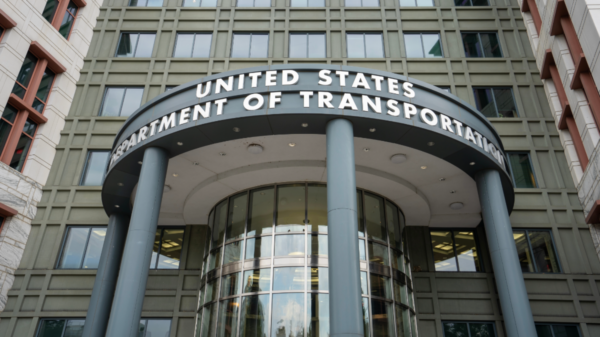
The US Department of Transportation (DoT) is set to leverage artificial intelligence in the drafting of federal transport regulations, aiming to enhance efficiency and speed in regulatory processes. Announced in December 2025, this initiative was presented to DoT employees as a demonstration of AI’s potential to transform the agency’s approach to rulemaking, according to a communication from Daniel Cohen, the department’s assistant general counsel for regulation.
The DoT oversees safety across various transportation sectors, including aviation, freight rail, and road traffic management, as well as gas pipeline maintenance. This new AI-driven approach is intended to significantly reduce the timeframe required to progress from a conceptual idea to a complete draft regulation ready for review by the US Office of Information and Regulatory Affairs, with the department aiming for an optimal timeframe of just 30 days.
Internal discussions revealed that Gregory Zerzan, the DoT’s general counsel, noted President Donald Trump expressed strong support for the initiative. Zerzan described the DoT as the “point of the spear” in this effort, suggesting that the agency could serve as a model for other federal departments in the future. The plan reportedly involves using a customized version of Google Gemini to enable staff to generate proposed rules in mere minutes or even seconds, as reported by ProPublica.
Ben Winters, the AI and privacy director at the Consumer Federation of America, pointed out that this initiative follows significant workforce reductions under the Trump administration, which saw the DoT lose nearly 4,000 of its 57,000 employees, including over 100 attorneys. Winters emphasized that such cuts had resulted in a loss of expertise that may be partially mitigated through the adoption of AI technologies.
Beyond the DoT, several other federal agencies have also been encouraged to adopt AI technology for various functions, such as translating documents, analyzing data, and sorting public comments. The General Services Administration (GSA) recently articulated its goal for 2026 to promote AI adoption across agencies, aiming to eliminate obstacles to innovation and foster collaborative efforts.
As part of its AI strategy, the GSA has begun testing chatbots to provide straightforward answers to common inquiries about federal programs, while also utilizing AI for drafting market research summaries. The agency is actively working to streamline the authorization process for AI initiatives, which it characterized as excessively slow and costly. Changes implemented last year included modifications to the Federal Risk and Authorization Management Program (FedRAMP), which standardizes security assessments and authorizations for cloud computing products.
The revised FedRAMP process, termed FedRAMP 20x, is designed to expedite the assessment and authorization pathway. This initiative aligns with a broader push within the federal government to harness technology for improved service delivery and operational efficiency.
As the landscape of federal regulation evolves, the DoT’s pioneering efforts to integrate AI into its operations may pave the way for a more adaptive regulatory framework, potentially fostering faster decision-making processes and improved public safety outcomes. The success of this initiative could have far-reaching implications for how government agencies across the country utilize technology to enhance their effectiveness.
See also US Congress Calls for Stricter AI Workplace Regulations Amid Rising Concerns on Worker Rights
 EU AI Act Guidance Delay Fuels Compliance Uncertainty for High-Risk AI Systems
 Black Duck Reveals BSIMM16: AI Drives 10% Rise in Application Security Innovations
 Cynomi Expands NIS 2 Coverage for MSPs in Croatia and Belgium Amid Rising AI Governance Demand