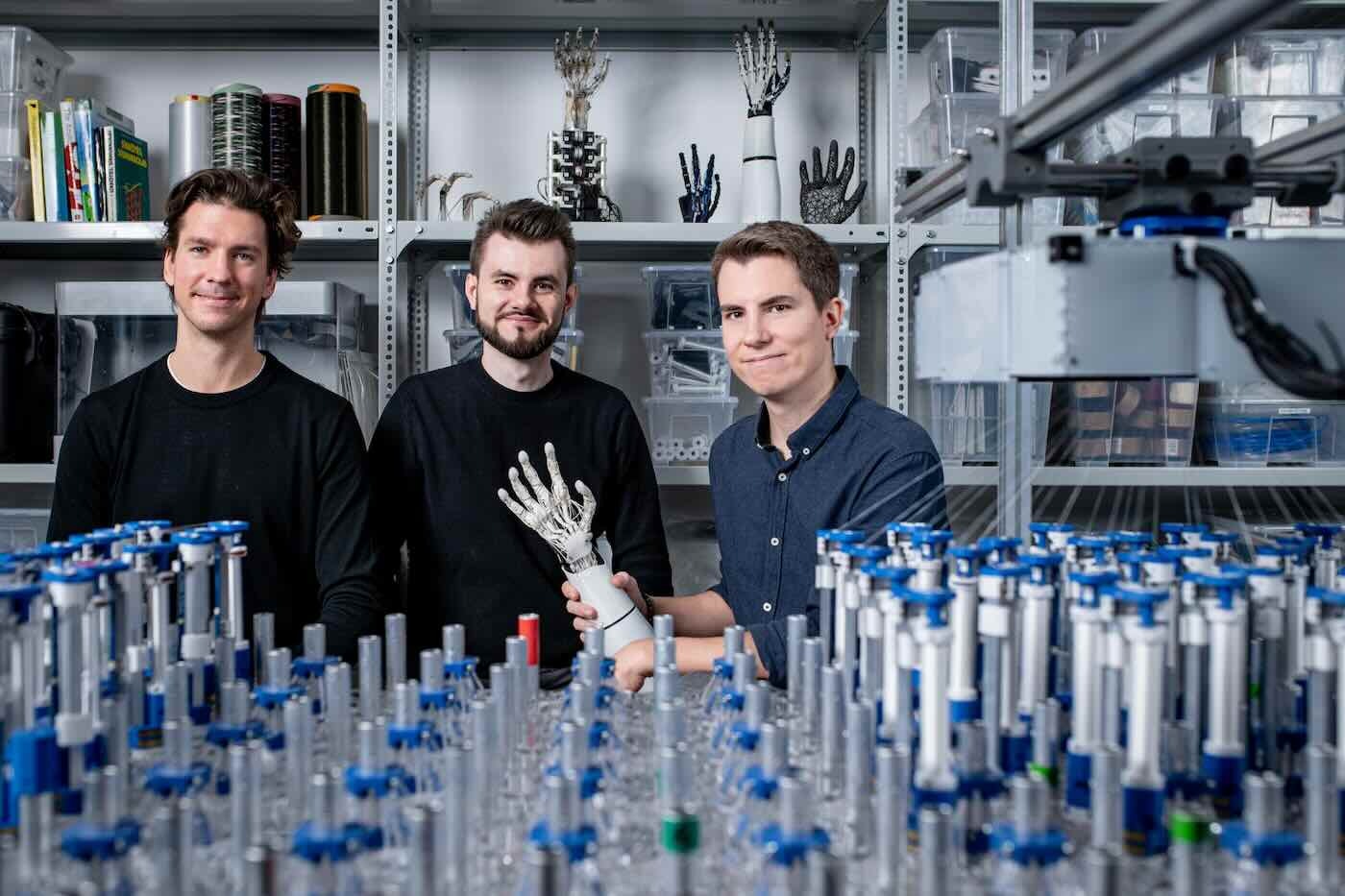
Budapest-based Allonic has raised $7.2 million in pre-seed funding, marking the largest such round in Hungary to date. The funding will be instrumental in developing a novel method for producing robotic bodies, addressing longstanding challenges in the field.
The funding round was led by Visionaries Club, with notable participation from Day One Capital, Prototype, SDAC Ventures, TinyVC, and RoboStrategy. Over a dozen angel investors, including individuals affiliated with OpenAI, Hugging Face, ETH Zurich, and Northwestern University, also contributed.
Robotics is experiencing significant growth in Europe, with companies in the sector raising €1.6 billion in equity funding last year, a notable 130% increase from 2024, according to Sifted data. However, despite advancements in artificial intelligence enhancing robot functionality, manufacturing constraints persist, particularly in the creation of robotic bodies, an area Allonic aims to revolutionize.
Currently, the assembly of advanced robots typically involves slow, manual processes requiring the intricate assembly of hundreds of precision parts. Robotic hands, arms, and manipulators are constructed piece by piece using bearings, screws, cables, and delicate joints, making the process costly and difficult to scale. “A lot of people agree that where robotics is versus where it could get to is tremendously different,” said Marton Sarkadi Nagy, a partner at Visionaries Club. He emphasized the importance of hardware in overcoming bottlenecks in the robotics sector, stating, “We won’t get there if the hardware is not right.”
Allonic’s innovative production process, termed 3D tissue braiding, automates the manufacturing of robotic bodies. This method replaces traditional assembly with an automated system that weaves together the equivalent of tendons, joints, and soft tissue directly onto an endoskeleton, allowing for a more streamlined production process. Co-founder and CEO Benedek Tasi explained, “It’s inspired by how rope braiding works. You have the ability to do anything with a high design freedom.”
The company is initially focusing on manipulators, such as hands, grippers, and various end-effectors, with plans to extend its technology to robotic arms and potentially entire bodies. Tasi noted, “We’re not just focusing on humanoids, but a wide range of form factors.”
Allonic aims to drastically reduce production times, with Tasi stating that the time required to manufacture a finger, manipulator, or arm could be shortened to just a few minutes. “What you get out from the machinery is basically a finished product that you will need to wire up to the actuators,” he said. “Instead of hours or days, it should be a couple of minutes, with the production itself also taking a couple of minutes. We’re talking a magnitude of difference.”
This rapid production capability could significantly reshape robotics design, according to Tasi. “Being able to go from idea to physical robot in minutes instead of weeks fundamentally changes how we can think about robotics design. Once that barrier disappears, entirely new classes of robots become possible.”
Allonic has already completed its first pilot project in the electronics manufacturing sector. Tasi highlighted the growing need for versatility in this market, noting that there is “already a much greater need for versatility than what current industrial solutions can provide.”
The company positions itself as an “infrastructure player,” allowing clients to design custom robotic bodies that Allonic then manufactures. Looking ahead, Tasi mentioned plans to evolve into a business model where the full platform could be sold to clients for in-house use.
With its current workforce of 15, Allonic intends to use part of the funding to expand to 25-30 employees. The funds will also support the development of its technological platform and facilitate additional pilots and early commercial deployments with industrial partners. “We’ve had a lot of conversations with potential pilot customers, startups, players in industry, and humanoid space, big tech companies,” Tasi noted.
See also Cisco Unveils $28B AI Infrastructure Strategy, Positioning to Dominate Enterprise Tech Future
 Alibaba Faces Overload Crisis Amid AI Shopping Surge and Robotics Breakthrough
 Amazon Achieves FCC Approval for 4,500 Kuiper Satellites, Doubling Constellation Size to 7,700
 India’s AI Impact Summit 2026 to Drive Global Collaboration on Equitable AI Access
 Singapore’s Wong Unveils 2026 Budget to Position Nation as AI Hub Amid Trade Challenges