
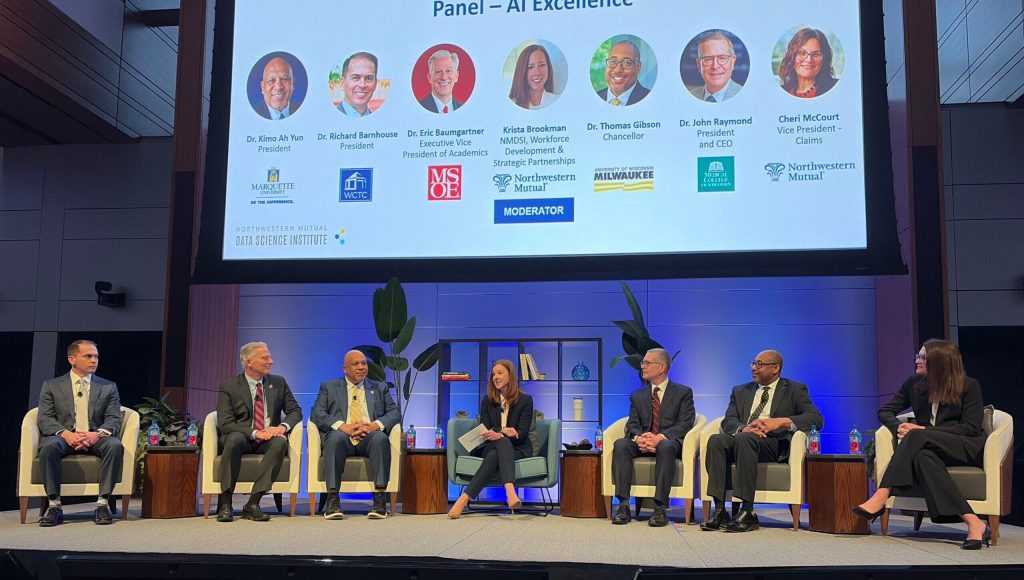
The leaders of Milwaukee’s five institutions of higher education convened on February 12, 2026, at Northwestern Mutual’s headquarters to discuss a collaborative initiative aimed at establishing the region as a national leader in artificial intelligence (AI) and data science. The meeting included the chancellors and presidents of the University of Wisconsin-Milwaukee, Marquette University, the Medical College of Wisconsin, Milwaukee School of Engineering, and Waukesha County Technical College.
“We’ve got to do it well, we’ve got to do it correctly and we’ve got to do it ethically,” emphasized Rich Barnhouse, president of WCTC. He underscored the necessity of adapting to the rapid pace of technological change, stating that keeping pace with AI advancements is crucial for maintaining competitiveness in an increasingly global economy. “Our competition as colleges and universities is really not with other colleges and universities in the United States. It’s with the Chinese and companies outside of this region,” he remarked.
Since its inception in 2018, the Northwestern Mutual Data Science Institute, a collaboration among Northwestern Mutual, Marquette, and UW-Milwaukee, has made significant strides. It has raised over $2 million in annual university research funding, collaborated with 160 faculty members, and helped launch 11 academic programs. Timothy Gerend, CEO of Northwestern Mutual, noted that the institute has awarded more than $275,000 to support 90 semester-long projects at the involved universities.
At the recent meeting, Gerend announced that MSOE, WCTC, and the Medical College would join the initiative, expanding the collaborative effort to encompass all five institutions. This partnership is designed to enhance the universities’ capabilities in data science and AI, while also providing Northwestern Mutual with access to a larger talent pipeline. Currently, the company recruits approximately a quarter of its employees and about 60 percent of its data workforce from the existing institute.
Wisconsin Governor Tony Evers addressed the gathering of about 400 attendees via a video message, highlighting AI’s potential impact on the workforce. “I’ve always believed that we don’t have to choose between creating jobs and economic development and protecting our environment,” Evers stated. He added that the expanding partnerships at the Northwestern Mutual Data Science Institute are essential for fostering both economic growth and environmental stewardship.
The education leaders reiterated the importance of collaboration in navigating the ethical complexities and rapid evolution of AI technology. Thomas Gibson, Chancellor of UW-Milwaukee, expressed concerns about the implications of this rapid change on curriculum development and institutional practices. “What really worries me is the pace of change and its implications on curriculum, our ability to keep pace and its implications on our technologies and related tools and our institutional practices and culture,” he said. “How are we preparing our institution’s culture for this rapidly changing technology?”
As the conversation surrounding AI continues to evolve, the consortium of Milwaukee’s colleges and universities aims to position the region as a hub for innovation in technology and education. Their commitment to ethical practices and collaborative learning is poised to play a significant role in shaping the future landscape of AI in the Midwest.
See also MagicSchool Shelves AI Chatbot Raina Amid Parental Protests Over Student Safety Concerns
 Bharat Bodhan AI Conclave 2026 Unites 3,100 to Advance AI in Education Ecosystem
 Ex-Google AI Leader Warns Law, Medical Degrees May Lose Value Amid Rapid AI Advances
 K-12 Schools Face AI Policy Vacuum Amid Rapid Generative AI Adoption and Ethical Concerns
 California Universities See 6% Drop in CS Enrollment Amid AI Program Surge