






















































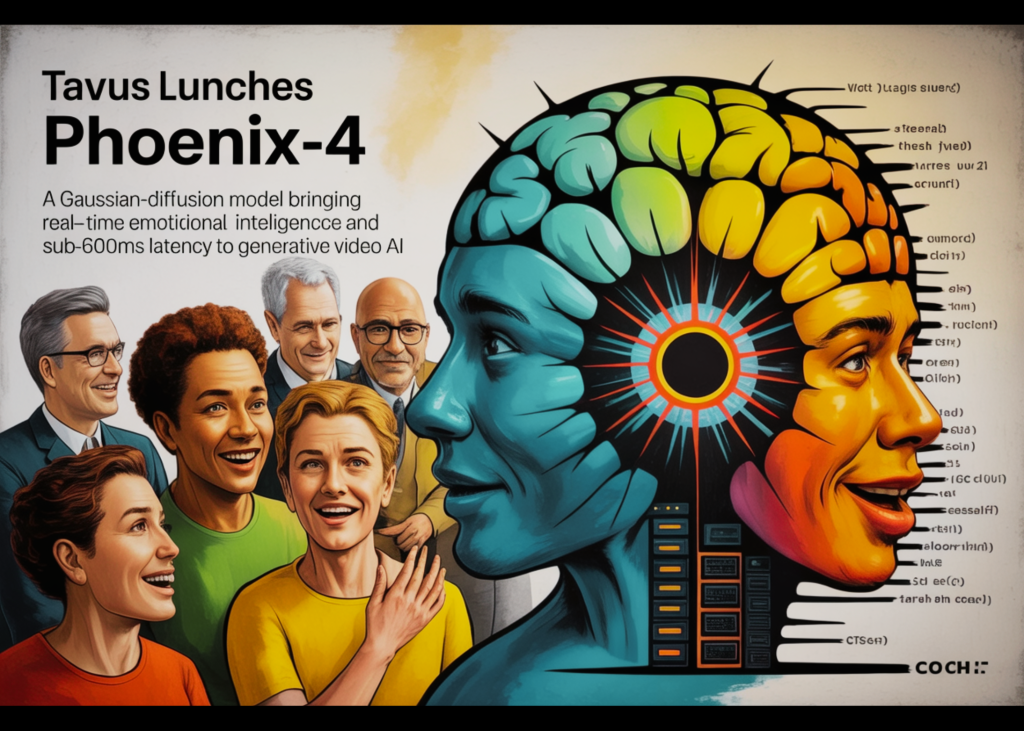
The launch of Tavus’ new generative AI model, Phoenix-4, marks a significant advancement in the field of conversational video interfaces (CVI). This innovative technology aims to overcome the “uncanny valley” effect that has plagued AI avatars, which often struggle with stiff movements and lack genuine emotional context. By enabling dynamic, real-time human rendering, Phoenix-4 seeks to create digital humans that not only speak but also perceive and respond with emotional intelligence.
Central to Phoenix-4’s capabilities is its unique three-part architecture, which is crucial for developers aspiring to construct interactive agents. The first component, Raven-1, serves as the system’s ‘eyes and ears,’ analyzing users’ facial expressions and tone of voice to gauge emotional context. The second, Sparrow-1, manages conversational timing, deciding when the AI should speak or pause, thereby ensuring a natural dialogue flow. Finally, Phoenix-4 acts as the core rendering engine, utilizing a Gaussian-diffusion model to synthesize photorealistic video in real-time.
One of the standout features of Phoenix-4 is its ability to generate high-fidelity, photorealistic facial movements, solving the challenges of spatial consistency. Unlike traditional GAN-based approaches, this model adeptly calculates complex facial movements and micro-expressions, enhancing the realism of digital interactions. It is capable of streaming at a rate of 30 frames per second, crucial for maintaining the illusion of life in a digital conversation.
Another critical aspect of Phoenix-4 is its remarkably low latency. The system achieves an end-to-end conversational latency of sub-600ms, a feat made possible through a ‘stream-first’ architecture that utilizes WebRTC to transmit video data directly to users’ browsers. Instead of generating a complete video file before playback, Phoenix-4 renders and sends video packets incrementally, minimizing the time to first frame and enhancing the overall user experience.
Phoenix-4 also introduces the innovative Emotion Control API, allowing developers to programmatically define the emotional states of their digital personas during interactions. By specifying an emotion parameter, developers can trigger specific behavioral outputs, including primary emotional states such as joy, sadness, anger, and surprise. This capability enables the model to modify facial geometry to reflect genuine emotional expressions, thereby enhancing the realism of interactions.
Building a digital twin, or “Replica,” with Phoenix-4 is a straightforward process. Developers need only two minutes of video footage to train a unique digital identity. Once trained, this Replica can be deployed through the Tavus CVI SDK in a few simple steps, ensuring a rapid development cycle.
The emergence of Phoenix-4 signals a pivotal moment in the generative video landscape, addressing long-standing challenges of realism and emotional engagement in AI-driven interactions. The combination of advanced rendering techniques and low-latency response times positions Tavus at the forefront of a technology that aims to redefine user experience in digital conversations.
As the demand for more lifelike digital interactions continues to grow, Phoenix-4 could set new standards in the field of conversational AI, making it a significant player in advancing human-computer interaction. Industry observers will be keen to see how this technology evolves and impacts various sectors, from customer service to digital entertainment.
See also Top 10 AI Image Generators of 2026: Tools for Stunning Visuals Unveiled
 Google Launches Lyria 3 in Gemini App for AI Music Creation from Text and Images
 Army Integrates AI in Doctrine Development, Acknowledges Technology’s Critical Flaws
 Oklahoma House Bill 3299 Advances, Aims to Regulate Deepfake Use and AI Protections
 Nandan Nilekani Highlights AI Diffusion as Key to India’s Digital Infrastructure Success






