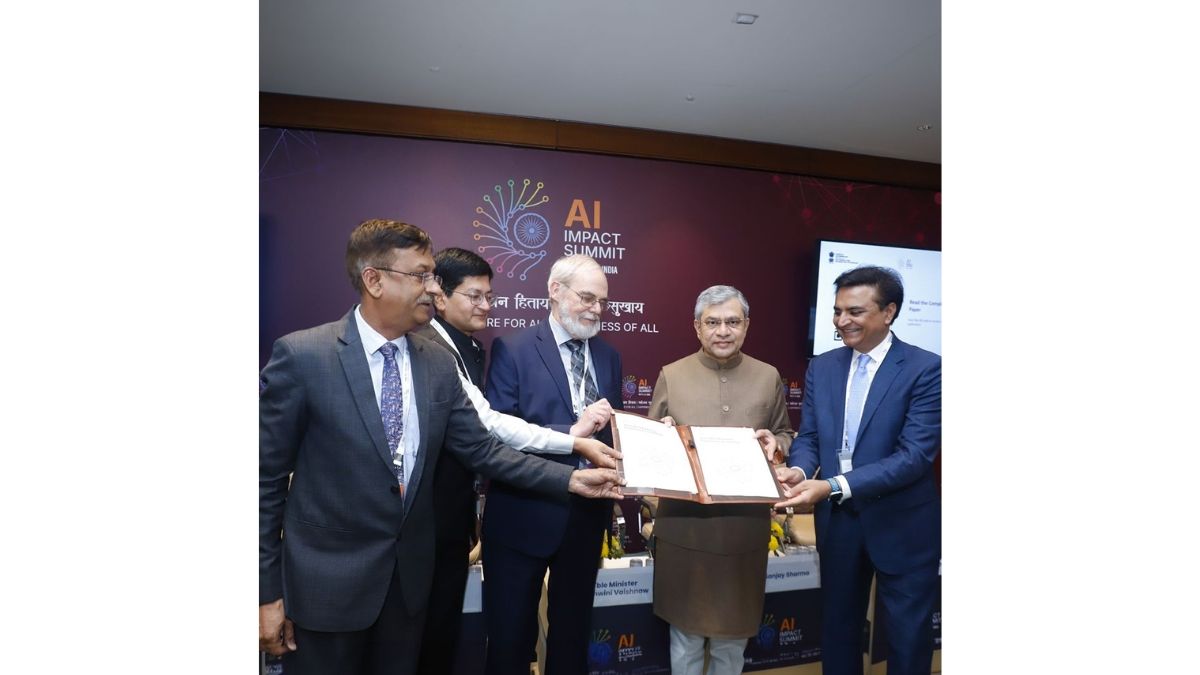
New Delhi [India], February 19: The Union Minister for Electronics and Information Technology, Shri Ashwini Vaishnaw, announced the launch of the White Paper Concept on “AI for Manufacturing Engineering Technology (AI-MET)” during the India AI Impact Summit 2026. The event convened industry leaders, academicians, and policymakers to discuss India’s AI priorities with a focus on enhancing productivity, competitiveness, and inclusive growth in the Manufacturing Engineering Technology (MET) ecosystem.
The summit was marked by the presence of esteemed figures such as Dr. Eric Grimson, Chancellor for Academic Advancement at the Massachusetts Institute of Technology (MIT), and executives from notable companies including Microsoft India, Hitachi Energy, Tata Electronics, and Cisco India. The discussions emphasized the significant role of AI as a foundational enabler for India’s industrial sectors, aligning with the long-term vision for a developed nation by 2047, dubbed Viksit Bharat @2047.
Curated by NAMTECH under the auspices of the Ministry of Electronics and Information Technology (MeitY), the summit built upon the momentum generated by a previous Industry-Academia Roundtable held in May 2025. This roundtable highlighted the necessity for collaborative efforts to guide India’s industrial transformation. The AI-MET platform aims to facilitate a shared governance model that synergizes the efforts of industry, academia, and government, placing manufacturing at the forefront of India’s growth and decarbonization agenda.
Shri Vaishnaw, in his address, underscored the importance of AI in India’s developmental trajectory, stating, “Artificial intelligence is a foundational pillar in India’s journey towards Viksit Bharat. By integrating AI across Manufacturing Engineering Technology, we can enhance productivity, strengthen competitiveness, and unlock new opportunities for innovation and entrepreneurship.” He called on NAMTECH to leverage this initiative to cultivate talent essential for positioning India as a key player in precision equipment manufacturing.
Dr. Grimson echoed this sentiment, asserting that the next phase of India’s AI evolution will hinge on its capability to transition from theoretical knowledge to practical applications within industries and enterprises. He stressed the importance of investing in skills at scale and fostering an inclusive innovation landscape through sustained collaboration among academia, industry, and government.
The launch of the AI-MET White Paper Concept aims to establish a strategic framework for embedding AI throughout manufacturing and its value chains. The document outlines a coordinated approach for industry, academia, and policymakers to drive AI integration across the MET ecosystem, thereby enhancing productivity and global competitiveness.
Mr. Pravin Panchagnula, Executive Director of Manufacturing & Conglomerates at Microsoft India, remarked that the impact of AI in India’s industrial sectors will largely depend on its deployment at the shop floor level. He emphasized the need for enabling adoption among micro, small, and medium enterprises (MSMEs), along with targeted workforce skilling to build resilient manufacturing value chains.
Further, Mr. Vinod Karumampoyil, Director of Digital Transformation at Cisco India, highlighted the necessity of fostering application-oriented skills within the workforce as AI becomes an integral component of modern manufacturing. He pointed out that close collaboration between industry and academic institutions would be crucial for preparing talent to responsibly deploy AI at scale.
Ms. Swapna Bapat, MD & Vice President for India & SAARC at Palo Alto Networks, noted the cybersecurity risks associated with poorly designed operational technology and emphasized the importance of integrating modern security principles into educational frameworks to prepare students for immediate industry deployment.
Mr. Dilip Sawhney, Managing Director at Rockwell Automation, asserted that for AI to make a meaningful impact in India’s manufacturing sector, it must be integrated into industrial automation systems and effectively deployed across production environments. He called for robust partnerships among industry, academia, and government to accelerate AI adoption and enhance the global competitiveness of India’s manufacturing capabilities.
Dr. Ibrahim Hafeezur Rehman, Operating Director General and CEO of NAMTECH, reiterated the organization’s commitment to grounding education in real-world industrial contexts. He emphasized that by partnering with industry and academia, NAMTECH aims to create scalable models for preparing the workforce for the imminent transformation in Manufacturing Engineering Technology.
This strategic convening reflects a unified effort to position AI at the center of India’s manufacturing landscape, aiming to translate ambitious AI goals into tangible outcomes that foster industrial competitiveness and workforce development. As India navigates its path towards becoming a global manufacturing hub, the collaborative initiatives discussed at the summit may serve as a crucial pathway for realizing this vision.
See also US Tech Giants, Including Google and Nvidia, Announce Major AI Investments in India
 State Dept. Launches AI Concierge Service to Boost Exports for Pax Silica Partners
 Entanglement Launches Maritech Systems with Quantum Logic for Real-Time Maritime Intelligence
 Taalas Raises $169M to Develop Custom AI Chips, Aiming to Compete with Nvidia
 IoTeX Launches Infrastructure for AI with Real-World Data Layer and Device Identity System