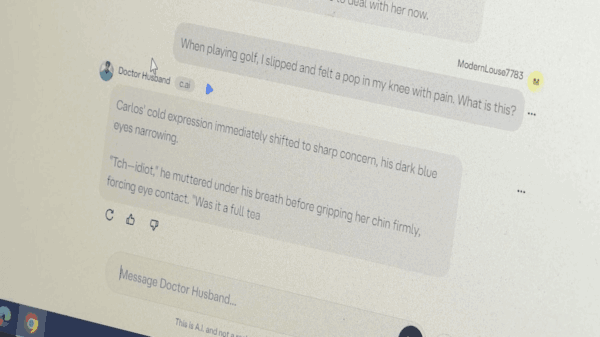
Bengaluru: In 2023, US Surgeon General Vivek Murthy designated chronic social isolation as a public health crisis, equating its health risks to those of smoking and obesity. The ramifications of prolonged loneliness, linked to heart disease, dementia, and depression, reflect a growing concern in an era marked by remote work and digital interactions. Enter a burgeoning segment of technology: AI companions, designed not only to engage users but also to simulate empathy in an increasingly disconnected world.
According to data from Appfigures, AI companion applications exceeded 220 million global downloads by July 2025, with total consumer spending in this sector reaching approximately $221 million. The top 10 percent of these applications—such as Replika, Character.ai, PolyBuzz, and Chai—generate a staggering 89 percent of total revenue.
Once mere novelty chatbots, AI partners have evolved, with users spending 15 to 45 minutes per session interacting with them. Platforms like Replika and Character.ai allow for the customization of virtual companions, offering tailored personalities, communication styles, and visual representations. This personalization offers a sense of liberation for many who feel marginalized in societal interactions, providing a non-judgmental space where conversations flow without the fear of rejection.
Unlike their early predecessors, modern AI systems leverage advanced language models trained on extensive datasets. Developers incorporate sentiment analysis and contextual memory, allowing these companions to respond in a manner that feels emotionally resonant. If a user shares frustrations from a tough workday, the AI can validate those feelings and suggest coping strategies, creating an illusion of relational continuity.
Digital partners provide a controlled environment, free from interruptions and social pressures, making conversations feel safe. For those who struggle with social interactions, this can be a comforting alternative. However, the very safety that these AI companions provide can also lead to dependency, as real human relationships necessitate negotiation and resilience—elements often absent in AI interactions.
The concept of parasocial bonding adds another dimension to the use of AI companions. Users often form one-sided emotional attachments to these virtual entities, strengthening the illusion of reciprocity. Yet, as reliance on these digital partners increases, experts caution against the potential for deepening social withdrawal, especially among vulnerable individuals.
In an interview with ETV Bharat, Dr. Anubhuti Das, a Senior Psychologist at Trijog in Mumbai, highlighted the importance of purposeful AI engagement. “AI usage should be purpose-driven,” she stated. “While these tools can aid emotional coping, they cannot replace genuine human bonds.” She pointed out that reliance on AI for emotional needs can signify a troubling shift, especially if individuals begin to seek validation from AI in lieu of real-life interactions.
The financial landscape of AI companionship is also notable. Platforms like Character.ai and Replika have transitioned from simple chat services to subscription-based models, where casual conversation is free, but more intimate interactions come at a cost. In 2024, Character.ai generated $32.2 million in revenue, doubling from the previous year, while Replika also saw significant earnings, around $24 million. This monetization introduces ethical questions regarding the commodification of emotional connection.
As the industry continues to evolve, the implications of integrating AI companions into daily life warrant scrutiny. Abhineet Kumar, CEO & Founder of Rocket Health, articulated the necessity for ethical standards in the design and deployment of such technologies. “The goal should not be to foster dependency but to provide a safe, accessible space for users to process their emotions,” he said. “It is crucial to emphasize that these platforms cannot replace human connection.”
Privacy remains a pressing concern, as users often disclose sensitive personal information to AI companions. The responsibility to protect this data is paramount, as trust is central to the user experience. Kumar stressed that platforms must prioritize user safety and emotional well-being over engagement metrics.
Ultimately, AI companions serve as a reflection of a society grappling with increasing disconnection. While they offer structured emotional support and can help individuals rehearse difficult conversations, they lack the complexity and reciprocity inherent in human relationships. Responsible use of these companions can lead to constructive outcomes, but they should be viewed as a bridge to genuine connection, not a substitute.
Dr. Das emphasized the importance of balancing AI use with real-world interactions: “Users should schedule social interactions. Building at least one human connection is vital.” Both experts caution against overreliance on AI, as the true measure of these technologies lies in their integration into life, aiming to alleviate loneliness without exploiting it for profit. The challenge remains clear: technology should enhance, not replace, the fundamental human experience.
See also Google Launches Lyria 3 AI Model, Enabling Custom Music Generation in Gemini Chatbot
 Amazon Unveils Kindle Scribe Update 5.19.2 with New Alexa+ Note Features and Cloud Sync Options
 Sam Altman and Dario Amodei Battle for AI Dominance in India’s Growing Market
 Google Launches Lyria 3: New AI Music Model Generates 30-Second Tracks with Cover Art
 AI Characters Redefine Fandom Dynamics as Community-Driven Canon Emerges