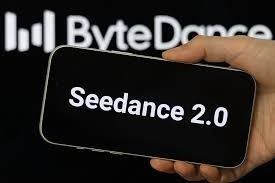
A new artificial intelligence (AI) model from the Chinese tech giant ByteDance, the company behind TikTok, is making waves in Hollywood, not just for its capabilities but for its far-reaching implications in creative industries. As reported by AzerNEWS, citing the BBC, the AI, Seedance 2.0, can generate cinema-quality videos, complete with dialogue and sound effects, from minimal written prompts. Clips created with Seedance, featuring popular characters like Spider-Man and Deadpool, have gone viral online.
Major studios, including Disney and Paramount, quickly accused ByteDance of copyright infringement. However, experts caution that the ramifications extend well beyond legal concerns, highlighting a transformative shift in how content can be produced.
Seedance was initially launched in June 2025, but its second version, released eight months later, has garnered significant global attention. “For the first time, I’m not thinking that this looks good for AI. It looks like a real production pipeline,” says Jan-Willem Blom from creative studio Videostate. Unlike Western AI video tools, Seedance integrates text, visuals, and audio within a single system. While platforms like MidJourney and OpenAI’s Sora can generate videos from prompts, Seedance stands out by producing high-quality clips from minimal input—sometimes a single sentence.
AI ethics researcher Margaret Mitchell remarks, “It’s impressive because it integrates text, visuals, and audio in a single system, producing results that feel like a real film.” Seedance has even been tested by generating videos of Will Smith eating spaghetti—complete with a spaghetti monster scene—and the results resemble big-budget productions. David Kwok, head of Singapore-based Tiny Island Productions, describes it as “like having a cinematographer specializing in action films assisting you.”
Despite its potential, Seedance has sparked concerns over copyright and ethical use. AI companies are increasingly developing powerful tools without compensating for the data used in their training. Disney and Paramount have issued cease-and-desist letters demanding that Seedance cease using their copyrighted characters. Furthermore, Japan is investigating ByteDance over videos featuring popular anime characters. ByteDance has stated that it is “strengthening current safeguards,” but copyright disputes are not unique to the company. In 2023, the New York Times sued OpenAI and Microsoft for using its articles without permission, while Reddit filed a similar claim against Perplexity.
Experts emphasize the need for clearly labeled content, licensing mechanisms, and public trust. As Mitchell explains, “Labeling content to prevent deception is more important than cooler-looking videos.” Disney, for example, struck a $1 billion deal with OpenAI’s Sora to legally use characters from Star Wars, Pixar, and Marvel.
Notably, despite these legal challenges, small studios view Seedance as a game-changer. Kwok asserts that AI of this quality allows companies to create films that would otherwise be economically unfeasible. Asia’s short-form videos and micro-dramas, typically produced on budgets of around $140,000 for 80 episodes under two minutes, have generally focused on romance or family drama to minimize visual effects costs. With AI, these low-budget productions can now delve into genres like sci-fi, period drama, and action.
“Seedance elevates what was once financially impossible for small studios, enabling ambitious storytelling at a fraction of the cost,” Kwok adds. As AI video tools like Seedance continue to advance, the creative industry stands at a crucial crossroads: balancing innovation and accessibility with copyright protections in a rapidly evolving landscape.
See also AI Enhances Qualitative Research: Human and LLM Analyses Yield Similar Insights
 Agentic AI Enhances Deep Learning Workflows, Automates Hyperparameter Tuning
 AI Scientists Surge: Autoscience Institute’s Carl Achieves 75% Conference Acceptance Rate
 Swansea University Joins Google DeepMind AI Programme for Disadvantaged Students
 Self-Proving AI Models Enhance Accuracy with Verifiable Outputs via Interactive Proofs