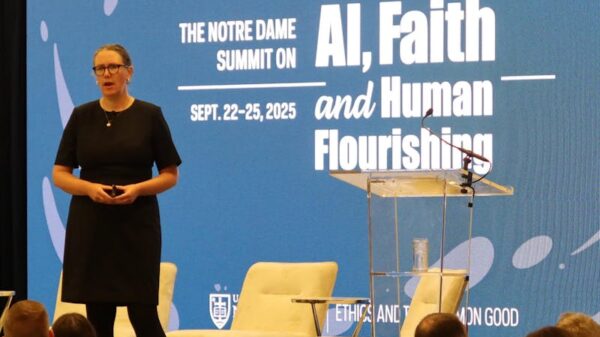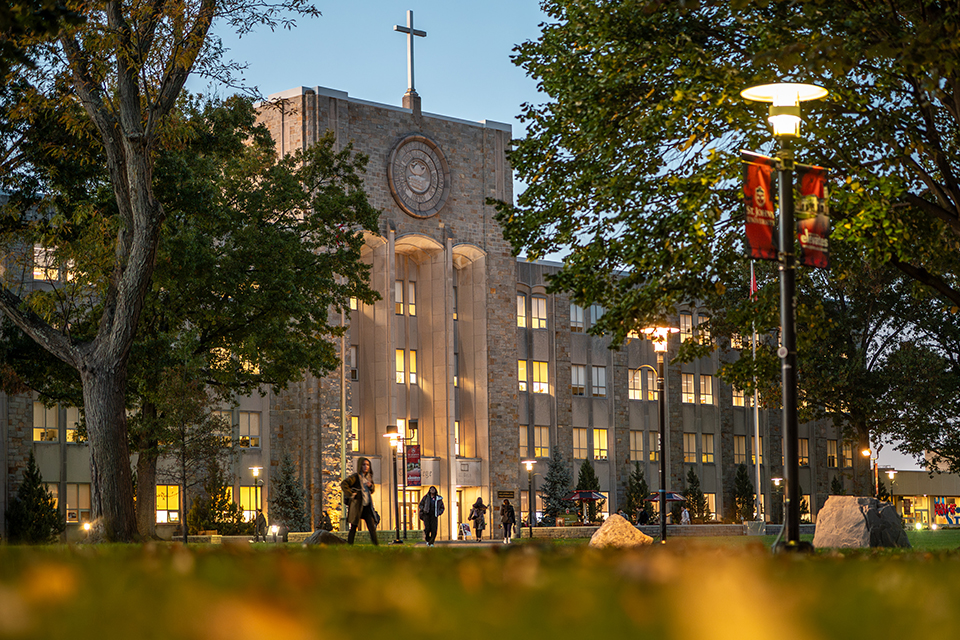
In a thought-provoking lecture on November 17, 2025, Joseph M. Vukov, Ph.D., Associate Professor of Philosophy at Loyola University Chicago, emphasized the need for a renewed defense of human dignity in the age of artificial intelligence (AI). Speaking as part of the 2025–26 Vincentian Chair of Social Justice Lecture Series at St. John’s University in Queens, NY, Vukov argued that while the first Industrial Revolution forced the Church to confront workers’ dignity, the current AI revolution demands a more profound engagement with the essence of humanity.
Dr. Vukov, a prominent voice at the intersection of AI, ethics, and Catholic thought, aims to dispel the misconception that the Catholic tradition is inherently anti-technological. “Catholic intellectual tradition is not, nor ever has been, antitechnological,” he stated, citing the advanced architectural feats of cathedrals as historical examples of the Church embracing technology. He pointed out that the Church has always regarded scientific advancement as part of humanity’s collaboration with God in enhancing creation.
Highlighting the leadership of Pope Leo XIV in navigating the implications of AI, Vukov reflected on how the Church’s historical engagement with technology can inform its approach to contemporary challenges. “The Church encourages the advancement of science and technology,” he said, underlining the ongoing relevance of the Catholic tradition in discussions about AI.
Vukov further elucidated that AI is fundamentally a tool, one that embodies human biases and limitations. “When our ancestors sharpened flint stones to make knives,” he explained, “they used them both to cut hides for clothing and to kill each other.” He stressed that while AI does not replicate human intelligence, its biases do not necessarily preclude its use in society. “Do the limitations of AI mean that it’s a tool that we simply can’t use? I don’t think so,” he concluded.
In the context of higher education, Vukov acknowledged the ongoing integration of AI and digital tools, noting that some applications may enhance educational experiences. However, he warned that the current trajectory often prioritizes efficiency and profit over human dignity. “The problem comes in when our value alignment gets off,” he cautioned, stressing the necessity for ethical guidelines to shape AI’s role in crucial sectors such as medicine and education.
Vukov also addressed the social justice implications of AI, highlighting disparities in access and distribution of these technologies. “AI tools are inevitably distributed unequally, and in ways that often are unjust,” he said, urging a preferential option for the poor in both personal and political decisions regarding technology use. “We have moved forward with AI integration without really giving an option at all to the vulnerable,” he added.
Student reactions to Dr. Vukov’s insights were overwhelmingly positive. Doctoral candidate Miriam E. Prever noted the timeliness of the lecture, emphasizing the importance of exploring how AI alters perceptions of humanity. Similarly, Matthew E. Sroczynski, a research assistant focused on AI within homeland security, appreciated the discussion on the environmental costs of AI technology.
Dr. Vukov concluded that the Catholic intellectual tradition provides valuable frameworks for addressing the ethical dilemmas posed by AI. “We need to confront this era with both cultural and spiritual responses,” he asserted, proposing that the Church’s teachings can offer guidance not only to Catholics but to broader society as well.
Rev. Patrick J. Griffin, C.M. ’13HON, Executive Director of the Vincentian Center for Church and Society, praised Dr. Vukov’s lecture as a “tour de force,” highlighting his articulation of key questions regarding AI’s relationship to human dignity as understood in faith-based traditions. Vukov’s insights could serve as a foundation for further reflection as society grapples with the implications of AI technology.
In addition to these discussions on AI, the lecture series also celebrated Lucy A. Pesce, Executive Director for Mission Initiatives at St. John’s University, who received the Dax Champion Award from Depaul USA for her leadership and commitment to uplifting individuals experiencing homelessness.
The integration of AI in contemporary society presents both opportunities and ethical challenges, and discussions from events like Dr. Vukov’s lecture are crucial in shaping a just and humane response to the rapid technological changes ahead.
See also Cross-Border Counsel Krish Thakker Transforms Compliance Amid Global AI Regulatory Chaos
 AWS Launches Autonomous AI Agents and Nova Sonic for Enhanced Customer Interactions
 AI Trade Wars Intensify: Semiconductors and Data Sovereignty Redefine Global Power Dynamics
 Affordable AI Sparks Investment Surge in Emerging Markets, Revolutionizing Startups and Education
 University Leaders Push for AI Safeguards to Protect College Students Amid Rising Misuse Risks