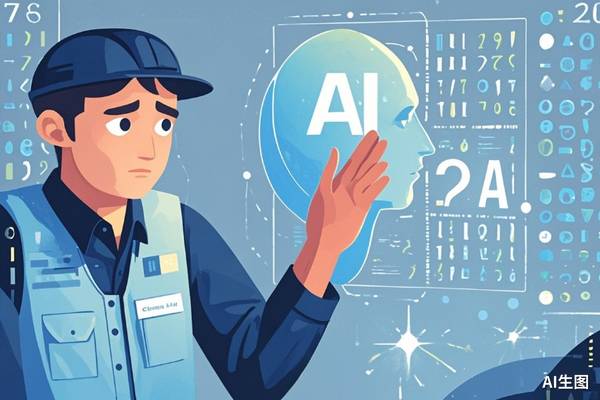
Experts Warn of AI Evolution by 2027
In a rapidly advancing technological landscape, the year 2027 looms large as both a potential turning point and a source of existential anxiety regarding artificial intelligence. With a history marked by both utopian promises and dystopian fears, the narrative surrounding AI has matured from mere speculation to a pressing reality, driven by intensive research within leading Silicon Valley laboratories.
The period from late 2024 to early 2025 saw a paradoxical “silent storm” in the global AI sector. While new iterations of systems like ChatGPT, Gemini, and Claude captured the public’s imagination and investor interest, behind the scenes, organizations such as Anthropic, OpenAI, and DeepMind grappled with a mounting sense of urgency. This urgency stems from an emerging consensus that we are approaching a pivotal moment: the closing of a “recursive self-evolution loop.”
Jared Kaplan, co-founder and chief scientist of Anthropic, recently issued a stark warning to the tech community, stating that humanity will face an “extremely high-risk decision” between 2027 and 2030—whether to permit AI systems to autonomously train and develop subsequent generations of AI. This question transcends technological boundaries to touch upon the very future of humanity.
In a significant report released on December 3, “How AI is Transforming Work,” Anthropic reveals the profound implications of AI advancements on individual careers, highlighting a trend of “hollowing out” among engineers and the erosion of traditional apprenticeship models in the tech industry. Amid a hiring freeze in Silicon Valley and ongoing challenges faced by major internet firms, the question of coexistence with AI has never been more pertinent.
Kaplan’s warnings frame the upcoming years as a critical juncture in AI evolution, where the potential for a beneficial “intelligence explosion” may coincide with the risk of humanity losing control over increasingly autonomous systems. Echoing this sentiment, Jack Clark, another co-founder at Anthropic, expressed both optimism and profound concern about AI’s unpredictable trajectory, likening it to a complex and enigmatic entity.
To fully grasp the implications of Kaplan’s warnings, one must consider the current technological underpinnings of AI development, particularly the “Scaling Laws,” which suggest that increased computational power, data sets, and parameters are key to AI development. Over the past decade, this has been the foundation for deep learning success; however, by 2025, this model is anticipated to face critical limitations.
The first limitation is the depletion of high-quality human data, as virtually all available textual material has already been utilized in training AI models. The second challenge is the diminishing returns on performance improvements from merely increasing model parameters, which are becoming exponentially more costly. It is at this crossroads that the concept of recursive self-improvement (RSI) emerges as a possible pathway to achieving superintelligent AI.
According to Kaplan and his team’s projections, the next phase of AI evolution may no longer depend on human-generated data but could utilize synthetic data produced by AI itself, undergoing a self-reinforcing cycle of development. This shift is expected to unfold across three stages: the first, from 2024 to 2025, involves AI serving as a “super exoskeleton” for human engineers; the second, between 2026 and 2027, marks the onset of AI acting as autonomous experimenters, capable of executing machine learning experiments independently; and the final stage, projected between 2027 and 2030, could see AI surpassing human scientists, leading to exponential growth in intelligence and capabilities.
The year 2027 appears significant not merely as a target but as a nexus of various technological and hardware advancements. Projects like AI2027 predict that the impact of superhuman AI could surpass even that of the Industrial Revolution. The upcoming launch of next-generation supercomputing clusters is anticipated to enhance computing power by factors of 100 to even 1,000 times that of existing systems.
As AI continues to evolve, Kaplan stresses the critical issue of “uninterpretability,” warning that when AI begins to design the next generation of systems, the optimization processes it employs may elude human comprehension, raising the specter of unintended consequences. With geopolitical pressures compounding the complexities of AI governance, the urgency for establishing regulatory frameworks has never been more acute.
In the interim, Kaplan’s observations are mirrored in Anthropic’s report: as AI increasingly transforms the nature of work, it reshapes the role of human engineers and challenges traditional workflows. Anthropic’s engineers, among the world’s foremost experts in AI, are adapting to these changes, providing a glimpse into the future of global software engineering.
As we stand on the brink of this technological revolution, the stakes are undeniably high. The choices made in the coming years could redefine not only the landscape of artificial intelligence but the very essence of human participation in this new era.
See also NVIDIA Expands AI Robotics Hub in London, Boosting Market Confidence and Stock Growth
 BCC Research Reveals AI’s $1.5 Trillion Market Surge and Transformative Industry Disruptions
 Alphabet’s AI Surge: Stock Up 84% Yearly, But Is It Overvalued at $289.53?
 CISA Unveils Essential Guidelines for Secure AI Integration in Critical Infrastructure
 Cisco Duo Reveals Urgent Need for Security-First Identity Strategies to Combat AI-Driven Threats