
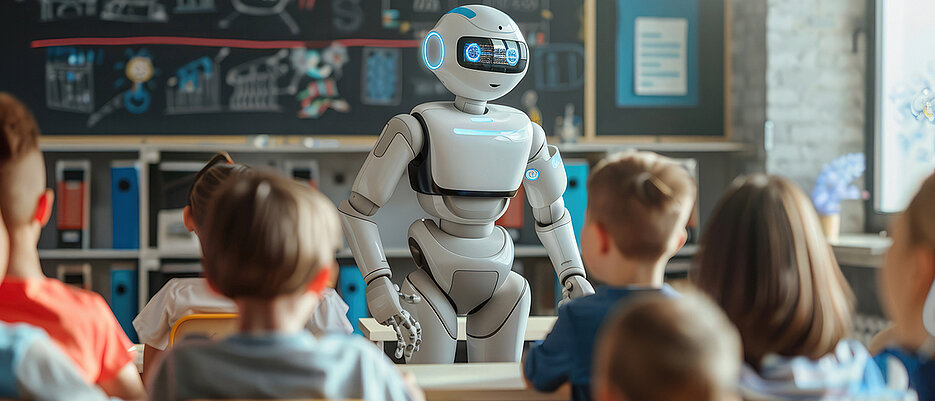
A recent study from the University of Würzburg’s Chair of Mathematics Education highlights a troubling trend in AI research for STEM education: an excessive focus on technology at the expense of students’ holistic development. The research, led by Professor Hans-Stefan Siller and his assistant Alissa Fock, systematically reviewed existing literature to evaluate how generative artificial intelligence (AI), such as ChatGPT, can enhance education in science, technology, engineering, and mathematics (STEM). Their findings were published in the International Journal of STEM Education.
The study emphasizes the importance of “human flourishing” as a benchmark for effective education. This concept goes beyond mere cognitive performance, aiming to foster young people’s potential to lead self-determined, meaningful lives and contribute positively to society. However, the analysis reveals significant gaps in current research, primarily centered on technological capabilities rather than the needs of learners and educators.
Evaluating 183 scientific publications, the study found that much of the existing research is predominantly technology-focused. “Instead of examining the impact of AI on learners and teachers, most studies focus on the systems themselves,” Fock noted. Approximately 35 percent of the research centers on AI performance, while 22 percent is dedicated to developing new AI tools. Alarmingly, in nearly half of the 139 empirical studies reviewed, researchers evaluated only AI-generated content, neglecting its actual application and impact on students and teachers.
According to Siller, this technocentric approach risks sidelining essential educational needs, overshadowing the comprehensive goal of developing young people’s personalities. “This tunnel vision on technology leads to other central aspects of human development being neglected,” he explained.
The study also uncovered critical gaps in research that are vital for a holistic educational approach. For instance, while cognitive skills receive significant attention, non-cognitive aspects—such as motivation, self-confidence, critical thinking, and ethical judgment—are rarely investigated. Moreover, ethical issues surrounding AI, including bias in systems and data security, are largely overlooked, despite their relevance in contemporary educational settings. Additionally, research has a geographical imbalance, with 73 percent concentrated in the Global North, and 30 percent from the United States alone. This poses a risk of developing solutions that ignore the cultural diversity and varying educational contexts of other regions.
The authors assert that research on AI in education must refocus on human needs. They suggest that rather than simply inquiring what is technologically feasible, it is crucial to ask what students need to find meaning and agency in an AI-driven world.
As a constructive response, Siller and Fock propose a collaborative model where teachers and AI work together. In this framework, educators can utilize AI to handle time-consuming tasks, such as generating exercises or drafting lesson plans. Nevertheless, the critical role of teachers remains essential. They must carefully review the AI-generated content for accuracy, bias, and pedagogical relevance, enhancing it with their expertise and real-world experience.
This collaborative approach can alleviate teachers’ workloads while maintaining their autonomy and the significance of their roles, ensuring that educational responsibility stays with humans. To unlock the long-term potential of AI in education, further research is necessary that consistently prioritizes the holistic development of students.
The study is titled “Generative artificial intelligence in secondary STEM education in the light of Human Flourishing: a scoping literature review,” authored by Alissa Fock and Hans-Stefan Siller, and can be found in the International Journal of STEM Education at this link.
See also AI Use in UK Law Education Surges 88% for Assessments, Raising Competence Concerns
 K-12 Leaders Must Make 5 Key Moves to Effectively Integrate AI in Schools
 OpenAI Launches Australia’s First Sovereign AI Program with NEXTDC to Boost Local Infrastructure