






















































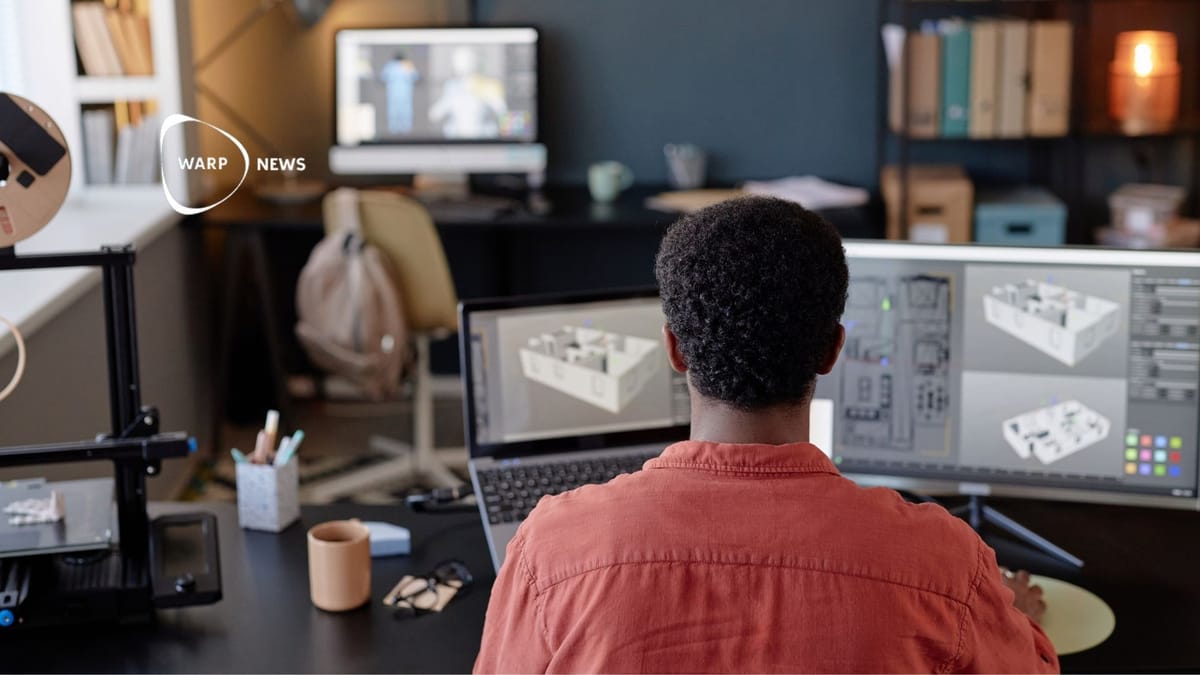
MIT Develops AI Agent to Revolutionize CAD Modeling
Researchers at the Massachusetts Institute of Technology (MIT) have developed an innovative AI agent capable of transforming rough hand-drawn sketches into fully realized, CAD-ready 3D models in mere seconds. This breakthrough technology addresses the steep learning curve associated with traditional Computer-Aided Design (CAD) software, which often requires extensive training for proficient use.
The AI system is designed to understand visual cues and engineering principles, allowing it to iterate, troubleshoot, and refine designs rapidly. According to the researchers, this advancement democratizes access to professional-grade 3D modeling, enabling individuals without formal engineering training to create complex designs efficiently.
To train the AI, the MIT team compiled a dataset known as VideoCAD, featuring over 41,000 video examples demonstrating how various 3D models are constructed using CAD software. This dataset provides a rich resource from which the AI learns to mimic the actions of human users by interpreting high-level design commands, such as “sketch line” and “extrude,” and executing them through precise mouse clicks and movements.
When presented with a hand-drawn sketch, the AI quickly initiates the relevant commands within CAD software, effectively functioning as a human would. The project aims to create an AI-driven CAD copilot that not only generates 3D models from scratch but also assists users by suggesting design modifications and automating repetitive tasks that typically consume significant time.
Indeed, the researchers suggest that there is substantial potential for AI to enhance engineer productivity while making CAD tools more accessible to a wider audience. By lowering the barriers to entry for design, this technology could facilitate more innovative contributions from those who may have previously been intimidated by the complexity of traditional CAD software.
Building upon prior advancements in AI-driven user interface agents, the MIT team explored whether similar technologies could be adapted for use in CAD environments, which demand a higher level of complexity due to their multifaceted features. The researchers first developed a model based on existing datasets of human-designed CAD objects, capturing not only the design commands but also the specific user interface actions—such as mouse clicks and drags—needed to execute each command successfully.
The newly trained AI model can construct 3D shapes from simple brackets to elaborate house designs by interpreting the precise sequence of actions a human engineer would take. Senior researcher Mehdi Ataei from Autodesk Research remarked that VideoCAD represents a significant step toward creating AI assistants capable of onboarding new users and streamlining repetitive modeling tasks that follow established patterns.
As the project progresses, the team plans to present its findings at the upcoming Conference on Neural Information Processing Systems (NeurIPS) in December, showcasing the potential of AI to revolutionize the design process in the engineering domain. With such advances, the future of CAD may be transformed, fostering a new wave of creativity and efficiency in product design.
For more on the ongoing developments in AI and CAD technologies, visit MIT and Autodesk.
See also Google’s AI Generates Misleading Headlines, Confusing Users on Google Discover
 Nvidia’s Huang Predicts Gradual AI Job Shift, Envisions Robot Apparel Industry Rise
 Discover Top AI Tools for 2026: Perplexity, Gemini 3 Pro, DeepSeek 3.2 Transform Workflows
 Getty Wins UK Trademark Case Against Stability AI, Clarifying AI’s IP Responsibilities
 AI’s Environmental Impact Smaller Than Anticipated, May Propel Green Tech Advances















