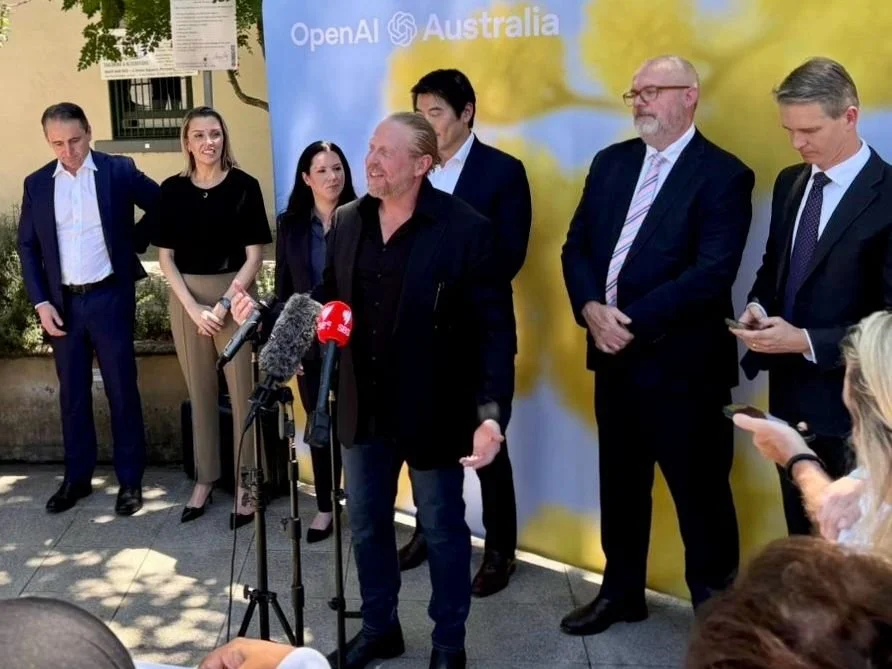
NEXTDC CEO and Managing Director Craig Scroggie announced the formal launch of OpenAI for Australia via LinkedIn, marking it as the first country-level OpenAI initiative in the Asia Pacific region. The Australian data center and digital infrastructure provider has entered into a partnership with OpenAI to develop a hyperscale AI facility at the company’s S7 site in Eastern Creek, Sydney. Scroggie stated that this initiative is a key move towards enhancing Australia’s sovereign compute capability, particularly as the demand for high-performance AI infrastructure surges across various sectors.
OpenAI’s accompanying blog highlighted that the initiative aims to enable Australia to capture the economic and workforce benefits of AI, while simultaneously bolstering national security, industry innovation, and long-term productivity. The project is a collaborative effort involving federal and state government partners, major employers, and segments of the country’s startup ecosystem. Scroggie remarked, “Today marks a major step forward in Australia’s sovereign AI capability,” describing the announcement as the beginning of a multi-year endeavor involving government, industry, and technology partners.
Under the agreement, NEXTDC and OpenAI plan to develop a next-generation hyperscale AI campus, where OpenAI is expected to be the initial offtaker in line with the OpenAI for Countries model. The facility is set to feature a large-scale GPU supercluster designed to cater to sensitive and mission-critical workloads across government, enterprise, research, and national infrastructure. This setup is intended to empower Australia to host and manage its own AI computing resources rather than solely depending on international cloud services.
The S7 campus development remains contingent upon planning and regulatory approvals. NEXTDC has indicated that the facility will incorporate advanced features including closed-loop liquid cooling, zero drinking water usage, and renewable energy integration. Scroggie emphasized that the project is akin to digital infrastructure on the scale of national utilities, forecasting multi-year construction and long-term technical roles in engineering, manufacturing, and operations.
This focus on sovereign capability aligns with the Australian Government’s National AI Plan, which identifies challenges such as compute scarcity, cyber resilience, and domestic talent development. Scroggie articulated the urgency of this issue, stating, “The National AI Plan is clear. Australia’s next wave of growth is constrained by compute. Sovereign capability is now a strategic asset.”
The OpenAI for Australia initiative also incorporates a significant workforce development component through the OpenAI Academy, which aims to enhance AI literacy across the nation. The company plans to collaborate with three of Australia’s largest employers—Commonwealth Bank, Coles, and Wesfarmers—to create tailored training programs. CommBank will distribute AI learning modules to around one million small businesses, while Coles and Wesfarmers will provide AI skills training for their entire workforce.
OpenAI characterized this training initiative as one of the most extensive coordinated efforts for AI education in the country. The program seeks to address the growing divide between AI adoption and workforce readiness, responding to long-standing concerns about digital confidence, productivity, and access to training for small businesses. CommBank CEO Matt Comyn noted, “Small businesses are the backbone of Australia’s economy and the engine of our communities, but too many small business owners tell us they simply don’t have the time or confidence to explore how AI could help them.”
Additionally, OpenAI’s announcement includes plans to bolster Australia’s startup ecosystem, leveraging the country’s history of producing globally recognized technology companies. The initiative will engage venture capital firms such as Blackbird, Square Peg, and AirTree, providing selected startups with access to API credits, technical mentorship from OpenAI engineers, and workshops focused on scaling, compliance, and safety. Extra credits will be available for startups participating in technical deep-dive sessions.
A new annual Founder Day will also be launched in Australia, offering early-stage companies dedicated time to explore use cases with OpenAI specialists. This initiative is framed as a strategy to lower barriers for founders looking to develop AI-enabled products in a competitive global landscape.
As Australia seeks to enhance its sovereign AI capabilities, interest in building domestic infrastructure has gained momentum amid global competition for compute resources, talent, and AI-ready frameworks. The launch of OpenAI for Australia formalizes a partnership model that positions the nation as an early adopter of OpenAI’s international strategy while addressing industry and government calls for expanded domestic AI capacity. OpenAI CEO Sam Altman remarked, “Australia is well placed to be a global leader in AI, with deep technical talent, strong institutions and a clear ambition to use new technology to lift productivity. Through OpenAI for Australia, we are focused on accelerating the infrastructure, workforce skills and local ecosystem needed to turn that opportunity into long-term economic growth.”
See also Anthropic Reveals AI Workforce Trends from 1,250 Professionals in New Study
 Nova Era Labs Launches 450+ Cloud-Based AI Labs to Bridge Skills Gap in Education
 Schools Embrace AI Challenges, Shift Teaching Methods to Prevent Student Reliance on Technology
 Employers Prioritizing AI Literacy See 76% Adoption Rate, Boosting Talent Retention
 EdTech Market Projects $92 Billion by 2033 as AI Adoption Surges to 50% in Schools