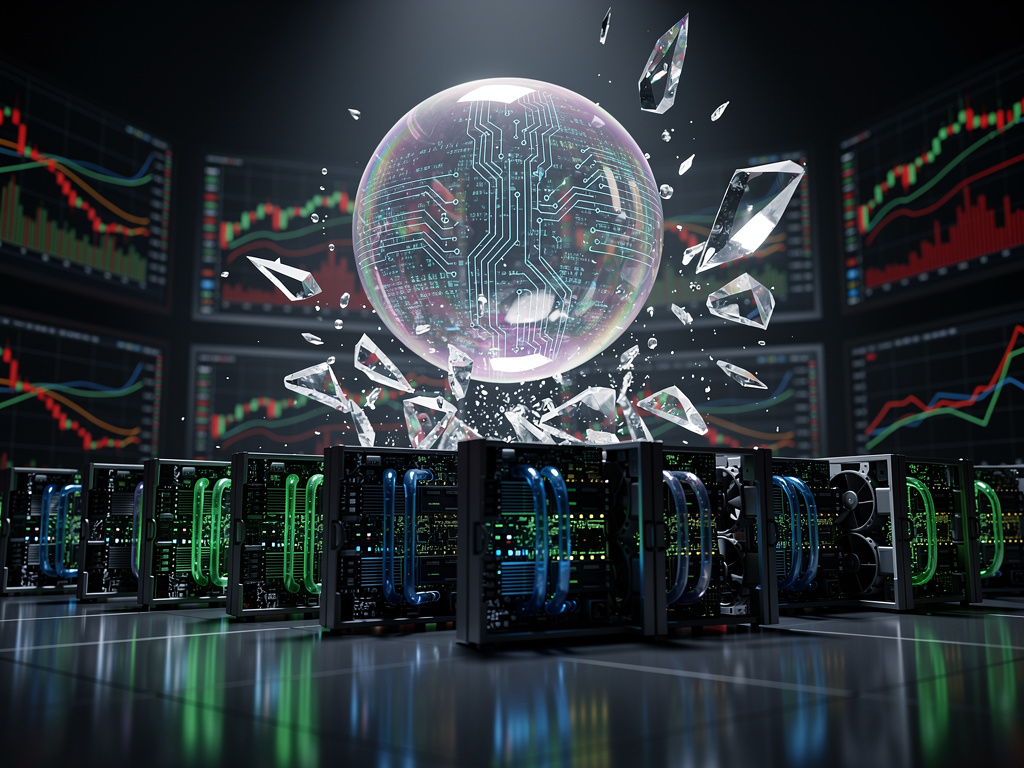
Michael Burry, the investor known for predicting the 2008 housing market crash, has issued stark warnings regarding an impending stock market bubble, particularly focused on the artificial intelligence sector. In a series of recent posts on X, Burry has drawn parallels between today’s AI boom and the excesses seen during the dot-com era, targeting companies like Nvidia and OpenAI as potential candidates for a significant downturn. His analysis leverages historical market patterns, capital expenditures, and depreciation practices that he contends could lead to a dramatic market correction reminiscent of past tech bubbles.
Burry’s critique of the current AI landscape centers on comparisons with the late 1990s internet frenzy. He likens Nvidia to Cisco Systems, which thrived during the dot-com bubble only to plummet when demand for networking equipment faltered. On his newly launched Substack, Burry highlighted risks associated with rapid technological advancements and overinvestment in AI hardware, suggesting that this trend could culminate in substantial write-offs once the current hype dissipates. Such a scenario mirrors the telecom bust that followed the initial excitement surrounding the internet.
The investor specifically warns that OpenAI, the creator of ChatGPT, risks facing a fate similar to that of Netscape, the once-dominant web browser that was quickly eclipsed by Microsoft’s Internet Explorer. He argues that OpenAI’s valuation may not hold up against larger competitors like Google and Meta, particularly amidst internal challenges and concerns about long-term profitability in the generative AI space.
Burry’s warnings are rooted in historical analysis, recalling how the dot-com bubble saw companies like Cisco benefit from a surging demand for internet infrastructure before facing a harsh reality. He asserts that today’s surge in AI investments shares a similar trajectory, where the anticipated economic returns may never materialize at the scale projected. The dramatic rise in Nvidia’s market capitalization, which recently surpassed $3 trillion, serves as a key example for Burry. He has publicly revealed his position in put options against the chipmaker, signaling a bet on its impending decline.
Despite Burry’s criticisms, Nvidia has pushed back, claiming that demand for AI technology is structural and long-lasting. However, Burry dismissed these assertions as “one straw man after another,” arguing that factors such as stock dilution and what he terms “give-and-take deals” within the AI supply chain further support his bearish stance. His portfolio manager has contributed to this narrative, emphasizing that the investment community may be overestimating the economic impact of AI.
Particular scrutiny falls on OpenAI’s trajectory, which Burry believes could mirror Netscape’s rapid decline, overwhelmed by stronger, more resourceful competitors. This skepticism aligns with broader market sentiments; a recent report highlighted Burry’s comparisons of Nvidia to Cisco, suggesting that AI infrastructure may become obsolete more swiftly than anticipated. His Substack, which promises a “front row seat” to his analyses, has garnered significant attention, attracting thousands of subscribers eager for his insights.
Diving into the quantitative aspects of Burry’s critiques, he emphasizes accounting practices that he believes artificially inflate the perceived value of AI firms. He accuses major tech companies, including Meta, Google, Amazon, Microsoft, and Oracle, of manipulating depreciation schedules for AI hardware, allowing them to report inflated profits while concealing the actual costs associated with rapid technological turnover. Burry describes this phenomenon as a “profit illusion,” echoing tactics reminiscent of Enron, although he stops short of alleging fraud.
Despite Nvidia’s impressive earnings reports, which revealed over 60% revenue growth and margins exceeding 50%, Burry remains unconvinced. He points to the company’s stock compensation costs, totaling $112.5 billion, as evidence of overvaluation. His substantial short positions against both Nvidia and Palantir signal a strong belief in an imminent market correction.
The investment landscape remains polarized, with voices like Warren Buffett taking a bullish stance on AI-driven growth by investing in Alphabet. This divergence highlights the divided sentiments on Wall Street, as Burry’s warnings continue to resonate across social media platforms where users debate his historical accuracy. His previous success in 2008 is counterbalanced by mixed performance since, including a premature sell call on the S&P 500 that preceded a substantial rally.
As Burry re-engages with public discourse—following the deregistration of his hedge fund, Scion Asset Management—his prolific output on X and Substack has sparked considerable discussion. Some users echo his concerns regarding the astronomical amounts spent on AI infrastructure yielding insufficient returns, while others question his timing and approach. Industry observers have noted that Burry’s influence could potentially trigger the panic he predicts.
Looking ahead, Burry envisions a reckoning by 2025, defending his predictions against critics who argue that the AI bubble’s burst will mirror historical cycles. While companies like Nvidia and OpenAI continue to innovate, he perceives fragility in their foundations, driven by overreliance on market hype, questionable accounting, and competitive pressures. As market optimism persists, Burry’s contrarian views serve as a reminder that investors should remain vigilant, as history suggests that those who caution against prevailing euphoria often identify cracks before the facade crumbles.
See also AI Transforms Classroom Learning: Educators Leverage Tools for Critical Thinking and Equity
 Google Reveals AI-Powered Smart Glasses to Transform Everyday Device Interaction
 Trump Administration Set to Sign National AI Preemption Order, Reshaping Industry Landscape
 Over 50 Nations Sign Landmark Pact for Global AI Regulation, Setting New Safety Standards