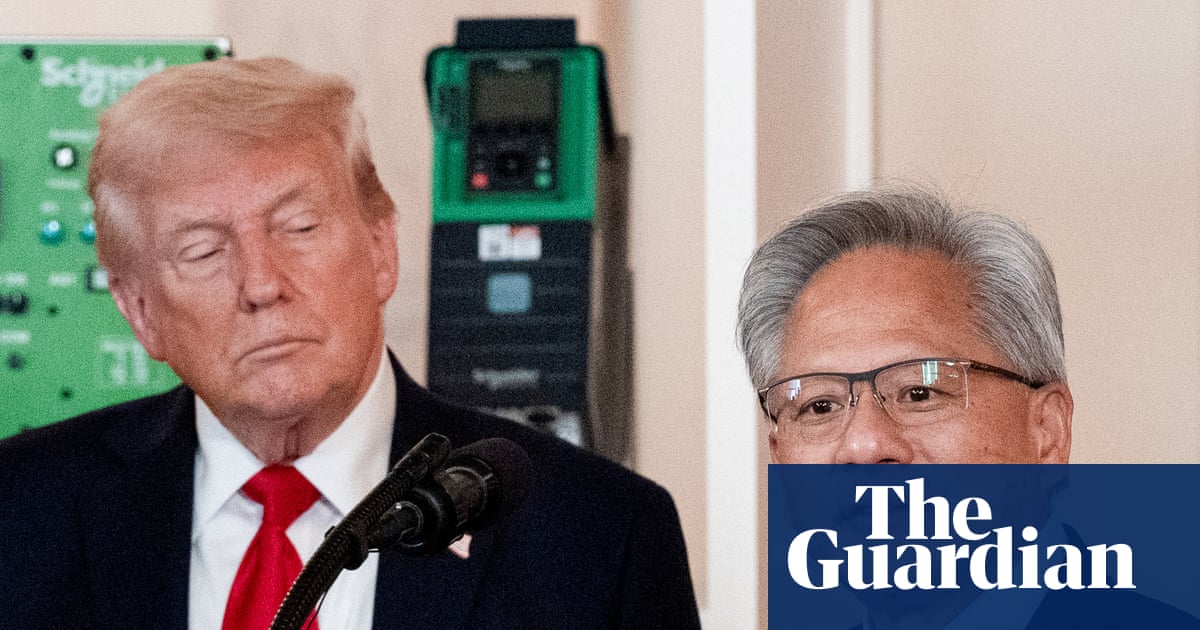
Donald Trump has authorized Nvidia to commence sales of its advanced AI computer chips to China, a significant development for the chipmaker and its CEO, Jensen Huang, who has been advocating for the reopening of this market. Prior to this announcement, the United States had forbidden the sale of Nvidia’s most sophisticated chips to China due to concerns regarding national security.
In a post on Truth Social, Trump stated, “I have informed President Xi of China that the United States will allow NVIDIA to ship its H200 products to approved customers in China, and other countries, under conditions that allow for continued strong National Security.” He indicated that President Xi responded positively to the news.
Trump mentioned that the Department of Commerce is finalizing details of the arrangement and plans to extend similar offers to other semiconductor manufacturers, including Advanced Micro Devices (AMD) and Intel. The H200 chips, which are Nvidia’s second-most powerful offering, are expected to generate substantial revenue.
The former president also revealed that the U.S. government would receive 25% of the proceeds from these sales, a move that has drawn scrutiny from some lawmakers. In August, Trump had announced a 10% stake for the federal government in Intel. Such arrangements have raised questions regarding their legality.
Concerns have been voiced by Democratic senators Elizabeth Warren of Massachusetts and Andy Kim of New Jersey. They sent a letter last week to Commerce Secretary Howard Lutnick, expressing apprehension over selling advanced chips to China, citing risks related to surveillance, censorship, and military applications. “I urge you to stop ignoring the input of bipartisan members of Congress and your own experts in order to cut deals that trade away America’s national security,” they wrote.
Huang has maintained a close relationship with Trump, making several visits to the White House and attending the president’s AI summit in July. He met with Trump as recently as last week and was a guest at a White House dinner for Saudi Crown Prince Mohammed bin Salman. The CEO has also committed to investing $500 billion in AI infrastructure within the U.S. over the next four years.
Entering the Chinese market—home to the world’s second-largest economy—could potentially yield billions for Nvidia, which is currently valued at $4.5 trillion. A representative from Nvidia expressed gratitude for Trump’s decision, noting that providing the H200 chips “to approved commercial customers, vetted by the Department of Commerce, strikes a thoughtful balance that is great for America.”
The Nvidia spokesperson and Trump both emphasized that this initiative would bolster U.S. jobs and manufacturing. In his Truth Social post, Trump criticized the policies of the Biden administration, which had imposed stringent export controls on powerful chips, arguing that withholding such technology from China enhanced U.S. competition and safeguarded national security. “That era is OVER!” Trump wrote. “My Administration will always put America FIRST.”
This shift in policy comes amid ongoing debates over the balance between fostering technological collaboration and maintaining national security. As the global race for AI technology intensifies, the implications of allowing chip sales to China will likely resonate across the industry, influencing future strategies for both U.S. companies and foreign entities seeking access to advanced technologies.
See also Harrisburg Launches AI-Powered Parking System Across 12 City Garages
 Trump Allows Nvidia to Sell H200 AI Chips to China, Boosting Revenue Potential by Billions
 Agentic AI Revolutionizes Decision-Making in 2025 with $7.28B Market Growth
 Taiwo Feyijimi Introduces AI-Driven Frameworks to Enhance Engineering Education Quality
 US Grants Nvidia 25% Fee Export Approval for H200 Chips to China Amid Tech Tensions