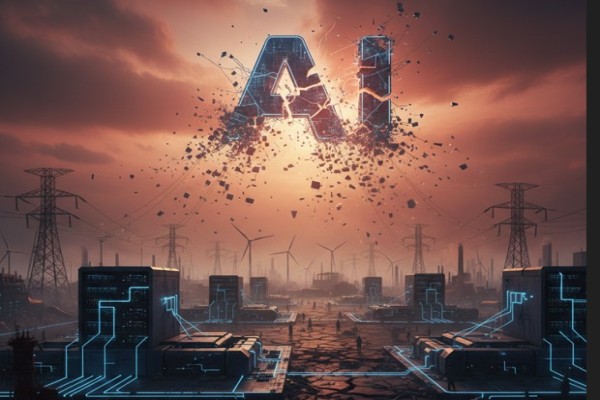
The rapid escalation in investments related to artificial intelligence (AI) is leading to concerns about a potential economic fallout, according to a recent article in the December edition of the Bulletin of the Atomic Scientists. Titled “When it all comes crashing down: The aftermath of the AI boom,” the piece by New York-based journalist Jeremy Hsu warns that the fervor surrounding generative AI technologies, particularly since the launch of ChatGPT in late 2022, may be inflating an ‘AI bubble’ that could result in significant economic and social consequences.
Investment in AI has surged dramatically, with estimations suggesting that annual expenditure in AI chips and data centers ranges between US$72 billion and US$125 billion. This monumental financial commitment is rooted in the belief that AI can fundamentally alter the global economy, or even lead to systems that exceed human capabilities. However, Hsu argues that this enthusiasm is driven more by “marketing hype” than by a realistic appraisal of the current AI technologies, raising alarms about the sustainability of such investments.
Concerns are being voiced by economists who highlight that the current AI spending may be artificially propping up financial markets and a fragile U.S. economy. As the article emphasizes, the momentum behind AI investments cannot persist indefinitely, and should the bubble burst, the repercussions could be widespread, affecting pensions, jobs, and public services. Much of the current funding is directed toward energy-intensive infrastructure that risks becoming “stranded assets,” meaning they might be built on uncertain returns that never materialize.
The article also notes that a disproportionate focus on AI has led to the neglect of other vital sectors. Economists quoted in the Bulletin express concern that essential industries are being starved of investment, with one stating, “We have foregone development in so many industries as we shove food into a mouth that’s already so full.” This lack of diversification in investment strategies could lock the economy into a precarious state overly reliant on speculative technology.
This situation echoes historical “AI winters,” periods characterized by disillusionment and funding cuts, which emerged when lofty expectations fell victim to technological limitations. However, the present scenario may be more severe due to the extensive integration of AI into global finance, energy infrastructure, and corporate dynamics. This complexity raises critical questions about the extent of the potential fallout: will losses be confined to venture capitalists and tech insiders, or will they resonate through the wider economy?
The societal implications could be profound. The author warns that if the current trajectory continues, the legacy of the AI boom might not usher in super-intelligent machines but instead result in costly, underutilized infrastructure and wasted capital. This could leave entire sectors starved of resources, with ordinary workers, communities, and taxpayers bearing the brunt of the fallout.
As the AI landscape evolves, it becomes increasingly vital to consider not only the technological advances but also the broader economic context. Governments, corporate leaders, and investors must carefully assess the sustainability of their commitments to AI technologies. With the potential for significant disruptions ahead, stakeholders must begin to prepare for a future marked by the consequences of an AI bubble bursting.
In this climate of uncertainty, the implications of unchecked AI investment will likely extend beyond mere financial losses, impacting various facets of society. The urgency to diversify investments and minimize risk across multiple sectors has never been more pressing, as the world stands on the precipice of a potentially transformative yet perilous era for the economy.
For more on the AI investment landscape, visit OpenAI and learn about ongoing developments in the field.
See also Microsoft Teams and Azure Unite to Solve CX Fragmentation for Enterprises
 IBM Acquires Confluent for $11B, Reinforcing Leadership in Enterprise AI and Real-Time Data Processing
 Corporate Leaders Prioritize Responsible AI Deployment Amid Safety and Workforce Concerns, JUST Capital Reports
 TD Cowen Reiterates Buy on AMD, Predicts Helios Launch will Drive AI Growth
 Reddit Fuels Small Business Growth; AI Transforms Beauty Strategies and B2B Channels Expand Reach