By Jonathan J. Cooper, The Associated Press
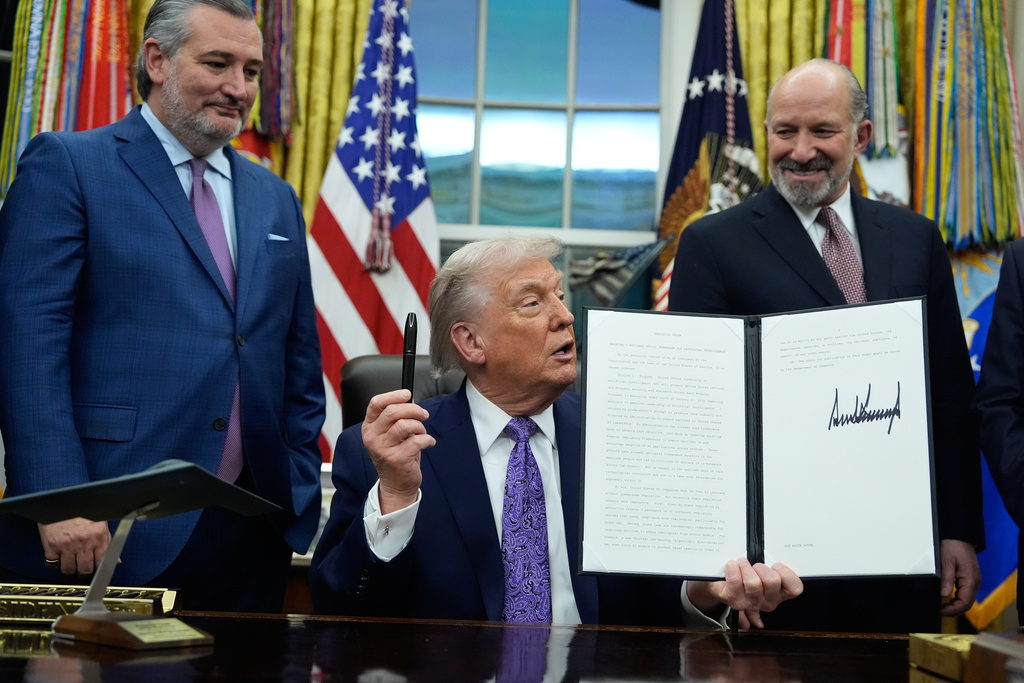
President Donald Trump signed an executive order on Thursday aimed at preventing individual states from establishing their own regulations for artificial intelligence (AI). The order underscores the administration’s concern that a fragmented regulatory landscape could hinder the growth of the AI industry and compromise U.S. competitiveness against China.
In remarks to reporters at the Oval Office, Trump asserted that nations are in a race to dominate AI technology, with only one emerging victor. He highlighted the streamlined approval process afforded to Chinese companies by their government, stating, “We have the big investment coming, but if they had to get 50 different approvals from 50 different states, you can forget it because it’s impossible to do.”
The executive order mandates the Attorney General to form a new task force to contest state laws and instructs the Commerce Department to compile a list of regulations deemed problematic. Among its more contentious provisions, the order threatens to limit federal funding for broadband deployment and other grant programs to states that enact AI-related laws.
David Sacks, a venture capitalist with a focus on AI and cryptocurrency, indicated that the administration’s efforts would primarily target “the most onerous examples of state regulation,” while still supporting necessary measures aimed at protecting children.
Several states have already begun to implement AI regulations. According to the International Association of Privacy Professionals, Colorado, California, Utah, and Texas have passed laws that impose certain restrictions on AI across the private sector. These regulations include limitations on the collection of specific personal data and increased transparency requirements for companies deploying AI technologies.
The growing presence of AI in daily decision-making processes—such as hiring, housing, lending, and healthcare—has prompted calls for more rigorous oversight. Critics assert that without proper regulations, AI systems can perpetuate biases, leading to discriminatory outcomes based on gender or race.
While some states have adopted ambitious proposals focused on transparency and risk assessment concerning AI, others have taken more targeted actions, such as banning the use of deepfakes in elections or prohibiting nonconsensual pornography. These varied approaches reflect the complex and evolving landscape of AI regulation in the United States.
The Trump administration’s executive order arrives amid broader discussions about the ethical implications and societal impacts of AI technologies. As AI systems increasingly influence critical areas of life, the balancing act between fostering innovation and ensuring accountability has become a focal point for lawmakers, industry leaders, and advocacy groups alike.
As the debate continues, the implications of this executive order extend beyond regulatory frameworks. Analysts are watching closely to see how it will shape the future of AI development in the U.S., particularly in terms of its global competitive standing against nations like China. The landscape of AI regulation may soon become a defining element in the broader narrative of technological advancement and international relations.
See also Trump Signs Executive Order to Block State AI Regulations, Favoring Tech Giants
 Trump Launches AI Task Force to Challenge State Regulations on Technology Oversight
 Trump Signs Executive Order Halting State AI Regulations, Calls for Federal Oversight
 Parents Urge NY Governor Hochul to Sign RAISE Act for AI Safety Amid Big Tech Opposition