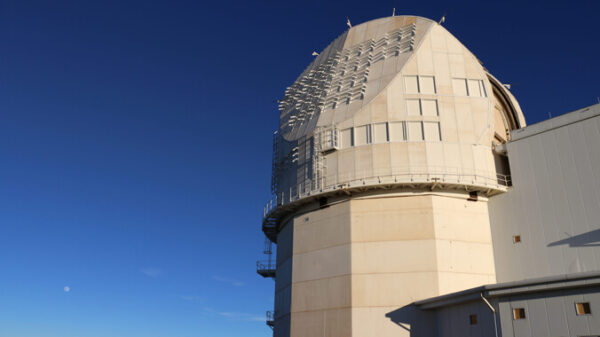
Researchers at the University of Hawaiʻi Institute for Astronomy have developed a new artificial intelligence tool that is transforming the study of the sun. This innovative AI system maps the sun’s magnetic field in three dimensions with unprecedented accuracy, enhancing our understanding of solar activity.
The project, which supports research at the National Science Foundation Daniel K. Inouye Solar Telescope located atop Haleakalā on Maui, aims to improve space weather forecasts that are crucial for protecting technology on Earth. The findings were shared in the Astrophysical Journal.
According to Kai Yang, a postdoctoral researcher at the Institute for Astronomy and the leader of this project, “The sun is the strongest space weather source that can affect everyday life here on Earth, especially now that we rely so much on technology.” Yang emphasized that the sun’s magnetic field drives explosive phenomena such as solar flares and coronal mass ejections, which can disrupt satellites and power systems globally.
The challenge of accurately measuring the sun’s magnetic field complicates the task of creating reliable maps. Traditional instruments can only indicate the tilt of the magnetic field, without revealing its direction toward or away from Earth. “It’s like looking at a rope from the side and not knowing which end is closer,” Yang explained.
Further complicating matters, scientists often observe several layers of the sun simultaneously, making it difficult to ascertain the actual height of each magnetic structure. Sunspots exacerbate this issue, as their strong magnetic fields bend the sun’s surface downward, creating a dip.
To tackle these challenges, researchers from the Institute for Astronomy collaborated with the National Solar Observatory and the High Altitude Observatory of the National Center for Atmospheric Research to develop a machine-learning system that integrates real data with fundamental physics principles. Their algorithm, named the Haleakalā Disambiguation Decoder, is based on a fundamental rule: magnetic fields form loops and do not have distinct starting or ending points.
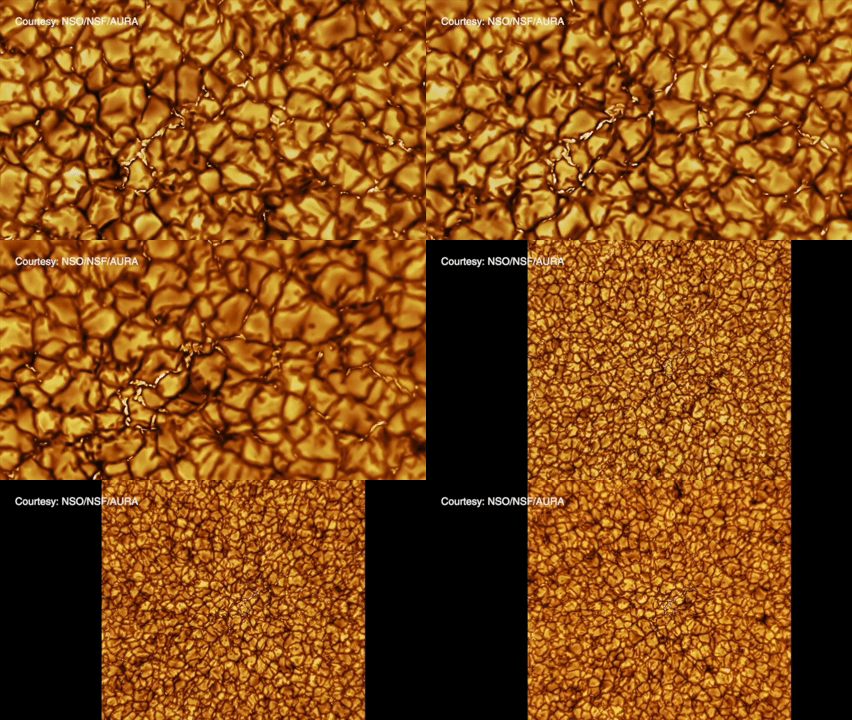
This AI tool can determine the true direction of the magnetic field and accurately estimate the height of each layer of the sun’s magnetic structure. The algorithm has shown exceptional performance on detailed computer models of the sun, encompassing a range of conditions from calm areas to active regions and sunspots. Its enhanced accuracy is particularly beneficial for interpreting high-resolution images from the Daniel K. Inouye Solar Telescope.
“With this new machine-learning tool, the Daniel K. Inouye Solar Telescope can help scientists build a more accurate 3-D map of the sun’s magnetic field,” Yang stated. “It also reveals related features, like vector electric currents in the solar atmosphere that were previously very hard to measure.”
These advancements allow researchers to visualize the sun’s magnetic landscape with greater precision, which is critical for improving predictions of solar activity that impacts life on Earth. “Together, this gives us a clearer picture of what drives powerful solar eruptions,” Yang concluded.
The implications of this research extend beyond academic study, as enhanced understanding of solar activity may lead to better preparedness for the effects of space weather on modern technology. As humanity continues to rely more heavily on digital systems, the ability to forecast solar events accurately becomes increasingly essential.
See also AI Platforms Set to Surpass Social Media as Major Advertising Destinations by 2026, Analyst Predicts
 Nvidia Poised for Surge: Projected $20 EPS by 2030 Amid AI Infrastructure Boom
 Amazon Pulls AI Recap from Fallout After Major Errors in Key Flashback Details
 Oracle Delays $300B Data Center for OpenAI, Signaling Risks in AI Investment Boom