Researchers have made significant strides in computational science with the introduction of OXtal, a novel diffusion model designed to predict the three-dimensional arrangements of molecules in organic crystals. Developed by Emily Jin and Andrei Cristian Nica from Synteny, along with Mikhail Galkin from Google and their colleagues, OXtal aims to transform the fields of drug discovery and materials design. By learning directly how molecular structures inform crystal packing, this model circumvents traditional methods that depend on predefined crystal symmetries.
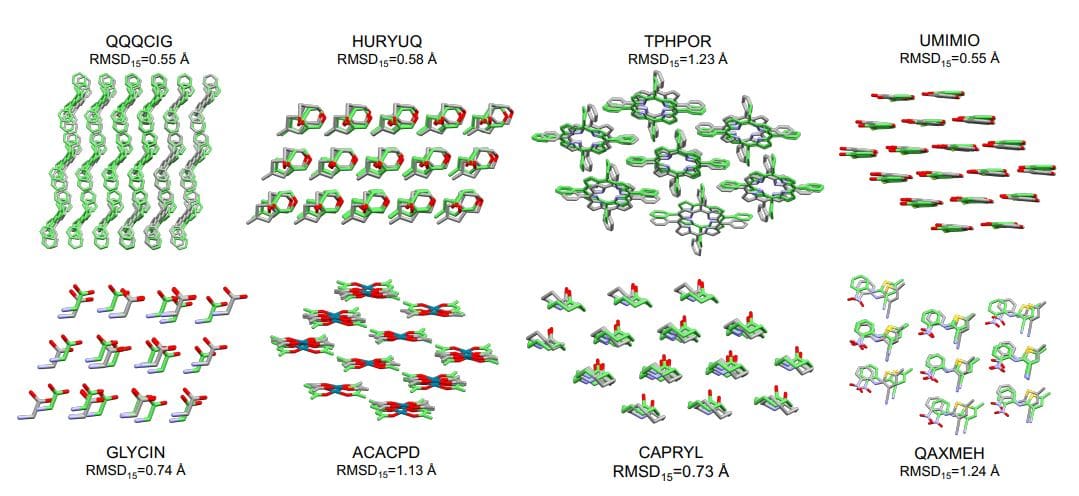
OXtal’s innovative approach integrates data augmentation techniques, enabling it to efficiently capture long-range interactions between molecules. By utilizing a dataset comprising 600,000 experimentally verified crystal structures, the model demonstrates remarkable accuracy, recovering experimental structures to within a fraction of an Angstrom. Furthermore, its ability to model the intricate processes of molecular crystallization positions OXtal as a groundbreaking tool in the realm of materials discovery.
The computational demands of crystal structure prediction are significant, as evidenced by data from blind testing challenges. Analysis of CPU core hours and computation time utilizing OXtal reveals the extensive resources required to model complex molecular arrangements. Different research groups exhibit varying levels of computational power, influenced by their methodologies and resources. Notable contributors such as MNeumann, KSzalewicz-MTuckerman, and DBoese stand out for their substantial investments, indicating a commitment to advanced computational methods in this field.
OXtal distinguishes itself by predicting molecular crystal structures directly from two-dimensional chemical graphs, addressing a persistent challenge in computational chemistry. This model not only relies on a diverse dataset of validated crystal structures but also departs from the constraints associated with traditional methodologies. Instead of relying on explicit crystal symmetries, OXtal utilizes data-driven strategies to learn from Cartesian coordinates, enhancing its predictive capabilities.
A key aspect of OXtal’s design is its introduction of Stoichiometric Stochastic Shell Sampling, a new training scheme that effectively captures long-range molecular interactions without the need for traditional lattice-based parameterization. The results indicate that OXtal can recover experimental structures with a high degree of accuracy, achieving over 80% packing similarity—a testament to its ability to model both thermodynamic and kinetic factors governing molecular crystallization.
Testing has shown OXtal’s superiority over existing machine learning models, with the ability to recover up to 90% of solid-state molecular conformers. Its performance in comparison to structures from blind tests highlights OXtal’s effectiveness, as it consistently outperforms other machine learning baselines and achieves results comparable to more costly density functional theory methods. This capability allows researchers to identify probable motifs while utilizing significantly fewer computational resources.
Looking ahead, the research team plans to enhance OXtal’s functionality, particularly in its handling of flexible molecules. Additionally, expanding the dataset to encompass a broader spectrum of chemical compounds and crystallization conditions could further refine the model’s predictive accuracy. As OXtal continues to evolve, it promises to play an integral role in advancing the understanding of molecular crystallization, thereby impacting the development of new materials and pharmaceuticals.
See also LodgIQ Launches AI Wizard, Hospitality’s First Generative AI Platform for Revenue Intelligence
 FDA Unveils 2025 AI Guidance: Key Takeaways on Risk Framework and Public Feedback
 Starcloud Achieves AI Training in Space Using Google’s Gemma Model Aboard Satellite
 Google’s Nano Banana Pro Revolutionizes AI Images by Embracing Real-World Imperfections
 Generative AI Raises Copyright Risks for Brands, Warns Legal Expert Rob Driscoll