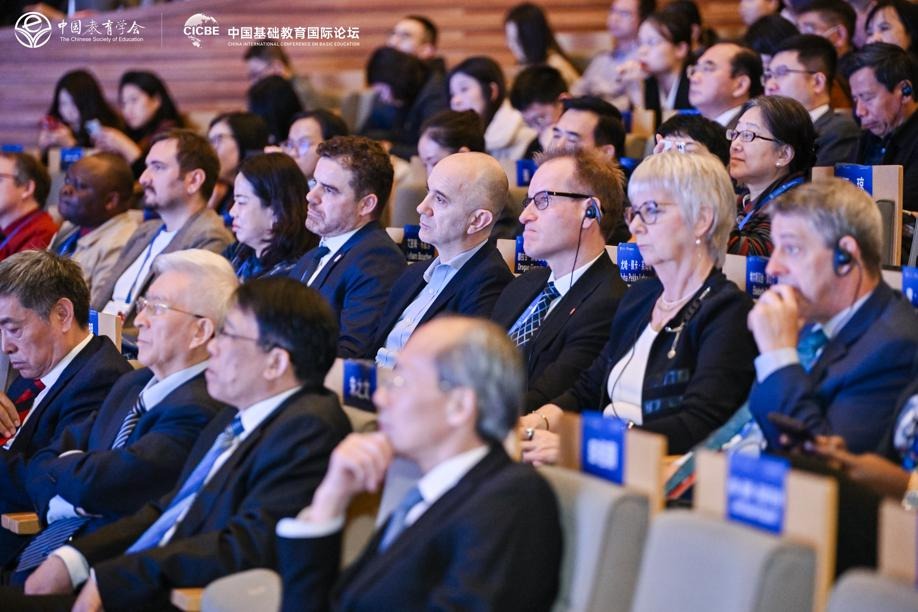
The China International Conference on Basic Education (CICBE) 2025 opened in Shanghai on Saturday, attracting nearly 400 participants from around the world to discuss the integration of artificial intelligence in education. Co-hosted by the Chinese Society of Education, Beijing Foreign Studies University, Shanghai Normal University, and the municipal government of Shanghai’s Jiading district, the two-day event aims to foster dialogue and collaboration on educational innovation through technology.
During the conference, an “Initiative on Leveraging Artificial Intelligence for Educational Innovation” was unveiled, calling for global action in six critical areas: proactive technology adoption, equitable access, AI-enhanced governance, collaborative efforts to fulfill educational missions, ethical standards, and open cooperation. This initiative underscores the importance of addressing educational disparities while harnessing the potential of AI.
In a video address, Vice-Minister of Education Ren Youqun reaffirmed China’s commitment to prioritizing education. He highlighted three guiding principles for the AI-driven transformation of education: ensuring inclusive access based on the “Digital for Good” concept to create a learning society for all; fostering innovation to nurture the creative spirit of future generations; and promoting openness and collaboration in global educational governance. These principles aim to align technological advancements with educational equity.
Zhu Zhiwen, president of the Chinese Society of Education, remarked on the profound impact of AI, stating that “AI, as a forefront of technological revolution, is profoundly reshaping human production, lifestyle, and education.” Wu Xinbao, vice-chairman of the Shanghai Municipal Committee of the Chinese People’s Political Consultative Conference, emphasized that hosting the conference would “encourage and impel Shanghai to deepen educational reform and international collaboration,” showcasing Shanghai’s role as a hub for educational innovation.
The conference featured keynote speeches from several distinguished scholars and practitioners. John Edward Hopcroft, a 1986 Turing Award laureate and member of the Chinese Academy of Sciences, noted that “AI can serve as a powerful assistant to teachers by freeing time for students to pursue their interests, but cannot replace the essential human connection at the heart of education.” Curtis J Bonk, a professor at Indiana University, showcased AI-supported self-directed lifelong learning tools, while Daniel Burgos proposed an ethical framework for the integration of AI in educational settings, calling for responsible and equitable use of technology.
In addition to keynote addresses, five parallel sub-conferences explored themes such as AI for educational equity, teaching transformation, and empowering teachers. Nearly 70 experts from 13 countries participated, providing diverse perspectives on the role of AI in shaping educational practices. The discussion emphasized the need for educational institutions to adapt to technological advancements while ensuring that all students benefit from these innovations.
The conference concluded on Sunday with field visits to local schools and innovation hubs in Jiading. These excursions offered participants firsthand insights into the practical integration of technology in education, demonstrating the tangible impacts of AI in real-world learning environments.
The CICBE 2025 not only highlights the growing importance of AI in education but also reflects a broader trend toward collaborative international efforts aimed at enhancing educational quality through technology. As countries navigate the challenges and opportunities presented by AI, the conference sets the stage for ongoing dialogue and cooperation in establishing ethical and effective educational frameworks. The integration of AI is poised to reshape how education is delivered, potentially making it more personalized, accessible, and effective for future generations.
See also Nigeria’s AI Talent at Risk: Expert Urges Urgent Education Reform to Retain Innovators
 UK Students Use GenAI in 90% of Assessments: Emphasizing Human Learning Essentials
 Straia Emerges from Stealth with $1M a16z Investment to Transform Higher Ed Data Use
 RAND Reports Reveal Pre-K Teacher Insights on Generative AI, Pay, and Training Gaps
 Sylacauga City Schools Expand AI Integration, Enhance Blended Learning for Educators