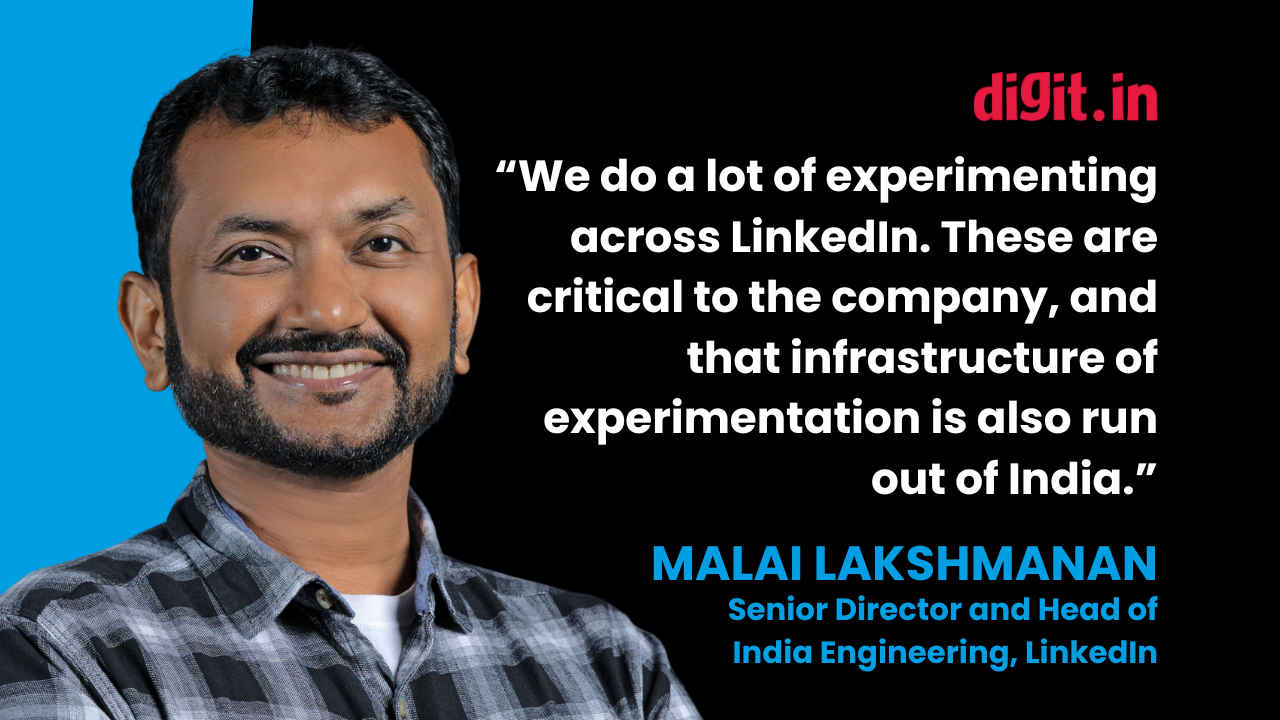
LinkedIn continues to reinforce its position as a professional networking platform, particularly among millennials and younger users. In an exclusive interview, Malai Lakshmanan, Senior Director and Head of India Engineering at LinkedIn, emphasized the platform’s commitment to maintaining its professional integrity amidst criticisms that it is evolving into a social network akin to Facebook. “LinkedIn has been a professional network and we’ll continue to be one,” Lakshmanan asserted.
He noted that the platform is witnessing heightened engagement from users eager to learn about developments in their fields and the implications for their careers. “If you look at the kind of content people share – especially with all the advancements in tech – we’re seeing strong engagement from members,” Lakshmanan explained. However, some users express concerns about the quality of their LinkedIn feed, likening it to the noise found on other social media platforms. Lakshmanan clarified that the experience largely depends on individual connections and interests.
Misconceptions about LinkedIn’s value often arise, particularly among entry-level professionals who believe they cannot derive benefits without a large network. Lakshmanan dispelled this notion, advising newcomers to focus on creating a profile, exploring interests, following relevant topics, and engaging with content. “You don’t need a large network from day one to begin seeing value,” he stated, underscoring that engagement leads to natural network growth over time.
India plays a critical role in LinkedIn’s global engineering efforts, according to Lakshmanan. He detailed how Indian teams contribute significantly to customer-facing features and systems that millions of users interact with daily, including the Easy Apply feature and the integration of job postings with customer platforms. “A lot of our Talent Solutions work is run out of India,” he noted, highlighting the substantial engineering presence that underpins the platform’s functionality.
Every user interaction on LinkedIn generates data that informs improvements in feed quality and recommendations. Lakshmanan pointed out that the tracking infrastructure is primarily managed by teams in India, emphasizing its importance to business insights and data science. He described the continuous experimentation culture at LinkedIn, where changes are rigorously tested to gauge member reactions, with significant infrastructure support managed from India.
LinkedIn is also leveraging artificial intelligence to enhance its internal operations. Lakshmanan explained how the company repurposed an existing universal schema registry to create a centralized GenAI prompt registry, which monitors and governs the prompts used across engineering for efficiency and compliance. This adaptation showcases LinkedIn’s agility in integrating AI into its workflows.
Moreover, Lakshmanan mentioned LinkedIn’s focus on conversational AI models capable of handling customer queries and improving resolution times, thereby reducing reliance on traditional support systems. “We’re working on models that can interact conversationally, guide people to the right information, and resolve issues faster,” he added, indicating a shift towards a more efficient customer service approach.
On the product development side, Lakshmanan highlighted the introduction of the LinkedIn Hiring Assistant, designed to assist recruiters in managing high workloads by filtering candidates and drafting outreach messages. This tool exemplifies how AI can enhance productivity while retaining human oversight in the recruitment process.
Looking ahead, Lakshmanan expressed optimism about the evolving landscape of AI, particularly the concept of agentic experiences, where multiple AI tools interact to create greater value. He cautioned against expecting immediate perfection from AI, acknowledging the complexities of human needs and technology’s current capabilities. “The interesting shift will be when these agentic systems connect and coordinate,” he said.
For younger professionals, he emphasized that skills are becoming the new currency, particularly in emerging fields like AI and machine learning. However, he also highlighted the increasing importance of human skills such as communication and empathy. “As AI frees up time, human skills become even more essential,” he remarked, reflecting on the need for adaptability in the workforce.
In a final note, Lakshmanan shared his experience of being reverse-mentored by interns, illustrating the shift in thought processes among entry-level talent who are more attuned to integrating AI into their workflows. “Entry-level talent can’t follow old playbooks,” he concluded, indicating a broader cultural shift that requires both new and experienced professionals to rethink their approaches to work and leadership.
See also Google’s AI Recipe Summaries Threaten Livelihoods of Food Bloggers, Sparking Industry Fears
 Ciena’s 160% Surge: Is AI Infrastructure Growth Already Priced In?
 Rebellions Aims to Build a Non-Nvidia AI Ecosystem with New Semiconductor Focus
 Saras AI Institute Launches $6,000 Online Master’s in AI Engineering for Professionals
 AI’s Role in Infrastructure: 95% of Firms Struggle to Profit, Human Expertise Essential