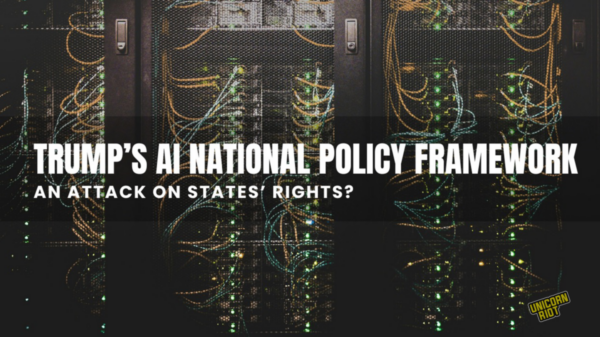
The National Council of Insurance Legislators (NCOIL) has publicly opposed President Donald Trump’s recent executive order, which they view as a significant impediment to state regulation of artificial intelligence (AI). In a statement released on December 15, NCOIL officials expressed being “greatly disturbed” by the executive order, characterizing it as an attempt to restrict state legislators’ capabilities to enact policies that safeguard their constituents.
NCOIL emphasized the importance of state legislators in crafting regulations, especially amid current political polarization and gridlock in Washington, D.C. The council argued that depriving states of their ability to develop tailored policy solutions undermines the essential function of state governance.
This executive order follows a prior legislative defeat for federal lawmakers who overwhelmingly rejected a proposal included in Trump’s extensive tax bill that sought to impose a 10-year moratorium on state regulation of AI. During that debate, both NCOIL and other insurance industry-related organizations voiced serious concerns, warning that such a ban would disrupt existing regulatory frameworks across numerous states and unjustly limit state legislators’ policymaking authority.
NCOIL reiterated its position, stating, “This moment is precisely the kind of opportunity in which the states should continue serving as the laboratories of democracy, as they have so effectively done in the past.” The organization expressed its belief that the executive order would not be the final word on the matter and anticipated judicial scrutiny regarding the legality of the order.
In its statement, NCOIL committed to continuing its efforts to develop public policy related to AI and insurance, aiming to provide guidance for states in protecting consumers without stifling innovation.
Trump’s executive order posits that state regulation poses challenges, including the risk of “ideological bias within models” and potential infringements on interstate commerce. The order asserts, “My administration must act with Congress to ensure that there is a minimally burdensome national standard—not 50 discordant state ones.” It establishes a task force to challenge state AI regulations that are deemed inconsistent with the new federal policy framework. The directive emphasizes, “It is the policy of the United States to sustain and enhance the United States’ global AI dominance through a minimally burdensome national policy framework for AI.”
The ongoing debate highlights the growing tensions between federal and state authorities as they navigate the complex landscape of AI regulation. As the technology continues to evolve and permeate various sectors, the outcome of this conflict will significantly impact how AI is governed in the United States, influencing both innovation and consumer protection in the insurance industry and beyond.
See also Australia’s AI Plan Lacks Dedicated Regulation, Experts Warn of Growing Risks
 OMB Issues New Guidelines for AI Procurement: Agencies Must Ensure LLMs Are Unbiased by March 11
 Anthropic Disrupts First AI-Driven Cyber-Espionage Campaign Targeting 30 Firms
 Thomson Reuters Launches CoCounsel Legal, Reducing Document Review Time by 63%
 Pennsylvania Advances AI Regulation Bill as Healthcare Integrates AI Tools Daily