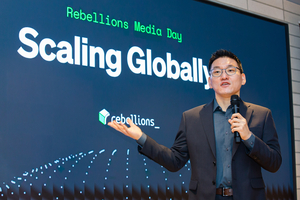
Rebellions, South Korea’s first AI semiconductor unicorn, has announced its ambition to spearhead the development of a “non-Nvidia” AI ecosystem, positioning itself as a pivotal player in next-generation AI infrastructure. CEO Park Sung-hyun made the declaration during a press conference held in Seongnam, Gyeonggi Province, on Tuesday, emphasizing the importance of an alternative framework to the current Nvidia-dominated landscape.
“The next five years will be about building a new AI infrastructure system centered on alternatives to Nvidia,” Park stated, asserting that Rebellions intends to be at the forefront of this industry shift. He underlined that the landscape of artificial intelligence infrastructure is primarily driven by long-term investments and ecosystem development rather than immediate performance metrics.
“Only companies that invest over the long term and create value as part of a broader ecosystem will survive,” he remarked, adding that national-level involvement is becoming increasingly crucial as global competition intensifies.
Founded in 2020, Rebellions has swiftly established itself as a key player in AI semiconductors. The firm garnered early support from KT Corp. in 2022, followed by significant Series B investments in 2024 from Saudi Aramco and Pavilion Capital of Singapore. This year, it entered Series C funding and became the first Asian startup selected by Arm.
In August 2024, Rebellions merged with Sapeon Korea, an AI chip spinoff from SK Telecom, formally creating Korea’s first AI semiconductor unicorn. The company has already mass-produced its first-generation neural processing unit, Atom, and commercialized large-scale AI services. Its flagship product, Rebel-Quad, delivers GPU-class performance that rivals top offerings from Nvidia, serving as a launchpad for its international expansion.
Rebellions has expanded operations with subsidiaries established in Japan, Saudi Arabia, and the United States. The company anticipates a rising global demand for diversified AI infrastructure, as governments and corporations increasingly seek alternatives to Nvidia-centric systems. These emerging architectures combine NPUs, innovative hardware designs, open-source software, and advanced interconnect technologies.
“Markets such as the US, Japan, the Middle East, and Southeast Asia are actively looking for diversified AI stacks,” noted Chief Business Officer Marshall Choy. He emphasized that with mature products and proven technology, Rebellions is well-positioned to become a competitive alternative in this evolving landscape.
Park framed the company’s growth as part of South Korea’s broader aspirations in deep tech. “Every step forward for Rebellions is a step forward for Korea,” he asserted, indicating the company’s role in the national vision of technological advancement.
Regarding its plans for public listing, Park highlighted the significance of the upcoming year. “We plan to pursue an initial public offering in Korea first while also considering a potential dual listing on Nasdaq,” he stated, signaling the company’s intent to expedite its global expansion.
See also Saras AI Institute Launches $6,000 Online Master’s in AI Engineering for Professionals
 AI’s Role in Infrastructure: 95% of Firms Struggle to Profit, Human Expertise Essential
 Global Semiconductor Equipment Sales to Reach $156 Billion by 2027, Driven by AI Demand
 Google’s Crawler Integration Halts AI Licensing Revenue for Publishers Until 2026
 Kaiser Therapists Rally Against AI Impact on Patient Safety Amid Industry Shift