






















































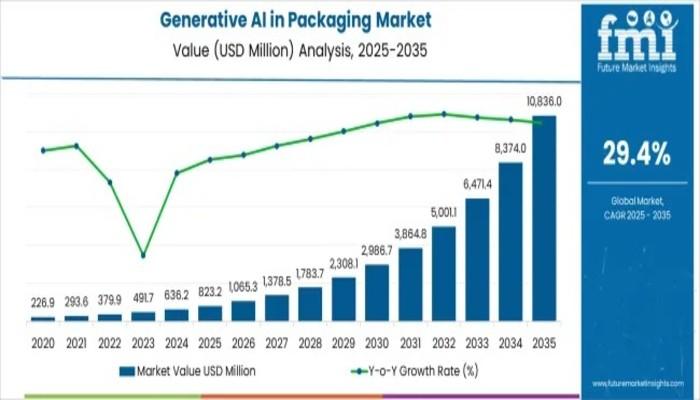
The global Generative AI in Packaging Market is on the cusp of transformative expansion, with projections indicating it will surge from USD 823.2 million in 2025 to a staggering USD 10,836 million by 2035. This represents a remarkable 1,216.4% total growth rate and a compound annual growth rate (CAGR) of 29.4%. The rapid growth is largely driven by increasing demand for AI-powered design automation, sustainable innovation, and personalized consumer engagement within the packaging sector globally.
At the forefront of this growth is Generative AI, an advanced artificial intelligence technology that autonomously creates, optimizes, and simulates packaging designs. As brands seek to enhance consumer experiences through innovative packaging, manufacturers are leveraging AI to accelerate the design process, reduce waste, and personalize packaging on a large scale.
From 2025 to 2030, the market is expected to grow from USD 823.24 million to approximately USD 3,012.45 million, generating an additional USD 2.19 billion in value. This phase is characterized by the swift adoption of AI-enabled design automation, sustainable material optimization, and consumer-centric packaging personalization. From 2030 onwards, the adoption is anticipated to gain momentum, bolstered by the integration of augmented reality (AR), generative models, and circular economy frameworks into standard practices within the packaging industry.
In terms of market segmentation, the software sector is projected to command a significant 67% market share by 2025, driving the industry’s digital transformation. AI design platforms facilitate automated model generation, simulation, and optimization, resulting in reduced time-to-market and lower design costs. Additionally, the cloud deployment segment is expected to capture 70% of the market share, signaling a shift towards scalable, subscription-based AI ecosystems. Such cloud solutions support continuous updates of algorithms, cost flexibility, and enhanced data security—essential for manufacturers managing extensive design datasets.
The food and beverages sector is notably significant, accounting for 26% of the total market share. AI-driven design tools in this segment help brands minimize plastic usage, comply with environmental regulations, and create personalized packaging that aligns with evolving consumer preferences.
Technological advancements such as Machine Learning and Natural Language Processing (NLP) are pivotal in transforming packaging communication and functionality. With NLP capturing 30.9% of the market, it enables intelligent labeling and multilingual product information, while structural design applications—holding a 34.3% share—focus on optimizing materials and performance. This allows AI to generate lightweight yet durable packaging designs, thus reducing waste and overall carbon footprint.
The push for sustainability is a critical driver behind the adoption of generative AI. These tools assist in identifying eco-efficient materials, simulating recyclability, and designing for disassembly, helping companies align with circular economy objectives. This technology reduces raw material consumption, optimizes packaging lifecycles, and ensures compliance with stringent environmental regulations in various regions.
Regionally, the generative AI in packaging market exhibits distinct growth dynamics. China is leading with a 39.7% CAGR, backed by robust manufacturing capabilities and substantial government investment in industrial AI. Following closely, India boasts a 36.8% CAGR, driven by a burgeoning consumer goods sector and widespread digitalization. In Europe, Germany retains leadership with a 33.8% CAGR, while France and the United Kingdom focus on luxury and e-commerce packaging, respectively. Meanwhile, the United States reflects a solid 25% CAGR, benefitting from mature cloud infrastructure and innovation, and Brazil also shows promise with a 22.1% CAGR.
The market’s competitive landscape is increasingly characterized by collaborations between technology giants and packaging solution providers. Major players such as Adobe Inc., Amazon Web Services, Microsoft, and NVIDIA Corporation are leading innovations through AI platforms and cloud computing. Specialized firms like Clarifai and PackageX Inc. are expanding the role of AI in packaging simulations and material innovations.
As the global packaging sector adapts to rapid technological changes, the convergence of creativity and computing power will likely redefine industry standards, ultimately enhancing sustainability and consumer engagement initiatives across various sectors.
For more details on this market, interested parties can access comprehensive reports and insights from Future Market Insights.
See also AdExchanger Reveals Key Trends Transforming Data-Driven Digital Advertising in 2023
 Sapphire’s Ed Chrysler Reveals RX 9000 Challenges, AI’s Market Disruption, and PC Gaming’s Future
 Meta Hires Partner Engineer for Generative AI to Launch New Product Experiences in Mumbai
 AI Investment Surges to $1.4 Trillion, Europe Faces Urgent Race for Tech Hegemony
 India Surges to 3rd in Stanford’s 2025 Global AI Vibrancy Index, USA Leads with 78.6















