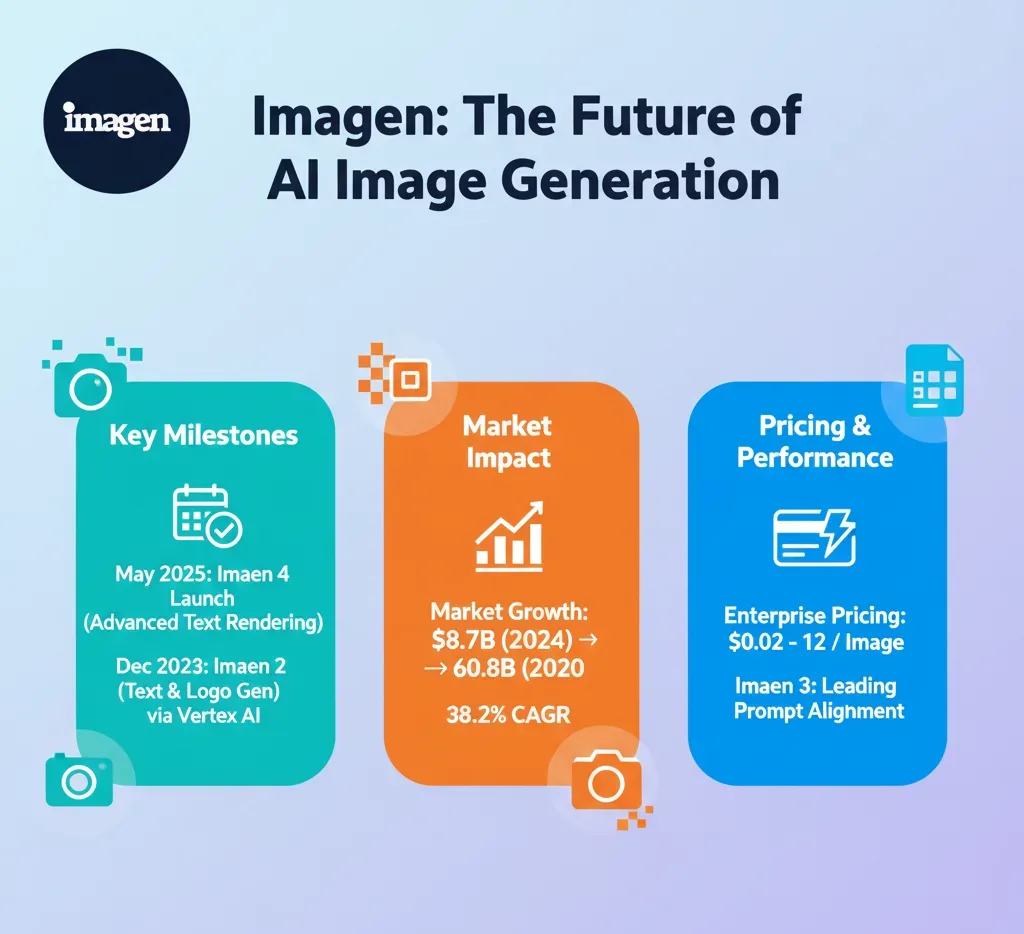
Google’s Imagen 4 reached general availability in May 2025, marking a pivotal development in the enterprise AI image generation landscape. Operating through the Vertex AI platform, the service allows companies to generate images at varying prices, ranging from $0.02 to $0.12 per image, depending on the quality tier and processing speed. This rollout comes at a time when the global AI image generator market was valued at $8.7 billion in 2024, with projections indicating a surge to $60.8 billion by 2030, representing a compound annual growth rate (CAGR) of 38.2%.
Imagen 4 introduces advanced capabilities, including improved text rendering and intelligent font selection, which enhance its functionality significantly for enterprise users. The platform’s evolution has been swift; Google DeepMind released five iterations from May 2022 to May 2025. The original Imagen was a research-only project, while Imagen 2 became commercially viable in December 2023, adding features like text and logo generation. Subsequent models, Imagen 3 and Imagen 3 Fast, introduced enhanced photorealism and latency reductions, respectively, solidifying the platform’s competitive edge.
Imagen’s pricing structure reflects its diverse offerings. The highest quality tier, Imagen 4 Ultra, costs $0.06 per image, while the standard Imagen 4 with 4K upscaling is priced at $0.04. The speed-optimized variant, Imagen 4 Fast, is available at the lowest rate of $0.02 per image. Also noteworthy is the Product Recontext feature, designed for specialized product scene creation, which is priced at $0.12 per generation. The enterprise adoption of Imagen has resulted in remarkable efficiency gains, as demonstrated by Kraft Heinz, which significantly reduced its content production timelines from 8 weeks to just 8 hours through the integration of Imagen within its Tastemaker platform.
The AI image generation market’s growth trajectory is underscored by substantial investments and technological advancements. In 2023, retail companies allocated $19.71 billion to AI tools, and enterprises leveraging generative AI in production environments reported an average revenue increase of 86%, with 6% attributed directly to AI implementation. Despite the growing interest, the competitive landscape remains robust, with platforms like Midjourney and DALL-E leading market shares of 26.8% and 24.35%, respectively. Midjourney users alone have generated over 964 million images, illustrating the demand and rapid adoption of AI-generated content.
Imagen’s performance benchmarks further emphasize its competitive standing. Evaluations revealed that Imagen 3 excels in prompt-image alignment, achieving the highest scores across GenAI-Bench, DrawBench, and DALL-E 3 evaluation datasets. Additionally, it recorded the lowest CMMD score among tested models, indicating superior quality metrics compared to its rivals. The platform has demonstrated industry-leading accuracy for text rendering within generated images, showcasing its capability to handle complex prompts effectively.
As enterprises increasingly adopt AI technologies, the sentiment around AI-generated images among consumers remains mixed. Research indicates that 67% of consumers expect disclosure when AI generates product images for commercial purposes. However, 62% express comfort with AI in marketing materials, while 75% have concerns about potential misinformation in AI-generated visuals. Google’s SynthID watermarking technology aims to address these transparency issues by embedding invisible identifiers in generated content.
In a broader context, the AI-generated image production volume has reached unprecedented levels. By 2024, platforms combined had generated more than 15 billion AI images, a figure that outpaces traditional photography’s historical benchmarks. This rapid production capacity illustrates a marked shift in how visual content is created and consumed, with AI-generated images now exceeding four times the total images in Shutterstock’s library and representing about one-third of all images uploaded to Instagram.
Looking ahead, AI-driven solutions like Imagen are poised to redefine industries ranging from e-commerce to marketing, as they offer unparalleled efficiencies and capabilities. With an estimated 80% of retail executives planning to adopt AI automation by 2025, the demand for advanced image generation technologies will likely continue its upward trend, catalyzing further innovations in how businesses engage with their audiences.
See also Forrester Wave™: Leading AI Infrastructure Solutions Transforming Production by Q4 2025
 Lunit and Daiichi Sankyo Collaborate to Accelerate AI-Driven Biomarker Discovery in Oncology
 AWS Unveils AI Risk Intelligence Solution to Enhance Responsible AI Governance
 News Anchor’s AI-Altered Photo Sparks Urgency Over Digital Privacy Risks
 Oracle’s AI World Tour 2026 Boosts Stock Confidence as Shares Near $400 Target