






















































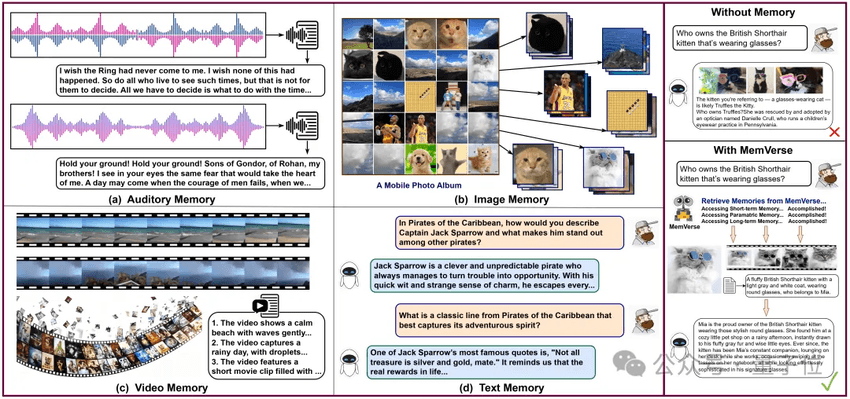
The Shanghai Artificial Intelligence Laboratory has unveiled MemVerse, the first universal multimodal memory framework designed for AI agents, addressing the prevalent challenges of “modality isolation and slow response” in traditional systems. This open-source initiative marks a significant advancement, enabling agents to possess cross-modal memory that integrates images, audio, and video. For the first time, these systems can exhibit a “growable, internalizable, second-level response,” facilitating what the lab describes as lifelong memory capabilities.
Traditional AI memory systems primarily rely on text-based frameworks, which often result in mechanical retrieval processes lacking an understanding of spatiotemporal logic or cross-modal semantics. In contrast, MemVerse employs a sophisticated three-layer bionic architecture. At its core, a central coordinator mimics the functionality of the “prefrontal cortex,” managing active scheduling. Meanwhile, short-term memory is designed with sliding windows to maintain coherence in conversations, and long-term memory crafts multimodal knowledge graphs that categorize different types of memory: core memory (user profiles), episodic memory (event timelines), and semantic memory (abstract concepts). This architecture aims to fundamentally reduce the issue of AI hallucinations.
A notable feature of MemVerse is its innovative “parameterized distillation” technique, which periodically refines high-value long-term knowledge into smaller, dedicated models. This method enhances retrieval speeds by over 10 times, significantly improving the efficiency of data access. Such advancements are particularly relevant in today’s fast-paced technological landscape, where rapid data processing is crucial for effective AI performance.
Initial benchmarks have demonstrated promising results for MemVerse. In tests using the ScienceQA dataset, the GPT-4o-mini model with MemVerse achieved a score increase from 76.82 to 85.48. Additionally, on the MSR-VTT text-to-video dataset, the model’s recall at rank 1 soared to 90.4%, significantly outpacing other models such as CLIP at 29.7% and the dedicated large model ExCae at 67.7%. These results underscore the robust capabilities of MemVerse in enhancing AI memory and response accuracy while effectively reducing token usage by 90%, thereby balancing both cost and performance.
As the field of artificial intelligence continues to evolve, the introduction of MemVerse signifies a pivotal moment in achieving more integrated and efficient AI systems. By offering a solution to the limitations of existing memory frameworks, Shanghai Artificial Intelligence Laboratory not only paves the way for more intelligent AI agents but also sets a new benchmark for future innovations in the sector. The open-sourcing of MemVerse invites collaborative development and potential enhancements from the global AI community, fostering a more interconnected technological landscape.
See also AI Framework Achieves 79% Accuracy in Ranking Educational Resources for Personalized Learning
 Brands Must Optimize AI Content Strategy as 60% of Healthcare Queries Go Directly Answered
 Brands Shift to 100% Human Content Policies to Combat AI Skepticism and Trust Erosion
 AI-Generated Images Mislead on Bondi Beach Attack; ABC News Debunks False Claims
 UC San Diego’s Hao AI Lab Unveils New DGX B200 to Enhance AI Language Model Research















