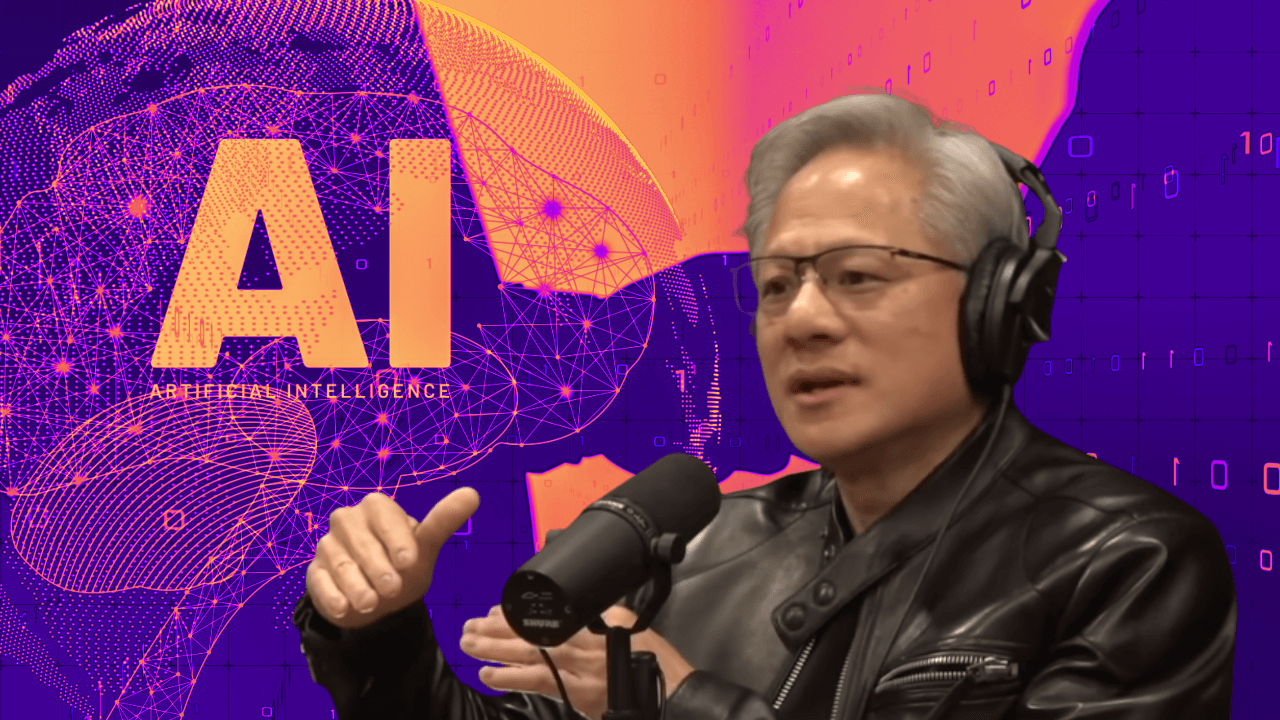
NEW YORK, UNITED STATES — In a recent interview on Joe Rogan’s podcast, Nvidia Chief Executive Officer (CEO) Jensen Huang discussed the transformative impact of artificial intelligence (AI) on the global job market. He outlined a future where AI gradually reshapes employment landscapes, displacing certain roles while simultaneously creating new industries, including a proposed robot-based apparel sector.
Huang highlighted that “there’s going to come a point in time where AI is going to be able to do all those things much better than people do, and people will just be able to receive money.” He emphasized, however, that the transition will be “quite gradual,” countering more alarmist predictions about the immediate effects of AI on job loss.
According to Huang, the jobs most at risk for automation are those that involve routine, definable functions. He illustrated this point with the analogy of chopping vegetables, suggesting that such tasks could be easily replaced by machines. This implies a focus on automating procedural aspects of various occupations rather than a wholesale elimination of entire industries.
Conversely, Huang believes roles that require high-level interpretation and complex reasoning will be more resistant to automation. Citing the example of radiologists, he noted that while AI has become integral to their work—helping analyze medical images—the demand for radiologists continues to grow. “It turns out AI has swept a whole field… What’s interesting is that what number of radiologists has actually grown,” Huang remarked.
This division in job roles suggests that skills involving savvy decision-making will remain critical, blurring the line between mundane tasks and intellectual labor. Huang generalized this perspective, asserting that the core purpose of various professions—such as law—has not changed, despite the automation of certain tasks like document review.
Job Creation Amidst Automation
Huang posited that the AI revolution will catalyze the emergence of new markets and job types. He speculated about the rise of new technical roles, particularly technicians who would design and service advanced AI assistants. More intriguingly, he imagined a future where entirely new consumer industries emerge, such as a robot apparel industry designed to meet the aesthetic needs of various robotic entities. “You’re gonna have robot apparels… because I want my robot to look different than your robot,” he explained.
However, Huang cautioned that even these new roles might be subject to future automation. He suggested that as robots become more prevalent, even jobs like creating robot garments could eventually be automated, necessitating further adaptation in the workforce. This perspective is supported by recent findings from MIT, which indicated that AI is already capable of performing tasks equivalent to 12% of the U.S. workforce, which encompasses approximately 151 million workers with wages totaling over one trillion dollars.
As a result, the long-term landscape of employment may involve continuous adaptation, where new roles are created only to be automated down the line. This cycle underscores the need for workers to develop versatile skills that align with the evolving demands of the job market.
Huang also discussed the AI revolution as part of a larger global technology race, emphasizing the significant competitive advantages for nations that lead in AI development. “It’s a really important race because whoever gets to whatever the event horizon of artificial intelligence is, whoever gets there first has massive advantages in a huge way,” he stated.
This view contrasts sharply with the stark warnings from Geoffrey Hinton, often referred to as the “Godfather of AI,” who has cautioned that tech companies are aggressively pursuing AI solutions to maximize profits, potentially at the expense of workers. Huang’s more optimistic outlook presents a diverging narrative regarding the speed and scale of the impending disruptions in the workforce.
See also Executives Must Adapt: AI Challenges Traditional Strategy, Demands New Decision-Making Models
 Appy Pie Launches AI Video Generation Automation for Streamlined Content Production
 Trump’s EO Targets State AI Laws, Aims to Centralize U.S. AI Regulations and Funding
 Sell Palantir and BigBear.ai: Unsustainable Growth Risks Ahead of 2026
 IBM and Notre Dame Launch 105 Open-Source Benchmark Cards to Streamline AI Evaluations