






















































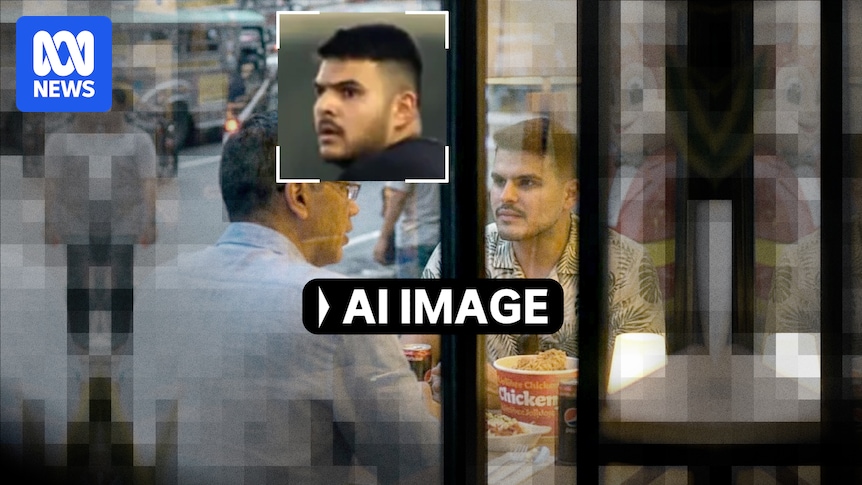
Following the recent attack at Bondi Beach, social media has been inundated with falsehoods and conspiracy theories, prompting a surge in misinformation. ABC News Verify has identified three notable instances where AI-generated imagery and manipulated content have contributed to the distortion of facts surrounding the incident.
One significant case involves an AI-generated image purporting to show the alleged gunman, Naveed Akram, at an outdoor cafe in the Philippines. This image was shared on X, claiming it depicted Akram in conversation with Captain Chandra Kant Kothari, the defense attache of India to the Philippines. However, ABC News Verify has confirmed that the image was produced using Google’s AI tools, with no evidence suggesting any interaction occurred between Akram and Kothari. Testing with Google’s Synth ID detector revealed the image contained an invisible watermark, further substantiating its artificial origins. Visual analysis highlighted several discrepancies, including garbled text on a bucket of chicken and an indoor desk lamp on an outdoor table. Moreover, the backgrounds were poorly merged, with cars overlapping and a lack of detail in the streetscape.
On Tuesday, ABC News reported that Naveed Akram and his brother Sajid traveled to the Philippines a month before the attack to receive “military-style training.” This context has fueled false narratives suggesting prior contact between Indian authorities and the alleged gunmen, primarily propagated through social media. However, the AI-generated image holds no factual basis, as the depicted scene never occurred.
The spread of misinformation continued with the circulation of a “leaked” screenshot of a Facebook profile allegedly belonging to a man named “David Cohen,” who bears a resemblance to Akram. This screenshot appears to have been created with AI, using modified real photographs of the alleged gunman in fabricated settings, such as wearing a Jewish yarmulke at a bar mitzvah. Despite evident signs of inauthenticity, the image has garnered significant attention, reaching over 2 million views, as users shared it as evidence of Akram’s Jewish identity. Transparency tools from social media platforms indicated that many of the accounts sharing the false profile were based outside Australia.
The original source of the screenshot, a pro-Palestine Instagram account, later issued an apology for disseminating the image, acknowledging its AI-generated status. This incident has fueled antisemitic conspiracies linking the Israeli intelligence agency, Mossad, to the alleged gunmen, despite the lack of any credible evidence.
Police Response
In addition to these misleading narratives, social media has also seen a rise in misogynistic attacks directed at female police officers who responded to the Bondi Beach shooting. Some accounts have shared misleading images, implying the officers were hiding from the gunmen rather than taking cover. Verified video footage of the attack contradicts these claims, showing a female officer engaged directly with one of the alleged gunmen while attempting to protect bystanders seeking cover. Another video illustrates her actions as she was the first to approach the footbridge after the attack concluded, navigating confusion surrounding a bystander who had run onto the bridge.
Both officers played crucial roles in managing the scene, preventing fights among bystanders even while under fire. Police Commissioner Mal Lanyon has condemned the dissemination of misleading images that misrepresent the officers’ actions, emphasizing the harm caused by such misinformation. “That type of misinformation, that type of taking situations out of context, is incredibly harmful,” he stated, while praising the bravery of the officers involved.
The proliferation of false narratives, especially those exploiting sensitive incidents like the Bondi Beach attack, underscores the critical need for media literacy and vigilance against disinformation. As investigations continue, authorities remain focused on dispelling myths that could undermine public trust and safety while highlighting the urgent necessity for responsible sharing of content in our increasingly digital world.
See also UC San Diego’s Hao AI Lab Unveils New DGX B200 to Enhance AI Language Model Research
 Sam Altman Unveils Hilarious AI-Generated Image as Firefighter With Calendar Flaw
 Nihon Falcom Reveals Limited AI Usage, Teases Tokyo Xanadu Sequel Ahead of 45th Anniversary
 USAF Innovation Chief Joe Chapa Addresses AI Trust Issues Affecting Adoption














