






















































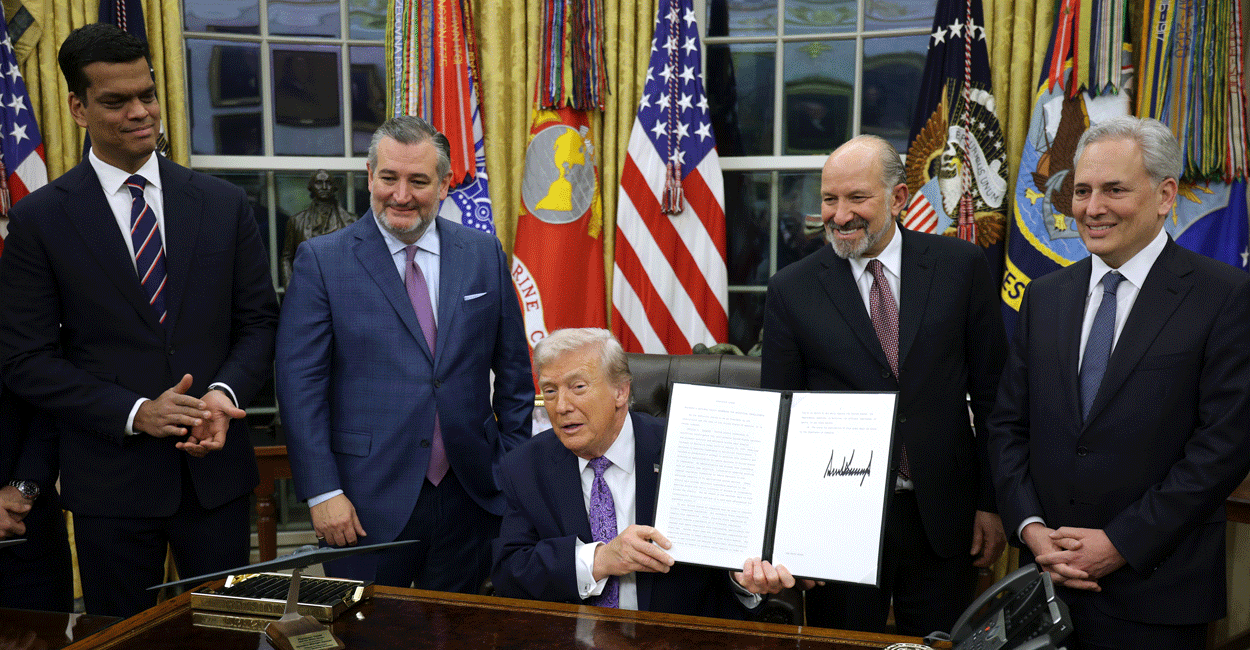
On December 11, President Donald Trump issued an executive order titled “Ensuring a National Policy Framework for Artificial Intelligence,” aimed at bolstering the United States’ global dominance in AI through a streamlined regulatory approach. This initiative follows President Joe Biden’s issuance of Executive Order 14110 in October 2023, which outlined guiding principles for the safe and equitable development of AI.
While the specifics of Trump’s strategy are yet to be fully detailed, the order emphasizes minimizing obstacles presented by state regulations that could impede national goals. In stark contrast, Biden’s Executive Order emphasized advancing equity and civil rights in AI, aiming to address existing inequities through community engagement.
Just days after taking office for a second term, Trump revoked Biden’s order with Executive Order 14179, which asserts the intent to enhance U.S. AI supremacy. Key to this executive action is the directive for the Secretary of Commerce to evaluate existing state laws related to AI within 90 days, identifying those laws that conflict with a national policy framework designed to be minimally burdensome.
Moreover, Trump established an AI litigation task force tasked specifically with challenging state regulations that could potentially hinder the national policy. The order outlines categories of state laws that will undergo scrutiny, particularly those that might be viewed as unconstitutional for regulating interstate commerce. The concept of the “dormant Commerce Clause” will be central to these evaluations, targeting state laws seen as infringing on federal authority over commerce.
The order references previous Supreme Court decisions that illustrate the limits of state regulatory power. In cases like United States v. Lopez and United States v. Morrison, the Court ruled against federal overreach, but it is unclear how these precedents will apply to state AI regulations since Congress has yet to legislate on the matter.
Trump’s executive order raises concerns over the potential implications for federalism, particularly if the administration pursues litigation broadly. The evaluation by the Secretary of Commerce will be critical, as the definitions of terms like “onerous” and “excessive” could lead to significant variations in how state laws are treated. Under the order, states deemed to have “onerous laws” may face consequences such as losing federal funding for broadband expansions.
For instance, several states have enacted legislation requiring online platforms to verify the ages of users accessing adult content, a move intended to protect children. Past Supreme Court rulings, including in Free Speech Association v. Paxton, affirmed state authority in such regulations. Trump’s order suggests a national AI framework should not undermine these state-level protective measures.
While the necessity for a cohesive national policy is acknowledged, especially to avoid a fragmented regulatory landscape for startups, the pursuit of this goal must align with constitutional principles of federalism. As Trump’s order seeks to establish a uniform federal framework that supersedes conflicting state laws, it must also respect the states’ rights to enact protections and regulations that serve their communities.
The forthcoming legislative recommendations outlined in the order will be pivotal in clarifying the extent to which federal law will preempt state law. The Constitution’s Supremacy Clause asserts that federal law prevails where conflicts exist, but the interpretation of what constitutes a conflict can vary widely.
As the national discourse around AI continues to evolve, the balance between fostering innovation and maintaining state authority will be critical. The success of a national AI policy framework hinges not only on its intent but also on how it is executed in practice, ensuring that the protection of constitutional rights and state powers remains at the forefront of regulatory efforts.
See also AI Use in Employment Decision-Making Surges to 80% Amid Legal Risks and Compliance Concerns
 ISACA Reveals Key AI Governance Lessons from 2025 to Enhance Safety and Trust in 2026
 Trump’s AI Executive Order Sparks State Backlash, Challenges Local Regulations
 TCS Launches Intelligent Urban Exchange™ for Enhanced ESG and CSRD Compliance Management
 Vietnam Advances AI Governance Framework with New Artificial Intelligence Law















