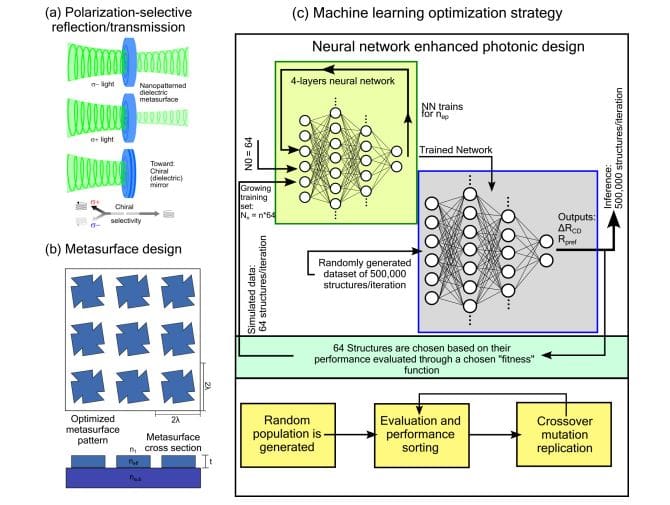
A team of researchers led by Davide Filippozzi from Justus-Liebig-Universität Gießen has made significant strides in the design and performance of chiral metasurfaces, which are vital for advanced optical devices. Collaborating with Alexandre Mayer and Nicolas Roy from the University of Namur, the group has developed a novel optimization framework that integrates deep learning and evolutionary algorithms to enhance these nanostructures’ capabilities. Their findings, which include contributions from Wei Fang at Zhejiang University and Arash Rahimi-Iman at Justus-Liebig-Universität Gießen, highlight a doubling in chiral dichroism alongside improved reflectivity, providing new avenues for the creation of chiral mirrors with tailored spectral properties suitable for polarization-selective light-matter interactions.
Chiral metasurfaces are nanoscale structures that manipulate light in unique ways, allowing for advancements in optical technologies. The research team utilized a refined neural network, trained on data generated from rigorous electromagnetic simulations, to expedite the design process and broaden the exploration of viable structural configurations. This approach significantly reduces the computational burden typically associated with extensive simulations, facilitating quicker development cycles for new designs.
Central to their advancements was a dual optimization strategy that enables the simultaneous prediction of the differential reflectivity of circularly polarized light and its reflectivity preference. This innovation led to a more robust optimization framework, enhancing both accuracy and efficiency. The research team also employed dynamic training techniques to adjust the model’s duration based on performance, effectively avoiding common pitfalls such as overfitting and underfitting.
To further expand their training dataset without incurring additional computational costs, the researchers cleverly utilized the symmetry of chiral structures. By applying geometric augmentation techniques, they effectively doubled their data size, creating new training examples that mirror existing designs. This combination of methods not only streamlines the optimization process but also sets the stage for the development of advanced optical devices with specific, tailored characteristics.
The results of the study demonstrated significant improvements in chiral dichroism, achieving a doubling of this crucial metric compared to previous designs. The team’s experiments employed materials such as gallium phosphide (GaP) and polymethyl methacrylate (PMMA), showcasing the versatility of their optimization framework across different materials. The research accounted for varying levels of geometric complexity while adhering to physical constraints related to edge angles and intersections, reflecting a comprehensive approach to design optimization.
A pivotal aspect of the optimization process was simulating the behavior of the metasurfaces using specialized software. This computational method efficiently calculated light transmission and reflectivity, further enhancing the robustness of the model. By integrating a genetic algorithm alongside the neural network, the team was able to simultaneously explore a diverse range of potential structure designs within a restricted computational envelope, leading to tailored spectral reflectivity for applications in polarization-selective light-matter interactions.
This research marks a significant advancement in the machine learning framework for designing chiral photonic metasurfaces. The combination of an optimized neural network architecture with evolutionary strategies has resulted in structures that exhibit high performance while efficiently managing computational resources. The findings indicate that careful consideration of structural features and material selection can lead to tailored spectral reflectivity, opening possibilities for practical fabrication of chiral mirrors and optical filters that can be produced using various lithographic techniques.
While acknowledging the computational demands of their simulations, the authors emphasized the efficiency of their newly optimized framework. Looking ahead, future research may focus on expanding the range of materials and geometries explored, further refining the design process and broadening the potential applications of chiral metasurfaces in fields such as polarization-selective light-matter interaction studies.
👉 More information
🗞 Advancing Machine Learning Optimization of Chiral Photonic Metasurface: Comparative Study of Neural Network and Genetic Algorithm Approaches
🧠 ArXiv: https://arxiv.org/abs/2512.13656
 vConTACT3 Launches, Achieves 95% Accuracy in Scalable Virus Classification
 White House Launches Genesis Mission with 24 Partners to Accelerate AI-Driven Discovery
 DOE Signs MOUs with 24 AI and Tech Leaders for $320M Genesis Mission Collaboration
 Jia Xu Advances AI Efficiency with New Research on Smaller Language Models