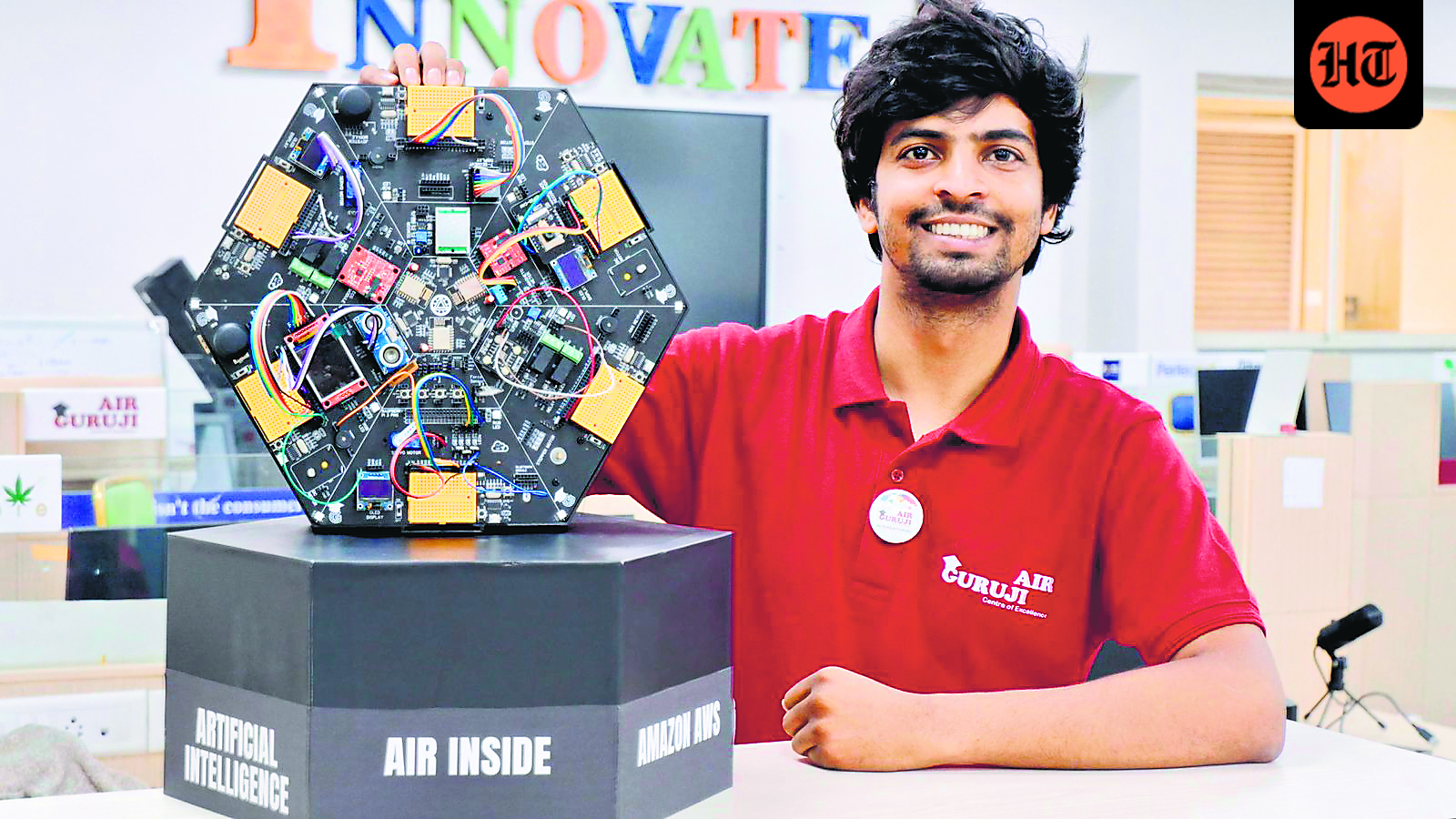
Pune-based entrepreneur Pratap Pawar is addressing a critical gap in the Indian education system by integrating practical hands-on experience in Artificial Intelligence (AI) into the curriculum. Having recently completed his Master in Telecommunication from VJTI Mumbai, Pawar is determined to reshape how students engage with technology, prompting the launch of his latest initiative, Hexabrain.AI, through his company AIR Guruji.
After an earlier start-up—focused on home automation—failed, Pawar relocated to Pune in 2021. He recognized a significant disconnect between what industries expect from graduates and the theoretical education provided by institutions. “As a student, I had seen how theoretical our education system is. What we learn is on paper. Very little importance is given to practical knowledge,” he reflected. This observation fueled his mission to provide students with the opportunity to learn AI through practical application.
Pawar began by conducting seminars in schools and colleges to gauge interest in new technologies, charging only ₹1,000 per session. His market research revealed a strong demand for knowledge in AI, Internet of Things (IoT), and robotics among over 10,000 students from more than 100 institutions. “They were ready to take the leap into new technology,” he noted, emphasizing that his approach would prioritize practical learning over theoretical instruction.
Recognizing that many schools, particularly in tier-2 and tier-3 cities, lack modern labs and trained faculty, Pawar sought to create a versatile educational tool that could teach multiple technologies simultaneously. “Why should global-standard innovation education be available only in elite schools or abroad?” he questioned, setting the stage for Hexabrain.AI, a product designed to teach AI, IoT, robotics, and drone technology.
Inspired by global leaders like LEGO Education and Kano Computing, Pawar developed Hexabrain.AI, which allows students to build devices such as agricultural tools or healthcare systems that can send data to the cloud. “Until then, there was no such machine built in India that could be used to teach four different technologies,” he stated. The device has gained traction, being utilized by PhD students for advanced research and even by younger students for simpler projects.
Pawar faced another challenge: how to make his product accessible to educational institutions. He began by demonstrating Hexabrain.AI to schools and colleges, and fortuitously around this time, the All India Council for Technical Education mandated that AI be part of the curriculum. Furthermore, the National Education Policy requires vocational subjects, including AI, to be taught at CBSE schools. This development provided a critical entry point for Pawar’s initiative.
Today, six engineering colleges and 50 schools are implementing Hexabrain.AI in their curricula. “Our unique selling proposition is an integrated innovation infrastructure. We are completely a made-in-India technology,” Pawar explained, emphasizing his company’s focus on outcomes and impact rather than branding alone.
Since launching in February 2023, Pawar has secured ₹1.5 crore from angel investors, with Hexabrain.AI valued at ₹2.4 crore shortly after its introduction. Recent investments have raised the valuation to ₹24.8 crore. Pawar plans to raise an additional ₹3 crore for customer acquisition and scalability, with revenue projections climbing from ₹10 lakh in the first year to an anticipated ₹1.5 crore by the end of this fiscal year.
His business model includes establishing dedicated centers within schools or colleges, equipped with 10 Hexabrain.AI machines, charging ₹3,000 per student annually. Alternatively, schools can invest approximately ₹15 lakh to build their own labs, with AIR Guruji providing ongoing training and updates for teachers.
In a significant endorsement of his work, AIR Guruji received recognition from the Ministry of Education, Ethiopia, paving the way to assist over 6,000 students in multiple African nations. The Indian Ministry of Education has also expressed interest in collaboration, demonstrating the potential for broader impact.
Currently, AIR Guruji operates 35 innovation labs, with aspirations to expand to over 10,000 across India. Pawar envisions creating a global network for student innovation linked to industry standards, ensuring every student has access to advanced technology education, irrespective of geographical limitations. “Our vision is to build the world’s largest innovation network,” he concluded, positioning India at the forefront of the global educational transformation in the AI era.
See also Macmillan and Microsoft Launch AI Courses for 10,000 Indian Schools, Training 15,000 Educators
 US Advances AI in K-12 Education, Adapting Lessons from El Salvador’s 5,000-School Initiative
 Chronic Absenteeism Doubles to 26% in K-12, Threatening Student Success and Engagement
 ADQ and Gates Foundation Launch $40M Initiative to Boost AI and EdTech in Africa