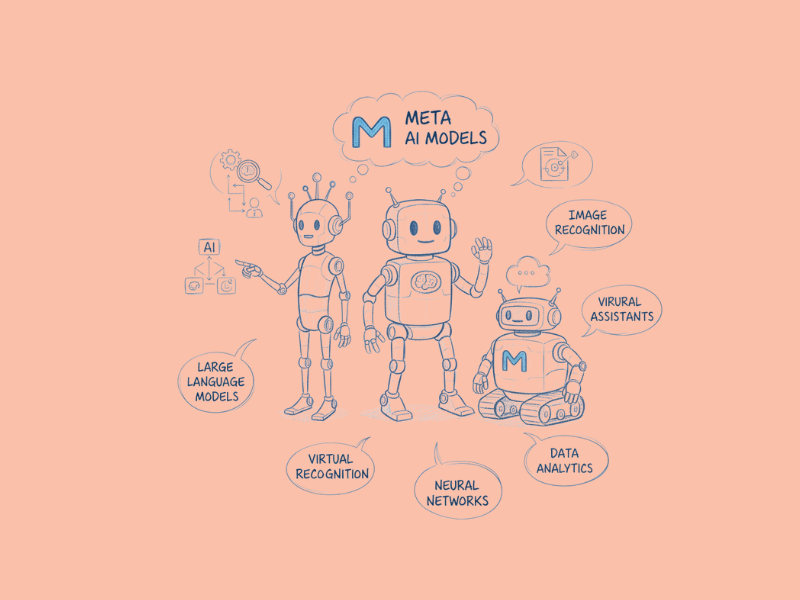
Meta is preparing for a significant advancement in artificial intelligence, with plans to launch new image, video, and text AI models by early 2026. The initiative is being spearheaded by the company’s Superintelligence Lab, currently led by Alexandr Wang, co-founder of Scale AI. Details about this effort were shared during an internal Q&A session with Meta leadership, as reported by The Wall Street Journal.
At the heart of the development are two models: one centered on visuals and the other on text. Internally dubbed “Mango” and “Avocado,” these models reflect Meta’s serious intent to enhance its AI capabilities.
The Mango model aims to revolutionize image and video generation. While no public demonstrations have been released, the objective is to refine AI’s ability to comprehend and interact with visual content. This encompasses not only the generation of images but also the understanding of scenes, motion, and context.
Conversely, the Avocado model concentrates on text processing, with the goal of achieving superior performance in coding tasks—an area where Meta’s competitors have made substantial gains. Wang has indicated that the ambition extends further into the development of “world models,” systems capable of reasoning, planning, and acting independently of exhaustive training on every conceivable scenario. Essentially, Meta aspires to create AI that mimics human cognitive processes.
This move is particularly significant for Meta, which has faced challenges in keeping pace with the rapidly evolving AI landscape. Competitors such as OpenAI, Anthropic, and Google continue to unveil headline-making AI products, while Meta has yet to introduce a standout offering. Despite its AI technologies reaching billions of users through platforms like Facebook, Instagram, and WhatsApp, the company has been criticized for lacking a distinct, independently chosen AI product.
The situation within Meta’s AI division has been tumultuous in 2025, marked by restructuring, leadership changes, and the recruitment of researchers from competing firms. However, many of these new hires have left the company within a short timeframe, raising concerns about the stability and direction of Meta’s AI strategy. Notably, the departure of long-time chief AI scientist Yann LeCun, who recently announced plans to establish his own venture, has further fueled speculation regarding the company’s long-term AI vision.
The pressure on the Superintelligence Lab is mounting, as expectations grow for the first models to emerge from this initiative. These initial releases are anticipated to serve not only as experiments but as crucial indicators for various stakeholders, including investors, developers, and the broader AI community. Should Mango and Avocado prove successful, Meta could reestablish its relevance in the AI conversation. Conversely, failure could widen the gap between it and its more innovative rivals.
As the countdown to 2026 begins, Meta remains largely reticent, opting for a strategy devoid of public timelines or flashy demonstrations. Instead, the company focuses on internal plans and long-term visions, acutely aware of its need to catch up in the fast-paced AI race. The next generation of models may determine not only Meta’s future in the AI domain but also its standing among industry leaders.
See also Rosenblatt’s Bullish Call on AI-Powered Taboola Signals Shift in Ad Investment Landscape
 Anthropic’s Claude AI Loses $1K in Vending Machine Experiment, Upgraded Version Turns Profit
 Tesla’s Governance Stabilizes Amid Delivery Declines; Rivian Bets on AI Autonomy for 2026
 Tensions Rise as Meta’s AI Chief Alexandr Wang Challenges Zuckerberg’s Control, Impacting Strategy
 PYLER Wins NVIDIA Inception Grand Challenge 2025, Reinforcing AI Trust with Video Understanding Tech