

















































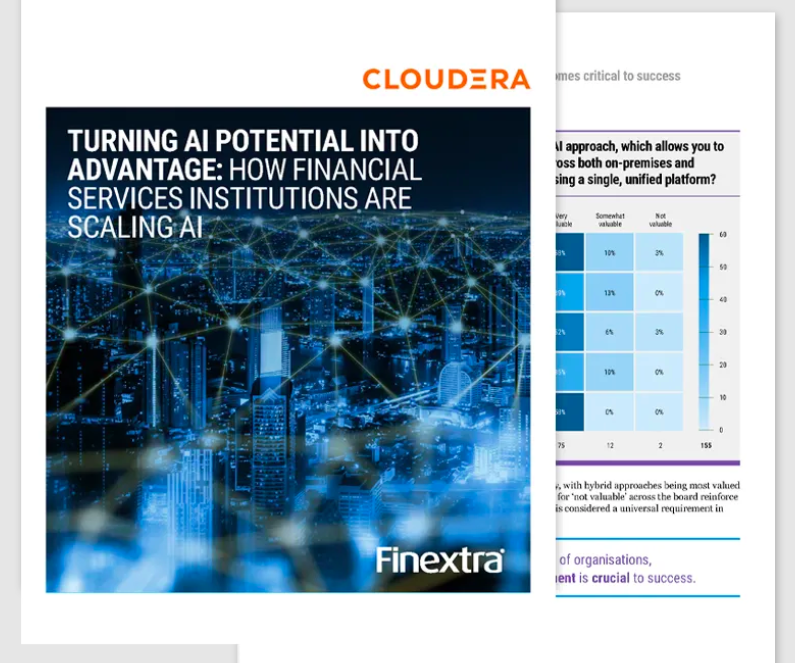
Hybrid AI deployment has emerged as a pivotal strategy within the financial services sector, with a striking 91% of organizations deeming a hybrid approach as highly valuable, according to a recent report from Cloudera. The findings underscore the increasing reliance on flexible data environments as firms navigate the complexities of AI integration.
Despite the widespread adoption of AI technologies, the study highlights persistent data and security barriers that hinder organizations from achieving comprehensive, enterprise-wide integration. This report is based on a global survey conducted by Finextra Research in August 2025, which included insights from 155 senior respondents in financial services and technology across regions such as North America, Europe, Asia Pacific, Latin America, and the Middle East & Africa.
The survey revealed that 62% of financial services organizations are currently utilizing a hybrid AI strategy, which encompasses public cloud, data centers, and edge environments to deploy AI capabilities wherever data resides. This model is increasingly seen as essential for managing legacy systems effectively, scaling operations, and addressing the resource-intensive tasks associated with training and deploying AI models. The findings suggest that a versatile, data-anywhere infrastructure has transitioned from being a mere option to a fundamental requirement for maintaining competitive advantage.
Data security has emerged as the foremost obstacle to bridging the AI implementation gap. Notably, 97% of financial services organizations indicated that data silos significantly impede their ability to develop and deploy effective AI models. These challenges reinforce the notion that true AI innovation can only thrive on a foundation of trusted, unified data governance and security protocols.
While many organizations exhibit high ambitions for AI, a substantial portion still encounters hurdles in unlocking transformative value. Nearly half (48%) of the surveyed organizations have progressed beyond initial AI trials but have yet to fully integrate the technology into their core operations. This situation places them at a disadvantage compared to the 26% of firms that have achieved complete enterprise-wide AI adoption.
“The report confirms that a data-anywhere, hybrid strategy is non-negotiable. It also highlights that infrastructure alone isn’t enough,” stated Adrien Chenallier, global director of AI solutions for financial services at Cloudera. “To truly bridge the implementation gap, financial institutions need a unified data and AI platform that ensures consistent governance and security across all environments. This is the only way to build trust, manage risk, and accelerate AI adoption at scale,” Chenallier added.
Survey findings indicate that hybrid AI has become the predominant approach, with 62% of financial services firms actively employing hybrid strategies. Furthermore, AI adoption is characterized as a strategic necessity, with 97% of financial services organizations deploying at least one AI or machine learning use case, marking a shift from AI as an emerging technology to a core business driver.
Among these organizations, 84% consider a unified data governance and security framework critical or very important. Additionally, security capabilities play a significant role in driving AI investments; 25% of firms rank security as their top priority when evaluating AI platform vendors.
“For our members, the reality is clear: AI can only deliver its full potential when data sovereignty, privacy, and trust are guaranteed,” said Gary Wright, managing director at Finextra Research. “Our survey results highlight both progress and gaps, underscoring that AI success will depend not just on the scale of investment, but on strategic decisions around infrastructure, vendor partnerships, and robust data governance,” Wright concluded.
See also Moonpig Reports 6.7% Sales Growth, Leverages AI for Card Design and Personalization
 Check Point Launches Quantum Firewall R82.10 with 20 New Features for AI Security
 Instacart’s AI Pricing Tests Could Cost Shoppers an Extra $1,200 Annually, Study Reveals
 Sharp HealthCare Faces Class Action Over AI Recording Violations: 6 Essential Steps for Businesses
 Surf Secures $15M Funding Led by Pantera Capital, Aims for $10M Revenue by 2026