














































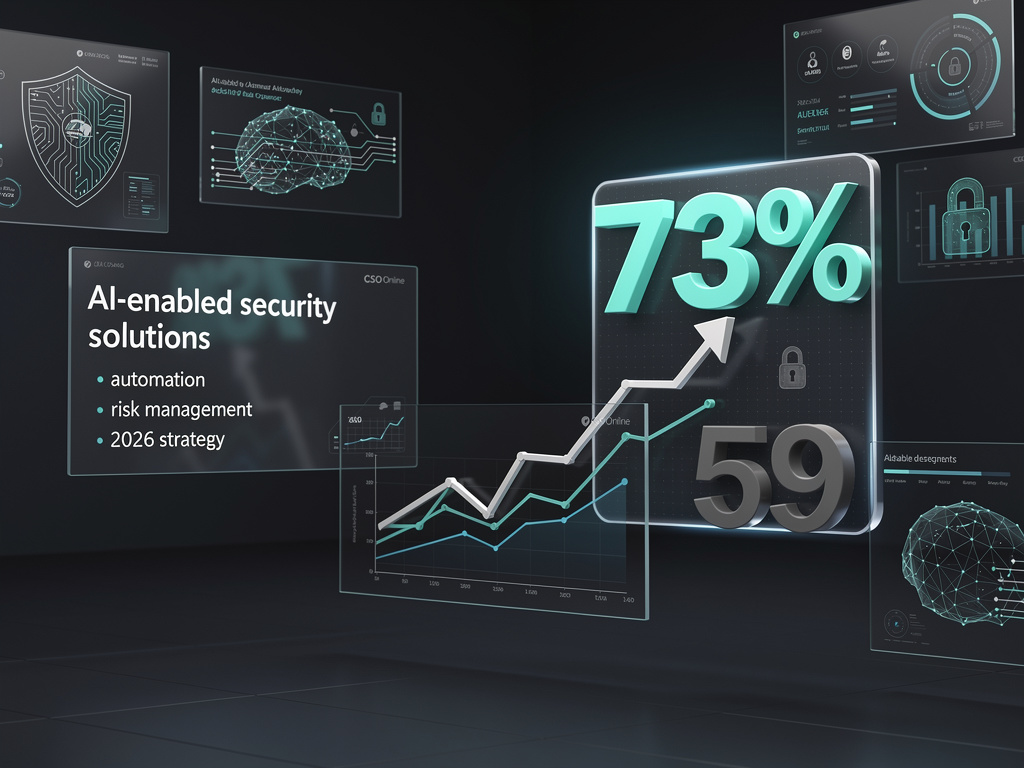
In a significant shift within corporate cybersecurity, 73% of chief information security officers (CISOs) are now more inclined to deploy AI-powered security solutions, a notable increase from 59% the previous year, according to a recent report by CSO Online. This surge reflects the growing urgency for advanced security measures amid escalating threats and stretched resources, with AI poised to enhance threat detection and response capabilities.
Executives praise AI for its ability to automate routine tasks and analyze vast datasets for anomalies that humans may overlook. “AI-enabled solutions are becoming table stakes for staying ahead,” remarked one CISO participating in the survey conducted by Foundry, which assessed responses from 200 U.S. CISOs. However, this enthusiasm is tempered by concerns; 68% of respondents express apprehensions regarding AI’s vulnerabilities, such as model poisoning and adversarial inputs that could compromise defenses.
The data illustrates a pivotal evolution in the cybersecurity landscape. Previous adoption rates were hampered by pilot programs and proof-of-concept initiatives. Now, with generative AI being integrated into both offensive and defensive strategies, CISOs report a heightened urgency to implement these technologies. Foundry’s findings resonate with broader industry trends, where AI is expected to feature prominently on priority lists for 2026, alongside resiliency and third-party risks.
The momentum is echoed in social media discussions, with industry observers like CSO Online amplifying the statistic of 73%. Cisco’s 2025 Cybersecurity Readiness Index indicates a lack of overall cybersecurity preparedness despite the transformative potential of AI, compelling leaders to pursue intelligent automation solutions.
AI’s strengths lie primarily in predictive analytics and behavioral analysis. Sophisticated tools are now capable of scanning petabytes of logs within seconds, identifying zero-day exploits through machine learning models trained on extensive global threat feeds. The CSO Online survey highlights that many CISOs are piloting AI to maximize budget efficiency by collaborating with partners to gain advanced capabilities.
Google Cloud’s blog outlines a vision for security in 2025, emphasizing the need to secure AI, in addition to traditional defenses, as AI agents take on roles such as triaging alerts. A sponsored piece in Harvard Business Review from Palo Alto Networks predicts that autonomous AI agents will dominate security operations centers by 2026, managing tasks ranging from financial modeling to cyber triage.
Despite tight budgets and rising threats, 75% of CISOs report stagnant funding levels. AI is seen as a solution for efficiency, with 62% of respondents anticipating workload reductions of 30% or more. CSO Online’s analysis of top challenges facing CISOs highlights AI threats and the need for scalable budgets as critical concerns.
Enterprise adoption metrics discussed in social media posts show AI is part of 38% of cybersecurity tools and integrates into 70% of workflows. Predictions from experts like Dr. Khulood Almani suggest that AI-driven autonomous defense mechanisms will become commonplace by 2026, with agents capable of real-time detection and mitigation.
While enthusiasm for AI grows, so do the associated risks. Concerns about large language models generating false positives can overwhelm security teams, and supply chain attacks targeting AI vendors remain a pressing issue. In the Foundry survey, 40% of CISOs emphasized the need for stringent vendor audits before deploying AI solutions.
CSO Online cautions about the potential pitfalls associated with AI, cloud, and interconnectivity in the coming years. Industry analyses highlight looming challenges such as data surges and the emergence of AI malware. As autonomous AI capabilities continue to advance, experts advocate for clearly defined boundaries regarding automation.
Real-world examples of success with AI in cybersecurity are emerging. Organizations implementing AI-powered Security Information and Event Management (SIEM) platforms report a 50% reduction in mean time to respond to incidents. Discussions around AI-assisted SIEM 4.0 indicate that it will be essential in 2026 amid escalating threats and talent shortages in the field.
Regulatory frameworks are evolving as well. New regulations such as the EU AI Act classify security AI solutions as high-risk, requiring transparency and accountability from developers. U.S. executives are preparing for similar scrutiny, with 55% prioritizing compliant AI tools in their strategies.
Despite integration challenges, such as the resistance of legacy systems to AI applications and a lack of training affecting 48% of teams, 81% of CISOs plan to make investments in AI within the next year. To navigate this landscape, CISOs are developing hybrid models that blend AI capabilities with human oversight, focusing on explainable AI for audit trails and federated learning to protect sensitive data.
As 2026 approaches, metrics for success are evolving. The emphasis is shifting from merely reducing breaches to measuring automation rates and analyst productivity. Early adopters report a 40% decrease in false positives, and research from Gartner echoes this trend, stressing the importance of measurable outcomes.
With the percentage of CISOs inclined to adopt AI likely to rise further, industry voices affirm that AI is no longer optional but essential in the operational framework of cybersecurity, redefining how organizations approach their defenses in an increasingly complex threat landscape.
See also VoidLink Malware Highlights AI’s Role in Accelerating Cyberattack Development
 Jeffs’ Brands Announces KeepZone AI’s Advanced Security Solutions for FIFA World Cup 2026
 AI Threats: Google Security Exec Warns of Impending Cyberattack Kits in Next 18 Months
 AI Transforms Aviation Security: Proactive Threat Detection & Risk Management Strategies
 Free Legal AI Tools Pose $10K Risk: 5 Hidden Costs Law Firms Can’t Ignore